Terminal-Universe rebuilds 37k terminal environments from agent trajectories
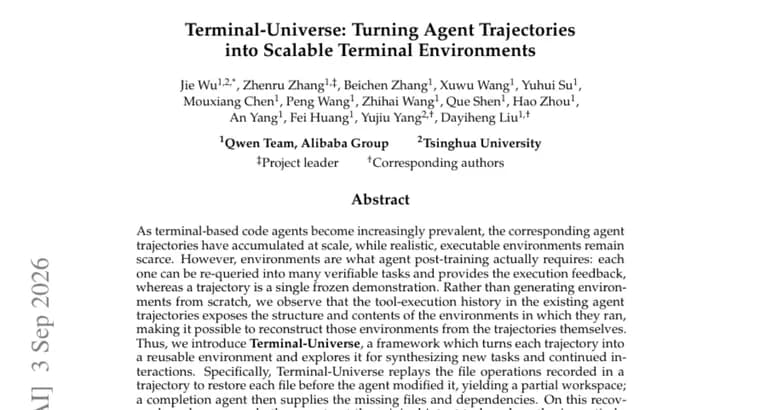
The authors of Terminal-Universe start from a practical bottleneck in training terminal-based coding agents: trajectories, the recorded logs of an agent working in a terminal, are plentiful, but realistic, executable environments to train on are scarce. The authors argue this matters because a trajectory is only a single frozen demonstration, while an environment can be re-queried into many different verifiable tasks and gives the agent execution feedback as it works. Rather than building environments from scratch, Terminal-Universe exploits the fact that a trajectory's tool-execution history already records the file operations the agent performed, which exposes the structure and contents of the environment it ran in. The framework replays those recorded file operations to restore each file to its state before the agent modified it, producing a partial workspace. A completion agent then fills in the missing files and dependencies that the trajectory alone did not capture. Once a workspace is recovered this way, the system both reconstructs the task the trajectory originally solved and synthesizes entirely new tasks from the same environment. Terminal-Universe scales the resulting task pool along two axes. On breadth, it mines directional dependency relations between related environments and synthesizes queries that span multiple codebases at once, mirroring how developers work across several repositories in real projects. On depth, it extends an initial single-turn query into a multi-round session, using a separate user agent to simulate iterative feedback and evolving requirements. Applied to public terminal agent trajectories, Terminal-Universe produced 37.3k task-sufficient environments. To test whether the resulting data actually helps, the authors ran supervised fine-tuning of Qwen3.5-27B on this corpus: single-round performance on Terminal-Bench 2.1 rose by 11.9 points, and multi-round performance on EvoCode-Bench v2's MT@4 metric rose by 13.8 points.
Key facts
- Terminal-Universe reconstructs executable environments from the file-operation history already recorded in existing agent trajectories, rather than building environments from scratch.
- It restores each file to its pre-modification state via replay, then a completion agent fills in missing files and dependencies to yield a full workspace.
- Task synthesis scales on two axes: breadth (cross-workspace queries spanning multiple codebases, via mined dependency relations) and depth (multi-round sessions with a user agent simulating iterative feedback).
- Applied to public terminal agent trajectories, the framework produced 37.3k task-sufficient environments.
- Fine-tuning Qwen3.5-27B on the resulting corpus improved single-round performance on Terminal-Bench 2.1 by 11.9 points and multi-round performance on EvoCode-Bench v2 MT@4 by 13.8 points.
Why it matters
Post-training terminal coding agents needs environments an agent can be repeatedly queried against with execution feedback, not just recorded demonstrations. Trajectories accumulate naturally as agents are used, but building fresh executable environments for them has been the scarce, manual step. Terminal-Universe's contribution is showing that the trajectories themselves already contain enough information, in their recorded file operations, to reconstruct the environments they ran in, turning an existing data byproduct into new, reusable training material without hand-built environments.
Who it affects
The direct audience is teams building or fine-tuning terminal-based and agentic coding models, since the method targets exactly the supervised fine-tuning pipeline demonstrated on Qwen3.5-27B. It also speaks to anyone maintaining agent trajectory logs at scale, since the value of that data is what the paper is trying to increase, and to benchmark designers, since the synthesized tasks are evaluated against Terminal-Bench 2.1 and EvoCode-Bench v2.
How to use it
The paper describes a framework and a reported result set, not a released product; the abstract does not state a release date or public availability of code, data, or model checkpoints. Anyone wanting to reproduce the pipeline would need to start from their own terminal agent trajectories and implement the replay, completion, and breadth/depth task-synthesis steps described in the paper.
How solid is it
The result rests on one demonstrated fine-tuning run: Qwen3.5-27B trained on the Terminal-Universe corpus gained 11.9 points on Terminal-Bench 2.1 (single-round) and 13.8 points on EvoCode-Bench v2 MT@4 (multi-round). The abstract does not give the baseline or resulting absolute scores on either benchmark, only the point gains, and it does not state how large or from what source the original pool of public trajectories was before processing.
Risks and caveats
The abstract names no individual authors or institutions, so provenance beyond the paper itself cannot be assessed here. With only point-gain figures and no baseline or absolute scores disclosed, it is not possible to judge from the abstract alone how strong the underlying models were to begin with or how much headroom the gains represent. No information is given on release plans, so it is unclear yet whether the environments or code will be made available for outside verification.