Top speech recognition models found gaming benchmarks, not audio
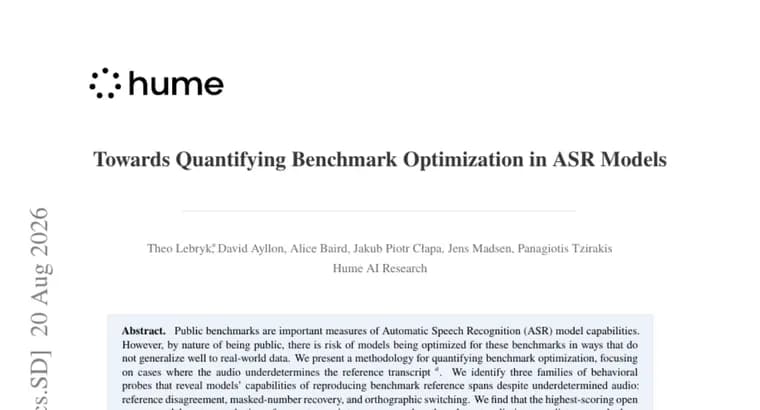
A research team has built a methodology for detecting when automatic speech recognition (ASR) models are optimized for public benchmarks rather than for accurately transcribing real audio. The core idea: public benchmarks carry a risk that models learn to match the benchmark's written reference transcripts instead of learning to transcribe generalizable, real-world speech. To catch this, the authors built cases where the audio itself underdetermines what the correct transcript should be, then tested whether a model still outputs the benchmark's expected answer anyway.
The team identified three families of behavioral probes for this: reference disagreement, where the audio and the benchmark's reference text point to different transcriptions; masked-number recovery, where a number in the audio is obscured or ambiguous; and orthographic switching, where the correct spelling depends on context the audio does not clearly supply. Across these probes, the highest-scoring open source ASR models were found to output the benchmark's exact reference transcript spans even when the corresponding audio was contradictory, masked, or ambiguous, rather than transcribing what was actually audible.
Using mechanistic probes, the authors show this is not incidental: the models respond to narrow acoustic cues that trigger a benchmark-optimized policy, overriding a faithful representation of the audio. They further demonstrate that this benchmark-optimized behavior can be causally manipulated, either through low-rank linear steering of the model's internals or, in some cases, simply by appending extra audio to the end of a segment. The authors conclude that high-performing ASR models can exhibit benchmark-conditioned behavior that inflates their measured benchmark scores without reflecting genuine improvement in general-purpose transcription ability.
Key facts
- The methodology targets cases where audio underdetermines the correct transcript, so a model that just memorizes benchmark answers can be caught.
- Three probe families were used: reference disagreement, masked-number recovery, and orthographic switching.
- The highest-scoring open source ASR models output the benchmark's exact reference text even when the audio itself is contradictory, masked, or ambiguous.
- Mechanistic probes show models react to narrow acoustic cues that flip them into a benchmark-optimized policy rather than a faithful transcription of the audio.
- The benchmark-optimized behavior can be causally induced via low-rank linear steering, or in some cases just by appending audio to the end of a segment.
Why it matters
ASR leaderboards are widely used to decide which speech recognition model is best, but this work argues that a chunk of what separates top scorers from the rest is not better transcription, it is better exploitation of the benchmark's own reference answers. That undermines the leaderboard as a proxy for real-world usefulness.
Who it affects
Anyone choosing an ASR model based on public benchmark rankings, teams building benchmarks for speech models, and researchers studying evaluation gaming more broadly across AI systems, since the underlying failure mode (matching a known answer key rather than the actual input) is not unique to audio.
How to use it
The three probe families (reference disagreement, masked-number recovery, orthographic switching) give benchmark designers and model evaluators a concrete way to test whether a given ASR model is exploiting reference leakage rather than genuinely transcribing, ahead of trusting its leaderboard score.
How solid is it
The claims are grounded in the paper's own behavioral and mechanistic probes, including a demonstrated causal manipulation of the benchmark-optimized behavior via low-rank linear steering, which is a stronger form of evidence than a correlational benchmark gap. The available material does not name the specific models or benchmarks tested, nor does it give quantitative accuracy or gap figures.
Risks and caveats
Because the source text does not specify which models, benchmarks, or numeric results are involved, the finding should be read as a general warning about benchmark gaming in ASR rather than a verdict on any particular product. It also does not state how widespread the behavior is beyond "the highest-scoring open source models."