AgentGarten pairs game engines with a neural renderer to train agents
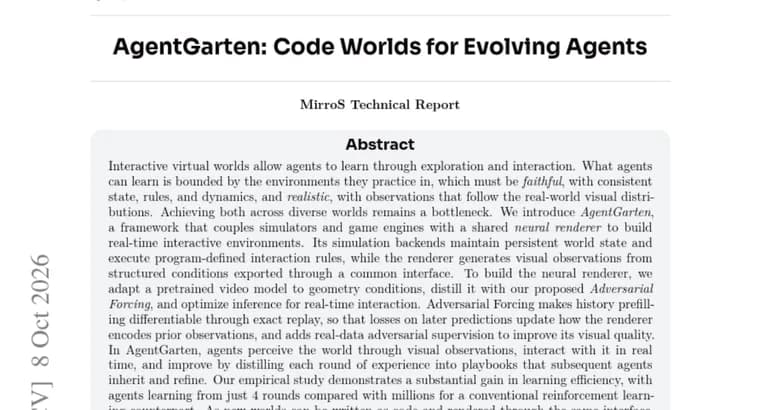
A paper on Hugging Face Papers introduces AgentGarten, a framework for building real-time interactive environments in which agents can learn. The starting point is a familiar problem: what an agent can learn is bounded by the environments it practices in. Those environments need to be faithful, with consistent state, rules and dynamics, and realistic, with observations that follow real-world visual distributions. The authors say achieving both across diverse worlds remains a bottleneck.
AgentGarten splits the job in two. Simulators and game engines act as the backends: they maintain persistent world state and execute program-defined interaction rules. A shared neural renderer then generates visual observations from structured conditions that the backends export through a common interface. The backend keeps the world consistent; the renderer makes it look real.
To build the renderer, the authors adapt a pretrained video model to geometry conditions, distill it with a method they call Adversarial Forcing, and optimize inference for real-time interaction. Adversarial Forcing makes history prefilling differentiable through exact replay, so losses on later predictions update how the renderer encodes prior observations. It also adds real-data adversarial supervision to improve visual quality.
Inside AgentGarten, agents perceive the world through visual observations and interact with it in real time. They improve by distilling each round of experience into playbooks that subsequent agents inherit and refine. The headline result is about learning efficiency: the authors say their empirical study shows a substantial gain, with agents learning from just 4 rounds compared with millions for a conventional reinforcement learning counterpart.
The authors also argue that because new worlds can be written as code and rendered through the same interface, environments can scale in both number and difficulty alongside their agents. They frame this as a step toward agents that keep evolving through interactive experience.
Key facts
- AgentGarten couples simulators and game engines with a shared neural renderer to build real-time interactive environments for agents.
- The simulation backends hold persistent world state and run program-defined rules; the renderer turns structured conditions from a common interface into visual observations.
- The renderer adapts a pretrained video model to geometry conditions and is distilled with Adversarial Forcing, which makes history prefilling differentiable through exact replay and adds real-data adversarial supervision.
- Agents improve by distilling each round of experience into playbooks that later agents inherit and refine.
- The authors report agents learning from just 4 rounds, compared with millions for a conventional reinforcement learning counterpart.
Why it matters
Agents can only learn what their training worlds let them practice, and those worlds need to be both consistent and visually realistic. The paper names that combination as a standing bottleneck. AgentGarten's answer is to keep rules and state in code-driven simulators while a neural renderer supplies realistic visuals. If the efficiency claim holds, the contrast is stark: 4 rounds of experience against millions for a conventional reinforcement learning counterpart.
Who it affects
The work is aimed at researchers building interactive environments and training agents that act from visual observations. The authors also point to environment builders: new worlds can be written as code and rendered through the same interface, so the number and difficulty of environments can grow with the agents.
How to use it
The abstract describes a workflow rather than a product. A developer writes a world as a simulator or game-engine backend that exports structured conditions through the common interface; the shared neural renderer turns those into visual observations; agents act in real time and distill each round into playbooks for the next agents. No code, model release, or license is mentioned.
How solid is it
This is a paper abstract, and the evidence is the authors' own statement that their empirical study shows a substantial gain in learning efficiency. The 4-round figure is reported against "millions" for a conventional reinforcement learning counterpart, with no exact baseline figure given. The tasks, games, or environments used in the empirical study are not named, and the baseline RL algorithm is not specified. No authors or institutions are named.
Risks and caveats
The headline comparison is hard to judge from the abstract alone. It is not stated what a round consists of, or how playbooks are formatted, so 4 rounds and millions of rounds may not measure the same thing. The pretrained video model is not named, and no frame rate, latency, or hardware figures for real-time rendering are given. The claim that environments can scale in number and difficulty is the authors' framing of where the approach leads, not a demonstrated result.
“Achieving both across diverse worlds remains a bottleneck.”
— AgentGarten paper abstract