TRACE-Bench finds attribute binding is the weak point in multi-reference image generation
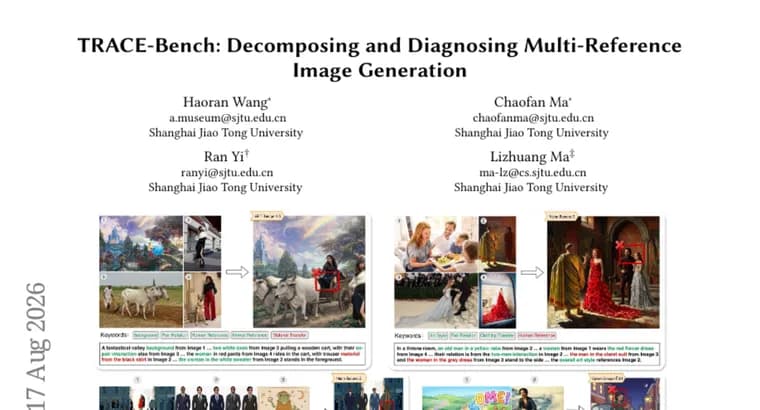
Multi-reference image generation asks a model to combine several reference images, such as a subject from one photo and a style from another, into a single output. Researchers argue that existing benchmarks for this task are organized around fixed, predefined task types, such as "subject composition," and that this approach is ill-suited to the combinatorial nature of multi-reference prompts. The result is fragmented coverage, uncontrolled complexity, and little diagnostic value: a benchmark built this way can report that a model failed without showing which underlying capability it lacked.
To address this, the researchers built TRACE-Bench around four atomic operators that they say any multi-reference task can be decomposed into: Anchor, Disentangle, Apply, and Compose. Any multi-reference prompt can then be written as a compositional formula over these four operators, and the structural complexity of a given prompt is measured by how many operator slots that formula uses. TRACE-Bench comprises approximately 1,600 evaluation cases spanning slot counts from 1 to 8, built from 631 formula templates and around 4,000 reference images covering a range of artistic styles and real-world subjects. Because every case is tied to an explicit formula, the benchmark supports an operator-aligned evaluation protocol that scores a model per capability, plus a diagnostic tree analysis that can trace a failure back recursively to the specific operator where it originated, rather than stopping at a single pass or fail score.
Applying the benchmark to 9 leading models, the researchers report that the primary bottleneck is disentanglement and attribute binding (the operators for separating and correctly applying attributes across references), not scene-level composition, which is the capability holistic benchmarks tend to emphasize. Even the best-performing model among the nine reached only 0.74 on attribute fidelity, indicating that current models still handle assembling a coherent scene better than they handle keeping the right attribute attached to the right subject.
Key facts
- TRACE-Bench replaces fixed task-type categories with four compositional operators: Anchor, Disentangle, Apply, and Compose, letting any multi-reference prompt be written as a formula over them.
- The benchmark holds approximately 1,600 evaluation cases across operator-slot counts 1 to 8, built from 631 formula templates and around 4,000 reference images spanning diverse artistic styles and real-world subjects.
- A diagnostic tree analysis traces a model's failure back to the specific operator responsible, instead of returning only a single aggregate score.
- Testing 9 leading models, the researchers found the primary bottleneck is disentanglement and attribute binding, not scene-level composition.
- The best-performing model scored only 0.74 on attribute fidelity, the score that measures how well attributes are bound to the right subject.
Why it matters
Multi-reference image generation is combinatorial by nature: a prompt can mix any number of subjects, styles and attributes drawn from different reference images, and a benchmark organized around a fixed list of task types cannot cover that space or explain a failure beyond a single score. TRACE-Bench's operator-based formulation gives each evaluation case an explicit formula, which is what makes per-capability scoring and root-cause failure tracing possible in the first place.
Who it affects
The benchmark is aimed at researchers and engineers building or evaluating unified multimodal models that generate images from multiple reference inputs. For teams developing such systems, it offers a way to see which specific capability, such as disentangling attributes or binding them correctly, is holding a model back, rather than only a pass rate on holistic tasks.
How to use it
TRACE-Bench and its associated tooling are described on the project page (https://amuseum-whr.github.io/TraceBench). Because each test case carries an explicit operator formula, it can be used to score a model on individual capabilities, Anchor, Disentangle, Apply, and Compose, separately, and the accompanying diagnostic tree analysis lets a user localize exactly which operator in a failed case caused the failure. The source text gives no pricing or licensing terms.
How solid is it
The benchmark is sizeable: about 1,600 cases built from 631 formula templates and roughly 4,000 reference images across slot counts 1 through 8, and it was applied to 9 leading models. The source text does not name which 9 models were evaluated, nor does it give author names, institutional affiliations, a release date, or a publication venue for the work.
Risks and caveats
Because the identities of the 9 evaluated models are not stated in the source, the specific ranking or comparison between named systems cannot be verified from this material, only the aggregate finding about where the bottleneck lies. The 0.74 attribute-fidelity ceiling for the best model also indicates that even leading systems still fall well short of reliable attribute binding on this benchmark's test cases.