TradingAgents open-sources multi-agent LLM trading framework
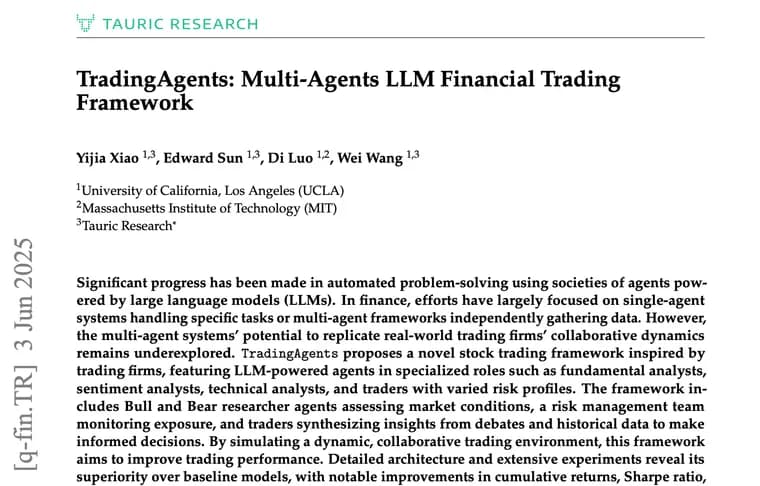
TradingAgents is an open-source multi-agent framework that simulates the structure of a trading firm using large language models. Specialized agents split the work: a Fundamentals Analyst evaluates company financials and flags red flags, a Sentiment Analyst aggregates news headlines, StockTwits and Reddit chatter into a single mood read, a News Analyst tracks global news and macro indicators, and a Technical Analyst applies indicators like MACD and RSI to spot patterns. Bullish and bearish researcher agents then critically debate those inputs, weighing potential gains against risk. A Trader agent turns the debate into a report and decides the timing and size of a proposed trade, a risk-management team assesses portfolio volatility and liquidity, and a Portfolio Manager makes the final call, approving or rejecting the proposal. If approved, the order is sent to a simulated exchange and executed there; the documentation does not describe any live or real-money trading path.
The project states plainly that it is a research tool, not financial, investment or trading advice, and that results depend on the backbone language model, its temperature setting, the trading period, data quality and other non-deterministic factors. The documentation is explicit that two runs on the same ticker and date can produce different decisions, and that this is expected behavior for an LLM-driven system rather than a bug. Two sources of variation are named: language model sampling is inherently non-deterministic, and reasoning models (the default GPT-5.x family, plus any thinking-mode model) vary the most because their internal reasoning is itself sampled; separately, live inputs such as news, StockTwits and Reddit content change over time, so even a run pinned to the same historical trade date sees different social and news data than an earlier run did. Lowering the temperature setting can reduce variation, but the currently curated models are reasoning-first and largely ignore temperature, so the documentation recommends a non-reasoning model, selectable via a custom model ID, for tighter reproducibility.
TradingAgents is built on LangGraph and supports a long list of LLM providers: OpenAI, Google Gemini, Anthropic Claude, xAI Grok, DeepSeek, Qwen through Alibaba's DashScope (both international and China endpoints), GLM through Zhipu (Z.AI internationally, BigModel in China), MiniMax (global and China endpoints), OpenRouter, Azure OpenAI for enterprise use, AWS Bedrock, local models through Ollama, and any other OpenAI-compatible server such as vLLM, LM Studio or llama.cpp. It works with any market covered by Yahoo Finance through exchange-suffixed tickers, including US stocks, Hong Kong, Tokyo and London listings, India, Canada, Australia, China A-shares, and crypto pairs. Two things persist across runs: a decision log that is always on, writing each run's outcome plus a realized-return reflection to a local markdown file and feeding recent same-ticker and cross-ticker lessons back into the Portfolio Manager's prompt, and an opt-in checkpoint system that saves LangGraph state after each node so an interrupted run can resume from its last completed step instead of restarting.
The project's changelog lists nine releases between January and August 2026. Version 0.4.0, released in August 2026, fixed look-ahead and point-in-time leaks across FRED macroeconomic data, social sentiment and the decision-log memory, added clearer decision signals, a working CLI checkpoint-resume flow, price grounding for the Trader agent, and support for the GPT-5.6 and GLM-5.3 models. Earlier releases (traced back to v0.2.0 in February 2026 and a January 2026 technical report called Trading-R1) progressively added multi-provider model support, a verified data-access contract, additional data vendors including FRED and Polymarket, structured-output agents, Docker support and a CI gate. The text does not name a specific software license, state any backtested trading performance or benchmark results, or give any adoption figures such as GitHub stars or download counts; it says only that the project was "fully open-sourced."
Key facts
- TradingAgents mirrors a trading firm's structure: fundamentals, sentiment, news and technical analyst agents feed bullish and bearish researcher agents, which debate before a Trader and risk-management team hand a proposal to a Portfolio Manager for final approval and simulated execution.
- Version 0.4.0, released in August 2026, fixed look-ahead and point-in-time data leaks in FRED macro data, social sentiment and the decision-log memory, and added support for the GPT-5.6 and GLM-5.3 models.
- The framework supports a wide range of LLM providers, including OpenAI, Google, Anthropic, xAI, DeepSeek, Qwen, GLM, MiniMax, OpenRouter, Azure, AWS Bedrock and local Ollama models, and trades any market Yahoo Finance covers via exchange-suffixed tickers.
- Built on LangGraph, it keeps a persistent decision log across runs and offers an opt-in checkpoint system so an interrupted run can resume from its last completed step rather than starting over.
- The documentation states it is a research tool, not financial advice, and that identical runs on the same ticker and date can produce different decisions because of non-deterministic LLM sampling and constantly changing news and social-media inputs.
Why it matters
Multi-agent LLM demos are common; a fully working pipeline that separates analysis, structured debate and a final approval gate, and ships it open source end to end, is a more complete reference architecture for orchestrating several specialized agents toward one governed decision. The pattern (specialist agents feeding a debate stage that feeds a decision-maker with a persistent memory of past outcomes) generalizes past trading to other domains where an LLM system needs to combine multiple viewpoints before acting.
Who it affects
Developers and researchers building multi-agent LLM systems get a concrete, documented example of role separation, structured debate and checkpointed state. Anyone experimenting with LLM-driven trading simulation, rather than live trading, can use it directly since it supports a wide range of markets and providers out of the box.
How to use it
Install via pip after cloning the repository, or run it through Docker, including a profile for local Ollama models. Set an API key environment variable for whichever LLM provider is chosen from the supported list. Launch the interactive CLI with the tradingagents command to pick tickers, an analysis date, provider and research depth, or call the TradingAgentsGraph class directly in code, for example ta.propagate("NVDA", "2026-01-15") to get a decision. The text describes the project only as "fully open-sourced" and does not name a specific license or mention any pricing or paid tier.
How solid is it
The changelog documents nine releases from January to August 2026, with recent versions specifically targeting correctness bugs such as look-ahead data leakage, crash-safety in the agent graph, and checkpoint-resume reliability, which points to active maintenance. The material provided gives no backtest results, trading-performance figures, or adoption numbers such as GitHub stars or downloads, so the framework's real-world trading performance and actual usage scale cannot be assessed from this source.
Risks and caveats
The project's own documentation states it is intended for research, not as financial, investment or trading advice, and that performance depends on the backbone model, its temperature and the quality of the data available at run time. It explicitly warns that two runs on the same ticker and date can yield different decisions, since reasoning models sample their own internal reasoning and since live news and social-media inputs change over time even when the historical trade date is fixed. Orders execute only on a simulated exchange according to the text; no live or real-money trading capability is described.
“TradingAgents is LLM-driven, so two runs of the same ticker and date can differ. This is expected for a research tool built on language models, not a defect.”
— TradingAgents project documentation