TGOPD verifies teacher reliability before dense distillation
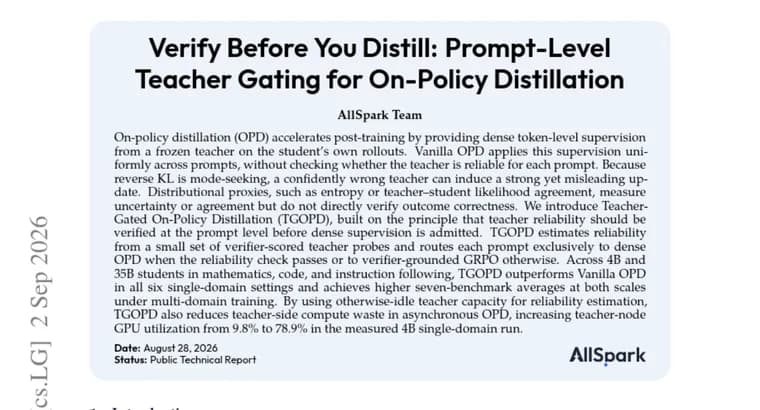
Researchers introduce Teacher-Gated On-Policy Distillation (TGOPD), a training method that checks a frozen teacher model's reliability on each prompt before letting it hand down dense, token-level supervision to a student model. Standard on-policy distillation (OPD) uses a frozen teacher to guide a student's own rollouts with dense supervision, but applies that supervision the same way on every prompt, without checking whether the teacher's judgment can be trusted on that particular prompt. The authors argue this is risky because the loss function commonly used for OPD, reverse KL divergence, is mode-seeking: a teacher that is confidently wrong can push a strong but misleading update onto the student. Existing signals such as entropy or teacher-student agreement measure uncertainty or agreement, the authors write, but do not directly verify whether the teacher's answer is actually correct.
TGOPD instead estimates each teacher's reliability from a small set of verifier-scored probes before deciding how to handle a prompt: if the teacher passes the reliability check, the prompt goes to dense OPD as usual; if it fails, the prompt is routed instead to verifier-grounded GRPO, a reinforcement-learning method that scores outcomes with a verifier rather than trusting the teacher's output distribution. The team tested TGOPD on student models of 4B and 35B parameters across three domains: mathematics, code and instruction following. TGOPD beat vanilla OPD in all six single-domain settings tested, and produced higher averages across seven benchmarks at both model scales when trained across multiple domains at once. Because the reliability probes reuse teacher compute that would otherwise sit idle during asynchronous OPD, the method also cuts waste on the teacher side: in the measured 4B single-domain run, teacher-node GPU utilization rose from 9.8% to 78.9%.
Key facts
- TGOPD checks teacher reliability at the prompt level with verifier-scored probes before allowing dense supervision, rather than trusting the teacher uniformly on every prompt.
- Prompts that fail the reliability check are routed to verifier-grounded GRPO instead of dense on-policy distillation.
- Tested on 4B and 35B student models across math, code and instruction following, TGOPD beat vanilla OPD in all six single-domain settings.
- TGOPD produced higher seven-benchmark averages than vanilla OPD at both scales under multi-domain training.
- The reliability probes reuse otherwise-idle teacher compute, raising teacher-node GPU utilization from 9.8% to 78.9% in the measured 4B single-domain run.
Why it matters
On-policy distillation is a cheap way to post-train a student model by having a frozen teacher score the student's own outputs token by token. But the paper argues the standard version trusts the teacher blindly on every prompt, and because the loss typically used (reverse KL) is mode-seeking, a wrong-but-confident teacher can push the student hard in the wrong direction. TGOPD adds a check before that trust is extended, aiming to keep the speed benefit of dense supervision while cutting the risk of learning from bad teacher judgments.
Who it affects
Teams that use large frozen models to post-train smaller ones through on-policy distillation, particularly setups where teacher and student run on separate compute pools (asynchronous OPD) and teacher GPUs would otherwise sit idle between scoring rounds.
How to use it
TGOPD is a training-time gating step rather than a shipped tool: it runs a small number of verifier-scored probes per prompt to test the teacher's reliability, then splits training so verified prompts go to dense OPD and the rest go to verifier-grounded GRPO. The source gives no public code release, license or price.
How solid is it
The authors test TGOPD against vanilla OPD on student models of two sizes, 4B and 35B parameters, across three task domains: mathematics, code and instruction following. TGOPD wins in all six single-domain combinations tested and posts higher seven-benchmark averages than vanilla OPD at both scales when trained on multiple domains together. The abstract does not name the seven benchmarks or give the size of the improvement beyond the GPU-utilization figures.
Risks and caveats
The source gives no author names, institutional affiliations, or publication date, and does not detail the verifier used for GRPO or for scoring the reliability probes. No score magnitudes are given for the "outperforms" claims beyond the GPU-utilization numbers, so the size of the accuracy gain over vanilla OPD is not stated here.
“Because reverse KL is mode-seeking, a confidently wrong teacher can induce a strong yet misleading update.”
— the authors, in the paper's abstract