TWIG paper represents every neural network weight as a shared path of discrete choices
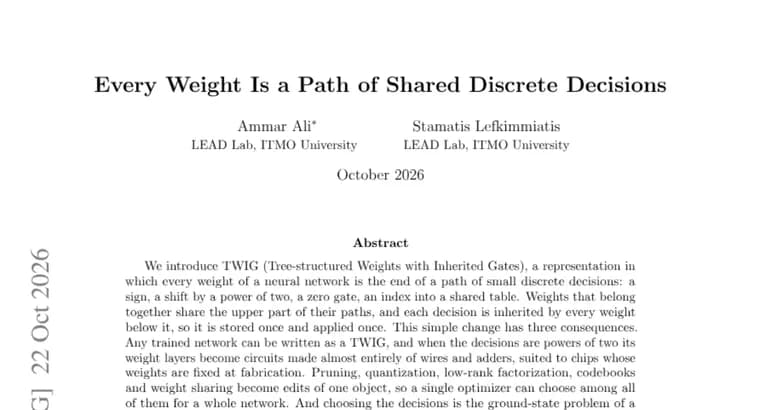
A new preprint introduces TWIG, short for Tree-structured Weights with Inherited Gates. In it, every weight of a neural network is the end of a path of small discrete decisions: a sign, a shift by a power of two, a zero gate, and an index into a shared table. Weights that belong together share the upper part of their paths. Each decision is inherited by every weight below it, so it is stored once and applied once.
The authors say this one change has three consequences. First, any trained network can be written as a TWIG. When the decisions are powers of two, the weight layers become circuits made almost entirely of wires and adders, which suits chips whose weights are fixed at fabrication. Second, pruning, quantization, low-rank factorization, codebooks and weight sharing become edits of one object, so a single optimizer can choose among all of them for a whole network. Third, choosing the decisions is the ground-state problem of a higher-order Boltzmann machine whose interactions follow the paths of the tree. That is the problem class that annealers and quantum optimizers are built to solve.
The authors frame this against current practice. Today these questions are handled apart: each compression method brings its own format and solver, a circuit with fixed weights needs a dedicated constant multiplier for every weight, and discrete solvers reach only narrow subproblems such as rounding. They also argue that weight formats have long been moving toward shared decisions, through group scales, shared exponents, microexponents and sparse weights. In their words, TWIG takes this trend to its end, and every common format is a shallow TWIG at no extra cost.
The one empirical result is a comparison with GPTQ on five weight matrices of a large language model. The TWIG variant tested is a flat tree whose signed power-of-two terms are chosen per weight for circuit cost, with no group scales. At equal layer error, at 3- and 4-bit accuracy, it needs 9-15% fewer additions than GPTQ on typical matrices, and 20-55% fewer on matrices with strong outliers.
Key facts
- TWIG (Tree-structured Weights with Inherited Gates) writes each weight as the end of a path of discrete decisions: sign, power-of-two shift, zero gate, and an index into a shared table.
- Related weights share the upper part of their paths, so each shared decision is stored once and applied once.
- With power-of-two decisions, weight layers become circuits of almost only wires and adders, aimed at chips whose weights are fixed at fabrication.
- Pruning, quantization, low-rank factorization, codebooks and weight sharing become edits of one object, which a single optimizer could choose among.
- On five weight matrices of a large language model, a flat-tree TWIG needs 9-15% fewer additions than GPTQ at equal layer error on typical matrices, and 20-55% fewer on matrices with strong outliers.
Why it matters
Compression today is a patchwork: each method has its own format and solver, and a fixed-weight circuit needs a dedicated constant multiplier for every weight. TWIG proposes one representation that covers pruning, quantization, low-rank factorization, codebooks and weight sharing, so one optimizer could pick among them across a whole network. The authors also say common formats such as group scales, shared exponents and microexponents are shallow special cases of it.
Who it affects
The framing points to people designing chips with weights fixed at fabrication, researchers working on model compression, and those building annealers or quantum optimizers, since the authors cast weight selection as a higher-order Boltzmann machine ground-state problem. Ordinary users of language models are not affected directly.
How to use it
Nothing in the text points to released code or a ready tool. For now it is a representation to read about. The idea the authors offer is that any trained network can be written as a TWIG, and that choosing power-of-two decisions turns weight layers into wires and adders.
How solid is it
This is a preprint with a single quantitative result: five weight matrices of one large language model, compared with GPTQ on the number of additions at equal layer error. The text does not name the model or the authors or institutions, and it reports no end-to-end quality or speed results. It also reports no fabricated chip and no annealer or quantum-hardware run; those points are framed as properties of the representation.
Risks and caveats
The 9-15% and 20-55% figures count additions at equal layer error, not latency, energy or chip area. The tested variant is a flat tree with per-weight power-of-two terms and no group scales, so the result may not carry over to deeper trees or other setups. The circuit and optimizer benefits are claimed by the authors but not demonstrated in hardware in the text.