UNIFIED folds encoder, generator and decoder into one diffusion transformer
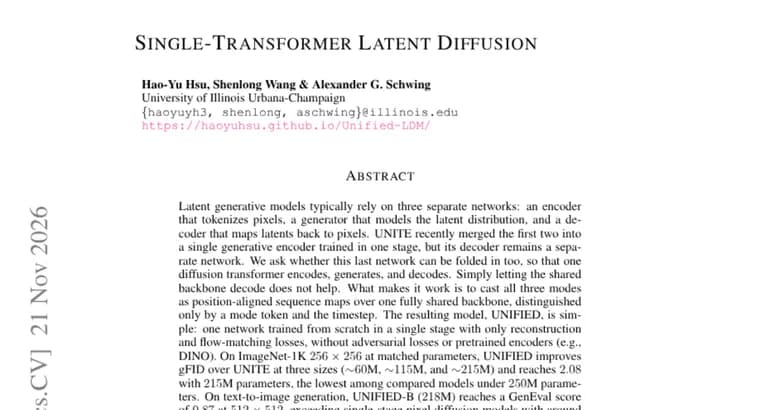
Latent generative models usually rely on three separate networks: an encoder that turns pixels into tokens, a generator that models the distribution of those latents, and a decoder that maps latents back to pixels. A prior model, UNITE, recently merged the first two into a single generative encoder trained in one stage, but its decoder is still a separate network.
The paper asks whether that last network can be folded in too, so that one diffusion transformer encodes, generates and decodes. The authors say that simply letting the shared backbone decode does not help. What makes it work, they write, is to cast all three modes as position-aligned sequence maps over one fully shared backbone, distinguished only by a mode token and the timestep.
The resulting model, UNIFIED, is described as simple: one network trained from scratch in a single stage, with only reconstruction and flow-matching losses. It uses no adversarial losses and no pretrained encoders such as DINO.
On ImageNet-1K at 256x256 and at matched parameters, UNIFIED improves gFID over UNITE at three sizes (about 60M, 115M and 215M parameters). At 215M parameters it reaches a gFID of 2.08, which the authors call the lowest among compared models under 250M parameters. On text-to-image generation, UNIFIED-B (218M parameters) reaches a GenEval score of 0.87 at 512x512, which the authors say exceeds single-stage pixel diffusion models with around one billion parameters. They conclude that full unification of latent diffusion is not merely feasible but beneficial.
Key facts
- UNIFIED uses one diffusion transformer for encoding, generation and decoding, where UNITE had merged only the encoder and generator and kept a separate decoder.
- The three modes share one backbone and are told apart only by a mode token and the timestep; the authors say simply letting the backbone decode does not help.
- Training is a single stage from scratch with only reconstruction and flow-matching losses, with no adversarial losses and no pretrained encoders such as DINO.
- On ImageNet-1K 256x256, UNIFIED improves gFID over UNITE at about 60M, 115M and 215M parameters, and reaches 2.08 at 215M, the lowest among compared models under 250M parameters.
- UNIFIED-B (218M) scores 0.87 on GenEval at 512x512 text-to-image, which the authors say exceeds single-stage pixel diffusion models with around one billion parameters.
Why it matters
Most latent generative pipelines carry three networks with separate training needs. UNITE cut that to two by merging the encoder and generator; UNIFIED goes to one, so the whole system is a single transformer trained in one stage. The recipe is also lean: only reconstruction and flow-matching losses, with no adversarial losses or pretrained encoders such as DINO. The authors present the result as evidence that full unification is beneficial, not only possible.
Who it affects
Mainly researchers working on latent diffusion, image tokenizers and image generators, who currently manage an encoder, a generator and a decoder as separate pieces. It is a research result on ImageNet-1K class-conditional generation and a text-to-image test, not a product release.
How to use it
There is nothing to deploy from the source text. No training cost, compute, inference speed or code and weights release is mentioned. For practitioners, the transferable idea is the design: treat encoding, generation and decoding as position-aligned sequence maps over one shared backbone, switched by a mode token and the timestep.
How solid is it
The claims are the authors' own, reported in the paper's abstract. Gains over UNITE are stated at matched parameters at three sizes, and the 2.08 gFID at 215M parameters is described as the lowest among compared models under 250M parameters. The source does not say it is the best overall. The gFID values for UNITE and other compared models are not given, nor are the gFID values at the 60M and 115M sizes, so the size of the improvement over UNITE cannot be judged from the source. No GenEval scores are given for the compared pixel diffusion models either.
Risks and caveats
The comparison against pixel diffusion models for GenEval is set against models with around one billion parameters, and the source gives no figures for them. The 2.08 result holds only within the under-250M group. No authors or institutions are named, and no submission or publication date is given. The source is the paper's abstract as published on huggingface.co, so its claims have not been checked here beyond the abstract.
“Full unification of latent diffusion is thus not merely feasible but beneficial.”
— UNIFIED paper abstract