Unreal Labs ships Unreal Agent, an async harness up to 40% cheaper than Codex
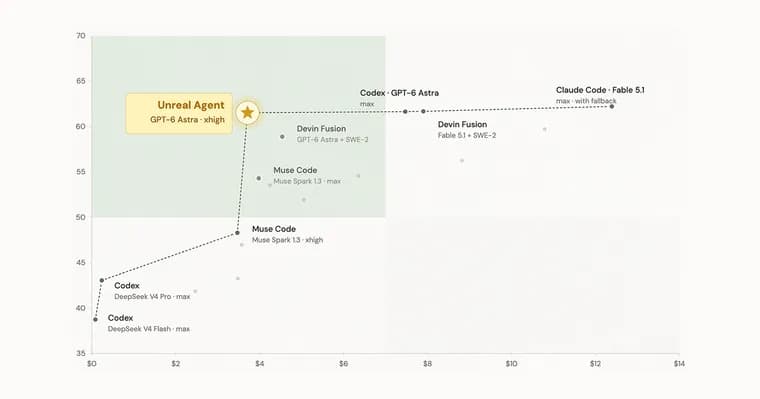
Unreal Labs has released Unreal Agent, an agent harness aimed at cutting the cost of running coding and agentic workloads by changing how tool calls are managed. The company says the current version delivers up to 40% cost savings compared to a system called Codex and up to 20% compared to a system called Pi, in real production workloads and on agentic benchmarks, without a negative impact on performance; the source does not say who builds either comparison system. Unreal Labs is also using the post to invite partners interested in frontier cost efficiency for their own AI agents to get in touch.
The core idea is asynchronous tool handling. In most harnesses, the model has to wait, poll or send heartbeats while a tool call runs. Unreal Agent instead appends an event-log record marking a tool call as "in progress" the instant it is issued, keeps executing the tool in the background, and only appends the actual result and calls the model again once the tool has finished. Unreal Labs says this brings two benefits: users can steer the agent at any time without waiting for tool calls to finish, and the harness can schedule more tool work between model calls, which is where the cost efficiency comes from. Doing this without breaking the model's prompt cache was, in the company's telling, a real engineering challenge. It also reports that during testing, carrying two tool-call result items, one in-progress and one final, in a single context caused rejections with some inference providers other than OpenAI; it argues this in-progress-to-final pattern is underspecified in the Responses API documentation and should be explicitly and consistently supported across providers.
Unreal Labs frames the harness as a lesson from building several agentic products of its own. It says CLI-oriented SDKs, naming Claude's Agent SDK as an example, carry assumptions about local sessions, subprocesses and resource limits that do not translate cleanly into production, forcing teams to build their own lifecycle management for completion, cancellation and background tasks. Supporting multiple model providers adds further work, since switching API modes can break tools or prompt caching, and SDK upgrades can change message formats and force integration rewrites; heavy dependency trees add maintenance and supply-chain risk on top. On security, the company says approvals and checks that rely on harness hooks and specialized tools tend to need more maintenance and be less robust than deterministic constraints enforced outside the harness, such as allowed and disallowed hosts, granular access tokens, and proxies with approval gates.
Unreal Labs attributes the cost savings to two factors: a minimal harness footprint, with simple prompts, token-optimized tool results, and no sub-agents or workflows; and the ability to pack more tool work into each model turn, since the asynchronous design does not spend tokens on polling or waiting. It tested Unreal Agent with a model it calls GPT-6 Astra xhigh, comparing it against Codex and Pi on Terminal-Bench 4.0 (with Codex's leaderboard score as the baseline), SWE-Atlas Codebase QnA, DeepSWE 1.1, and a benchmark it calls Agents' Last Exam (ALE-CLI). The company says pass-rate differences between the systems are marginal and attributes them to benchmark variance rather than a real capability gap; full pass rates and mean scores are shown as charts rather than stated as numbers in the post's text. It says it ran mostly coding benchmarks because they are available on the Harbor evaluation platform, which it says eases reproduction and verification, even though it describes the harness itself as domain-agnostic.
The Unreal Agent SDK currently offers a Go library for direct integration, a runner executable comparable to claude -p or codex exec, and a benchmark runner compatible with Harbor, with the code available on the company's GitHub repository. The post cites two outside sources for its engineering claims: a 2026 paper, "HarnessTax: How Much Does Harness Matter for Coding Agents?" by Melissa Z. Pan, Shuo Yang, Negar Arabzadeh, Wei-Lin Chiang, Ion Stoica and Matei Zaharia, and a blog post, "(KV) Cache Rules Everything Around Me," by a writer identified only as Diogo on the blog Complete Skeptic. The post does not give a release date, pricing or availability terms for Unreal Agent, or company background for Unreal Labs, and it is signed collectively as "we" with no named individual author.
Key facts
- Unreal Agent handles tool calls asynchronously: it logs an "in-progress" placeholder the instant a tool call is issued, keeps it running in the background, and only appends the result and calls the model once the tool finishes, so users can steer the agent without waiting.
- Unreal Labs claims up to 40% cost savings versus Codex and up to 20% versus Pi in real workloads and agentic benchmarks, with no negative performance impact; the source does not identify the vendors behind either comparison system.
- The company tested Unreal Agent with GPT-6 Astra xhigh on Terminal-Bench 4.0, SWE-Atlas Codebase QnA, DeepSWE 1.1 and Agents' Last Exam (ALE-CLI), attributing marginal pass-rate differences to benchmark variance; full pass rates and mean scores appear only as charts, not as numbers in the text.
- Unreal Labs criticizes CLI-oriented SDKs, naming Claude's Agent SDK, for assumptions about local sessions, subprocesses and resource limits that require custom lifecycle management in production, and says it prefers deterministic sandbox and access-token constraints outside the harness over harness-hook-based security.
- The Unreal Agent SDK ships a Go library, a runner executable similar to claude -p or codex exec, and a Harbor-compatible benchmark runner, with code published on GitHub; no release date, pricing or availability terms are given.
Why it matters
Unreal Labs is treating harness design, the layer that manages tool calls around a model rather than the model itself, as a direct lever on agent cost. Its central claim is that most of the token and turn overhead in production agents comes from the model having to wait, poll and send heartbeats while tools run, and that removing that overhead through fully asynchronous tool management can cut costs by double digits without hurting task performance. The company states outright that it sees harness design as its own research area with unexplored ideas, positioning this release as evidence for that view rather than as a one-off product announcement.
Who it affects
The post is aimed at teams building production agent products, particularly those already using CLI-oriented agent SDKs such as Claude's Agent SDK or Codex-style tooling and running into the lifecycle, compatibility and security trade-offs Unreal Labs describes. It also doubles as a pitch: Unreal Labs explicitly invites teams interested in frontier cost efficiency for their AI agents to contact it, so the audience includes potential commercial partners as well as engineers evaluating harness architectures for their own systems.
How to use it
The Unreal Agent SDK is available now with three pieces: a Go library for direct integration into an existing codebase, a runner executable comparable to claude -p or codex exec, and a benchmark runner compatible with the Harbor evaluation platform. Unreal Labs points to its GitHub repository for anyone who wants to try it. The post gives no pricing, licensing terms, release date or company background, so cost and commercial availability beyond the open code are not addressed.
How solid is it
The benchmark results come entirely from Unreal Labs itself, run on a model it calls GPT-6 Astra xhigh against Codex and Pi across coding-focused suites (Terminal-Bench 4.0, SWE-Atlas Codebase QnA, DeepSWE 1.1, and its own Agents' Last Exam), with Codex's Terminal-Bench score taken from the public leaderboard. The post presents pass rates and mean scores as charts rather than stating the figures in text, and it attributes the pass-rate gaps it does see to benchmark variance rather than a real capability difference, which is itself a judgment call by the party whose product is being evaluated. The engineering claims about prompt caching and the Responses API are backed by the company's own testing account plus two external citations, a HarnessTax paper on harness impact and a blog post on cache behavior, rather than by independently reproduced numbers.
Risks and caveats
The comparison systems, Codex and Pi, are named without saying who builds either one, and the post does not disclose whether the cost-savings and benchmark figures were independently verified or audited. There is no pricing or availability information for Unreal Agent as a product, no release date, and no named individual author or company background for Unreal Labs; the post is written entirely in the collective "we." The claim that harness-hook-based security is less robust than external sandbox constraints, and the criticism of CLI-oriented SDKs like Claude's Agent SDK, are stated as the company's own experience rather than as findings from a controlled comparison.
“We believe harness design is a research area in its own right, with many promising ideas still to be researched and implemented.”
— Unreal Labs, Unreal Agent blog post