US confirms it has deployed a space weapon in orbit
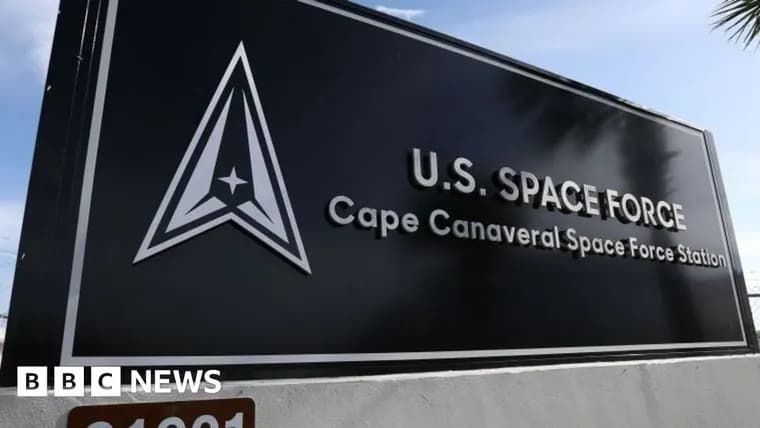
The United States has confirmed, for the first time, that it has deployed a weapon in Earth's orbit. US Secretary of the Air Force Troy Meink made the acknowledgment on Monday at the Air, Space and Cyber Conference, describing an "on orbit" weapon as necessary to safeguard US forces against hostile action and saying the US was ready for "evolving threats." He did not elaborate on the weapon's capabilities or say when it entered orbit. A US Space Force spokesperson added that space control covers using kinetic and non-kinetic means to disrupt, degrade or, if necessary, destroy adversary capabilities, and that these can be used offensively or defensively at the direction of combatant commands. China responded the next day, with a foreign ministry spokesman quoted by AFP urging the US to stop expanding its military capabilities and preparing for war in outer space, and warning against an arms race in space. Outside experts have little to go on. Dr Bleddyn Bowen of the Royal United Services Institute told the BBC that "precious little" is publicly known and that there could be a whole range of different weapons systems involved. Bowen said he was "totally guessing," but floated two possibilities: an electronic-warfare or radio-jamming platform of a kind that already exists on Earth and could disrupt radio communications, or a kinetic kill vehicle that would ram a projectile into a satellite to destroy it. He considered the second option less likely because a physically destructive weapon would generate significant orbital debris. The disclosure comes as senior US military leaders have said they plan to expand capabilities in space, pointing to Russian and Chinese programs aimed at attacking and disrupting US satellites in a future conflict. The Trump administration has said space-based capabilities and interceptor missiles are central to its planned "Golden Dome" missile-defense system, and last year Trump signed an executive order emphasizing the Space Force's role as an attacking force as well as a defensive one. The Space Force, the first new US military branch created in more than 70 years, was launched in 2019 to protect American satellite assets used for communication and surveillance. A 1967 treaty bans weapons of mass destruction in orbit, but the US, Russia and China have all continued developing other counterspace capabilities that fall outside it, including tools to target rivals' satellites. In early February it emerged that two Russian satellites had likely intercepted the communications of at least a dozen European satellites since Russia's 2022 invasion of Ukraine, potentially letting Russian intelligence read the data or even take control of the satellites. In 2024 the US said Russia had launched a satellite it believed might be capable of attacking other satellites; Russia did not comment publicly. The Space Force says China is developing and operating space and counterspace capabilities as part of a military modernization strategy, while Russia views space as a warfighting domain and believes space supremacy will decide future conflicts.
Key facts
- US Secretary of the Air Force Troy Meink said on Monday at the Air, Space and Cyber Conference that the US has an "on orbit" weapon, the first time the US has acknowledged such a capability, without detailing what it is or when it was deployed.
- China's foreign ministry urged the US to stop "expanding its military capabilities and preparing for war in outer space" and warned against an arms race in space.
- RUSI's Dr Bleddyn Bowen said "precious little" is publicly known and guessed, while stressing he was "totally guessing," that the weapon could be an electronic-warfare or jamming platform, or a kinetic kill vehicle he called less likely because of the debris it would create.
- The confirmation follows a February report that two Russian satellites had likely intercepted the communications of at least a dozen European satellites since Russia's 2022 invasion of Ukraine, and a 2024 US claim that Russia launched a satellite it believed might be capable of attacking others.
- The US Space Force, launched in 2019 as the first new US military branch in more than 70 years, operates under a 1967 treaty that bans orbital weapons of mass destruction but not other counterspace tools; the Trump administration's "Golden Dome" missile-defense plan includes space-based capabilities.
Why it matters
This is the first time the US has publicly acknowledged having an offensive or defensive weapon already in orbit, rather than merely planning for one. The acknowledgment, made on the record by the Secretary of the Air Force at a major conference rather than leaked, marks a shift from ambiguity to open acknowledgment of orbital weapons, in a domain long governed by deliberate silence about specific capabilities. It lands alongside the Trump administration's "Golden Dome" missile-defense plan, which explicitly folds in space-based capabilities and interceptor missiles, and an executive order last year that recast the Space Force's mission to include attacking, not just defending.
Who it affects
The disclosure is aimed squarely at Russia and China, the two powers the US Space Force names as developing counterspace capabilities meant to attack and disrupt US satellites in a future conflict. It also concerns satellite operators more broadly: the same article notes that two Russian satellites had likely been intercepting the communications of at least a dozen European satellites since 2022, and that the US separately accused Russia in 2024 of launching a satellite it believed could attack others. Ordinary users of satellite-dependent services, such as communications, surveillance and navigation, sit downstream of whatever this new arms dynamic does to the 1967 treaty framework that has governed orbital weapons for decades.
How to use it
There is no product here to use, only a fact to track. What is confirmed: the US has a weapon in orbit, a Space Force spokesperson has described space-control capabilities in general, not this weapon specifically, as usable for offensive or defensive purposes at the direction of combatant commands, and the weapon was put there before Monday's remarks with no disclosed date. What is not confirmed: its type, how it works or its current operational status. Readers should treat any specific description of the weapon, including the electronic-warfare or kinetic-kill-vehicle guesses below, as expert speculation, not confirmed capability.
How solid is it
The core fact, that the US has confirmed an orbital weapon for the first time, rests on an on-record statement by the Secretary of the Air Force at a named conference, corroborated by a separate on-record statement from a US Space Force spokesperson describing the space-control mission more broadly. China's reaction is sourced to AFP, quoting a foreign ministry spokesman. The technical speculation about what the weapon might be comes from a named RUSI expert who explicitly flagged his own guesses as guesses. The background claim about Russian satellite interceptions is attributed to earlier, unnamed reporting rather than to fresh reporting in this piece, while the 2024 claim about a Russian satellite launch is attributed to the US government itself.
Risks and caveats
Officials disclosed that a weapon exists without disclosing what it is, how it works, or when it went up, so any description of its function beyond "on orbit" is unverified; a Space Force spokesperson's description of capabilities as usable for offense or defense referred to space control generally, not to this weapon specifically. China's public response signals a risk of an accelerating action-reaction cycle in space, and Bowen's caveat that a kinetic weapon would create significant debris points to a physical risk beyond the geopolitical one. The 1967 treaty bans weapons of mass destruction in orbit but does not cover the counterspace tools all three powers are reported to be developing, leaving the legal boundary around this disclosure unsettled.
“We urge the US side to stop expanding its military capabilities and preparing for war in outer space”
— a Chinese foreign ministry spokesman, quoted by AFP