V-Rubrics uses rubric-based RL to ground vision-language models
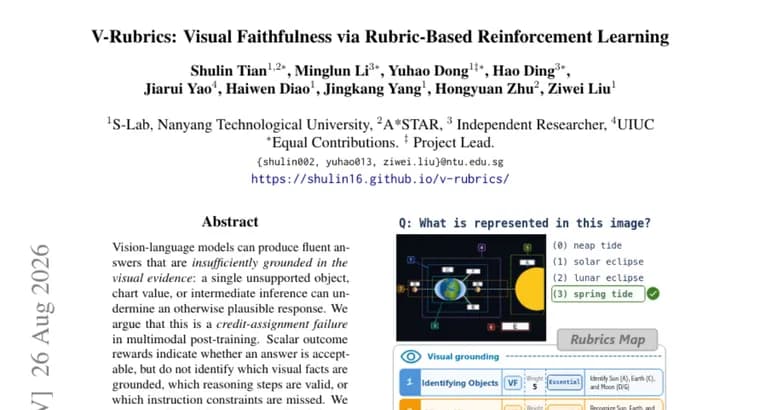
Vision-language models can produce answers that sound fluent and plausible but rest on details the image does not actually support: a misidentified object, a misread chart value, or a reasoning step that does not follow from what is visible. A paper posted to Hugging Face argues this is a credit-assignment failure in multimodal post-training: the reinforcement-learning rewards typically used to fine-tune these models are scalar, telling the model only whether an answer as a whole is acceptable, not which visual facts in it are actually grounded, which reasoning steps are valid, or which instruction constraints were missed.
The authors, including Shulin Tian, propose Visual Rubrics-Based Reinforcement Learning (V-Rubrics) to close that gap. The method decomposes each reference answer into atomic propositions and scores a model's generated answer along three axes: Visual Faithfulness (VF), Reasoning Consistency (RC), and Instruction Following (IF). Because each rubric item can be checked against a specific supporting span of evidence, the reward gives structured partial credit and can localize it to the exact part of the answer that is right or wrong, rather than judging the response as a single pass or fail.
To test the approach, the team first built a supervised fine-tuning (SFT) checkpoint by adapting the OpenMMReasoner cold-start data recipe: they fine-tuned Qwen3-VL-8B-Instruct on the public OpenMMReasoner-SFT-874K corpus. They then built V-Rubrics 50K, a 50,248-example training set drawn from 17 visually grounded sources, applying rule-based filters, deriving each example's difficulty from rejection-sampling scores, and annotating every example with Gemini-3-Pro under one fixed structured prompt and protocol. Starting from the same SFT checkpoint, they trained a model using this rubric-derived, prefix-localized credit with GRPO.
The paper reports that this rubric-based GRPO training improves over both the shared SFT baseline and a standard answer-only GRPO baseline, with the largest gains on knowledge-oriented and visually grounded reasoning benchmarks. The abstract does not give specific benchmark scores or percentage-point improvements, and it does not mention a release date, code, or model weights. The authors frame the result as evidence that rubrics, rather than a single scalar reward, are a useful abstraction for reward design in visual post-training.
Key facts
- Introduces Visual Rubrics-Based Reinforcement Learning (V-Rubrics), which decomposes reference answers into atomic propositions scored on Visual Faithfulness, Reasoning Consistency, and Instruction Following.
- Builds V-Rubrics 50K, a 50,248-example training set drawn from 17 visually grounded sources, with example difficulty set from rejection-sampling scores and annotations from Gemini-3-Pro under one fixed protocol.
- Starts from an SFT checkpoint made by fine-tuning Qwen3-VL-8B-Instruct on the OpenMMReasoner-SFT-874K corpus, adapting its cold-start data recipe.
- Trains the model with component-wise, prefix-localized rubric credit using GRPO.
- Rubric-based GRPO beats both the shared SFT baseline and answer-only GRPO, with the largest gains on knowledge-oriented and visually grounded reasoning benchmarks; no specific benchmark scores are given.
Why it matters
Vision-language models can sound confident while quietly resting on an unsupported detail: a wrong object, a misread chart value, or a faulty inference step. The authors argue this is a credit-assignment problem in post-training: the reward signal used to fine-tune these models typically only judges whether the whole answer is acceptable, without telling the model which specific visual claim inside it was wrong. V-Rubrics addresses that by breaking a correct answer into atomic, checkable propositions so the training signal can reward or penalize individual claims instead of the answer as a whole.
Who it affects
Researchers and engineers building or post-training vision-language models, particularly anyone using reinforcement learning to reduce hallucination and improve grounded visual reasoning in models that read images, charts, and diagrams.
How to use it
The recipe: start from an SFT checkpoint made by fine-tuning Qwen3-VL-8B-Instruct on the OpenMMReasoner-SFT-874K corpus, adapting its cold-start data recipe. Build training data from V-Rubrics 50K, 50,248 examples pulled from 17 visually grounded sources, filtered with rule-based filters, difficulty-ranked via rejection-sampling scores, and annotated by Gemini-3-Pro under a single fixed structured prompt and protocol. Then train with GRPO using component-wise, prefix-localized rubric credit. The abstract gives no code or model-weight release, so this is currently a described method rather than a downloadable one.
How solid is it
The evidence is a single paper's own experiments, comparing rubric-based GRPO against a shared SFT baseline and an answer-only GRPO baseline built from the same starting checkpoint. The authors report an improvement over both baselines, largest on knowledge-oriented and visually grounded reasoning benchmarks, but the abstract does not state the actual benchmark scores or the size of the improvement, so the magnitude of the gain cannot be checked from this text alone.
Risks and caveats
The rubric annotations that drive training come from Gemini-3-Pro, an external model, so the quality of the reward signal partly depends on that model's own judgment; the abstract describes the annotation process only as using the same structured prompt and protocol, without further validation detail. No release date, code, or model weights are mentioned.