VBVR-Pro debuts 300-task benchmark for visual reasoning
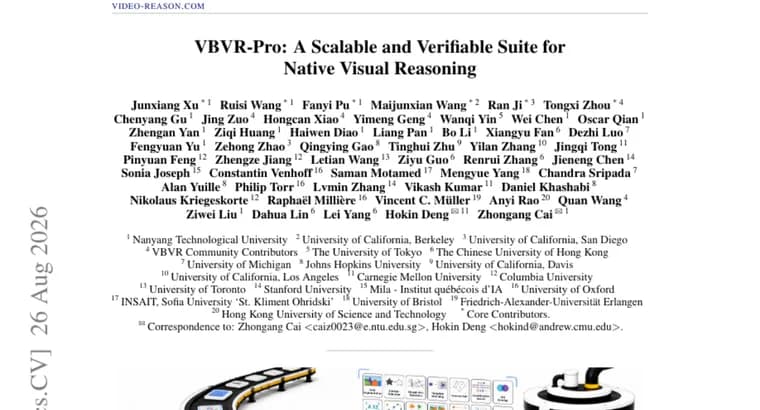
Researchers have introduced VBVR-Pro, a closed-loop testbed built around the idea of native visual reasoning: treating image and video generation not as an end product but as the medium through which a model works out a problem, rather than only describing a solution in words.
The suite targets three gaps the authors say have bottlenecked progress in this area: a lack of scalable training tasks, unreliable feedback for judging results, and no controlled way to compare different generative approaches. VBVR-Pro turns visual reasoning into a controlled task space of 300 procedurally generated tasks. Models trained on this task set showed, according to the authors, strong transfer to seven external visual reasoning benchmarks outside the VBVR-Pro suite, including RISE-Video, MME-CoF-Pro, and BabyVision.
A second part of the work addresses evaluation. Rather than relying on another multimodal model to judge whether a generated image or video correctly solves a task, an approach commonly called VLM-as-a-judge, the authors built verifiable reward scorers grounded in deterministic, task-specific rules. A systematic study of leading multimodal large language models used as judges, the authors report, turned up recurring failure modes in that judging approach, while their rule-based scorers achieve fine-grained alignment with human judgments. The authors say these scorers also work as reliable reward signals for large-scale multi-task reinforcement learning, producing stronger post-RL performance on visual reasoning tasks.
The third component is a mechanism study spanning more than 30 image, video, and interleaved generation models. The analysis finds that video generation remains strongest for tasks requiring persistent spatiotemporal state tracking, while interleaved generation offers a more compute-efficient alternative. Ablation experiments and probing, the authors write, suggest the presence of vision-native trajectories that are crucial to visual reasoning. The team says it is releasing all data, models, scorers, and code from the project.
Key facts
- VBVR-Pro provides a controlled task space of 300 procedurally generated native visual reasoning tasks.
- Models trained on VBVR-Pro show transfer to seven external benchmarks, including RISE-Video, MME-CoF-Pro, and BabyVision.
- The suite's verifiable reward scorers use deterministic, task-specific rules instead of VLM-as-a-judge, aligning more closely with human judgments and doubling as reward signals for large-scale multi-task RL.
- A mechanism study across more than 30 image, video, and interleaved generators finds video generation strongest for persistent spatiotemporal state tracking, with interleaved generation as a compute-efficient alternative.
- The authors say they are releasing all data, models, scorers, and code.
Why it matters
Native visual reasoning treats images and video as a first-class problem-solving medium rather than just inputs to interpret or outputs to render. The authors argue that progress on this idea has been stuck for a specific reason: there was no scalable set of training tasks, no reliable way to score whether a generated image or video actually solved a problem, and no controlled setup for comparing different generative approaches against each other. VBVR-Pro is built to remove all three blockers at once, packaging 300 tasks, deterministic scorers, and a shared testbed spanning over 30 generators into one closed loop that the authors say is trainable, verifiable, optimizable, and experimentally controllable.
Who it affects
The suite is aimed at researchers building and training generative models that reason visually, and at teams designing reinforcement learning pipelines that need a dependable reward signal rather than another model's subjective judgment. It also speaks to anyone building or comparing image, video, and interleaved generation systems, since the mechanism study directly compares over 30 of them on the same tasks.
How to use it
The authors say VBVR-Pro's data, trained models, verifiable scorers, and code are all being released, so a team can plug the 300-task suite and its deterministic scorers into its own training and evaluation pipeline, including as a reward signal for multi-task reinforcement learning. The source text does not give a release date, repository link, or license terms for any of it.
How solid is it
The claims come from the paper itself, posted to Hugging Face Papers, and describe the authors' own experiments: transfer to seven external benchmarks, closer alignment between the rule-based scorers and human judgments than VLM-as-a-judge, and stronger post-RL performance using those scorers. The source text gives no specific numeric scores or head-to-head comparisons against baseline methods for any of these results, so the strength of the improvements cannot be judged from the text alone, and none of it has been independently verified.
Risks and caveats
The available text names no authors or institutional affiliations, gives no publication or submission date, and does not spell out what "VBVR" stands for. Despite the stated release of data, models, scorers, and code, no repository link or license terms are given. All performance claims, including the transfer results and the comparison against VLM-as-a-judge, are self-reported by the authors without accompanying numeric detail in the source.