Vesuvius Challenge awards $50K for first readable text in Herculaneum scroll PHerc. 306B
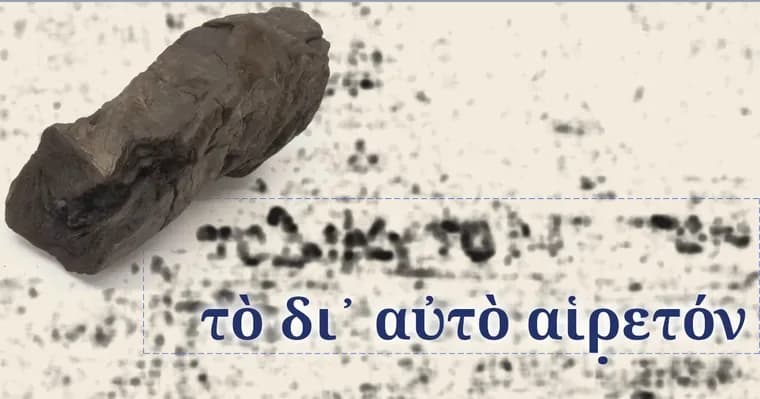
PHerc. 306 was buried by the eruption of Mount Vesuvius in AD79. It was excavated in the 1750s and micro-CT scanned last year, and until now no one had read what was written in it. The Vesuvius Challenge has now awarded a $50K First Letters Prize on PHerc. 306B, after reviewing 25 submissions on this scroll from its community. The winners are Liam Warner and Nicola Bodill, credited with revealing ink and recovering readable text.
The scroll is broken into two parts, PHerc. 306A and PHerc. 306B. Until now the team had no information about which part came from the upper or lower section of the original. Thanks to the identification of ink and the orientation of the script, the team says PHerc. 306B is the upper section and the smaller PHerc. 306A is the lower part. With ink now found in 306B, the article says the other portion has become all the more valuable to scan and virtually unroll. The carbonized roll sits at the Biblioteca Nazionale di Napoli, around 10km from the Villa dei Papiri in Herculaneum, where it was excavated.
The award was unusually hard. Several submissions identified the exact same area of the scroll, and some came very close to the prize criteria, which set a target of 10 readable characters within a 4 cm² area. Several fell just short, recovering sequences of 7, 8, or even 9 characters. The article thanks eight teams or contestants who worked on the same segment: The Gold Panners, Grilli Security Research Team, Matteo Bulloni, Clovis Hublin, TAUIL-Abd-Elilah, Ben Kyles and Colleagues, Les Copronautes, and Doom Scrollers. Micro-CT cross-sections taken by the Vesuvius Challenge team at the ESRF in Grenoble show the papyrus sheet the winners isolated, deep within tight windings. The scroll is badly distorted and compressed, as is typical of Herculaneum papyri, which were subject to extreme temperatures during the eruption.
The decisive step was subtle. The sequence τοδιαυτο had been identified in multiple submissions for almost a month, but what followed was too faint for the papyrology team to reach a consensus. The traces right after it were read as either a mu or a nu. In the image from Warner and Bodill, improved readability let the papyrology team agree, for the first time, on the reading αι. In majuscule scripts, Μ, Ν and ΑΙ can look remarkably similar, and the article notes they were confused even in antiquity during copying. The deciding feature is the middle stroke of the second alpha, which rises diagonally from the bottom of the left oblique stroke, as in the first alpha. Their submission made that stroke visible for the first time.
As Bodill noted in the submission, the reading τὸ δι᾽ αὑτὸ αἱρ̣ε̣τ̣όν̣ then becomes very plausible. The expression means "that which is in itself desirable" and has parallels in works by Aristotle and Sextus Empiricus. A similar expression appears in Philodemus' ethical treatise On Anger, where he refers to the "folly of those who think it the greatest good and who turn to it as to a thing in itself worthy of pursuing" (translation by D. Armstrong and M. McOsker). In an Epicurean context, the article says, the expression should only refer to good and pleasure.
The method is described in detail. The segment, the surface within the 3D scan, was built with VC3D's GrowPatch tool on the m7 surface predictions released by the Vesuvius Challenge team. The seed location lay on a line found by screening windings from the publicly available spiral-fitter, and the right-hand end of the patch was corrected by snapping to the m7 predictions. Final ink detection multiplies the outputs of two ink models, so a pixel shows as ink only where both agree. One is TRACE v3B, a public model from Jashanjot Singh Gill and Nhat Nam Tran. The other is A-hn, a custom model fine-tuned by Warner and Bodill from Youssef Nader's v8-in model, which was itself used to discover the first letters in PHerc. 1447. A-hn is the average of three 600-step runs. Each run trained half on Nader's PHerc. 1447 labels and half on machine labels made by averaging four public models (v8-in, Reader v3 and v2, and TRACE v3B) on other parts of PHerc. 0306B, with an extra loss penalty for marking blank papyrus as ink.
The winners introduce themselves in the article. Warner is from northern England and is a freelance software engineer and consultant who has worked in video games, healthcare and broadcasting technology. He planned to contribute a few optimisations and bug fixes, but with a spare RTX 4090 he tried ink detection. Bodill is from Australia, holds a BA in Latin and Ancient Greek, and is a current MA student at the University of Sydney, working on a critical edition of a 2000-year-old Gandharan Buddhist birch-bark manuscript. Since 2023 she has spent hundreds of hours manually creating ink labels to train machine learning models, and she presented a paper on her approach at the 2025 International Congress of Papyrology.
Looking ahead, 20 more scrolls remain eligible for First Letters Prizes: scanned, but without enough readable text found yet. The article says the result makes PHerc. 306B a front-runner for the $800,000 Grand Prize, awarded to the first team to virtually unwrap and read 70% of an entire scroll with minimal human input. The community has already submitted work on 13 other scrolls (besides PHerc. 306B and Erwin Nieuwlaar's prize-winning work on PHerc. 0343), though none has yet met a prize's requirements. Extending these results to reliable ink detection on 8 to 9um resolution scans, which are relatively practical and affordable to acquire, will in the team's words allow them to unlock the rest of the Herculaneum collection.
Key facts
- The Vesuvius Challenge awarded a $50K First Letters Prize on PHerc. 306B to Liam Warner and Nicola Bodill, after reviewing 25 submissions on the scroll.
- The papyrology team agreed for the first time on the reading αι after τοδιαυτο; the full reading τὸ δι᾽ αὑτὸ αἱρετόν, "that which is in itself desirable", is called very plausible.
- The prize target was 10 readable characters within 4 cm²; several rival submissions reached 7, 8 or even 9 characters.
- Ink detection multiplies two models, TRACE v3B and the custom A-hn, so a pixel counts as ink only where both agree; code and data are public.
- 20 more scrolls remain eligible for First Letters Prizes, and PHerc. 306B is now a front-runner for the $800,000 Grand Prize.
Why it matters
This is the first time anyone has read writing inside PHerc. 306, a scroll buried in AD79, excavated in the 1750s and scanned last year. Finding ink also settled a structural question: PHerc. 306B is the upper section of the original scroll and the smaller PHerc. 306A the lower part, which makes the second part more valuable to scan and unroll. The result also moves PHerc. 306B toward the $800,000 Grand Prize, which requires virtually unwrapping and reading 70% of an entire scroll with minimal human input.
Who it affects
The winners are Liam Warner, a freelance software engineer from northern England, and Nicola Bodill, an MA student at the University of Sydney with a BA in Latin and Ancient Greek. Eight other teams and contestants worked on the same segment and came close to the target. The papyrology team had to settle the reading, and the wider Vesuvius Challenge community works on 20 more eligible scrolls and has already submitted work on 13 others. The article also credits earlier model authors: Youssef Nader (v8-in), and Jashanjot Singh Gill and Nhat Nam Tran (TRACE v3B).
How to use it
The winners published their work. The code is on GitHub (SirProdigle/pherc0306b-first-letters) and the data is on Hugging Face (Prodigle/pherc0306b-first-letters), so others can download, reproduce and build on it. The article describes the pipeline: a segment grown with VC3D's GrowPatch tool on the m7 surface predictions, then ink detection from the product of TRACE v3B and the custom A-hn model. Teams who want to compete can target one of the 20 scrolls still eligible for First Letters Prizes or the $800,000 Grand Prize.
How solid is it
The announcement comes from the Vesuvius Challenge organisers themselves, who ran the award process. The papyrology team agreed on the reading αι, and the article says the image leaves little room for doubt about the previously uncertain sequence. The wider reading τὸ δι᾽ αὑτὸ αἱρετόν is described only as becoming very plausible, not as certain. The code and data are public, so the result can be checked and reproduced.
Risks and caveats
The reading of the longer expression is a plausibility judgement, not a settled fact. The article discusses only the sequence τοδιαυτο followed by αι. It does not say what the surrounding text on PHerc. 306B means, nor how many characters the winning submission read. Philodemus is cited as a parallel for the expression, not as the scroll's author. Being a front-runner for the Grand Prize is not winning it, and no timescale is given. The article says reliable ink detection on 8 to 9um scans is still a goal; once achieved, it will allow the rest of the Herculaneum collection to be unlocked.
“Luckily I managed to strike gold, and with the tireless efforts of Nicola, we were able to slowly improve the quality of our segment, detection model, and reading.”
— Liam Warner, First Letters Prize winner