Wave Forcing generates streaming video at 134.8 FPS on eight H200 GPUs
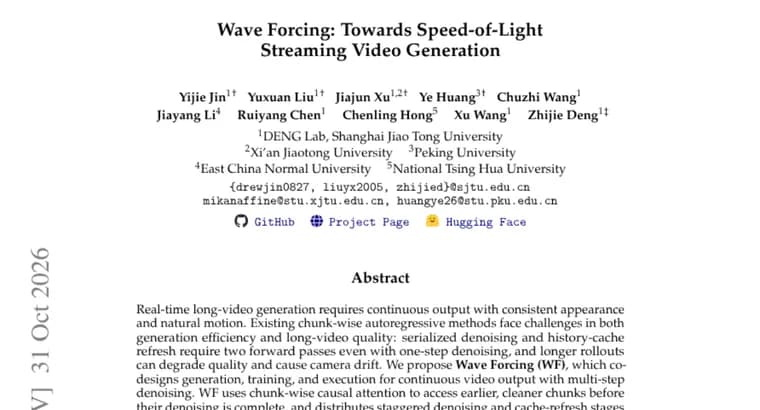
A paper listed on Hugging Face Papers, "Wave Forcing: Towards Speed-of-Light Streaming Video Generation", targets real-time long-video generation, which needs continuous output with consistent appearance and natural motion. The paper says existing chunk-wise autoregressive methods struggle on two fronts. On efficiency, serialized denoising and history-cache refresh require two forward passes even with one-step denoising. On quality, longer rollouts can degrade the video and cause camera drift.
The proposed fix is Wave Forcing (WF), which co-designs generation, training and execution for continuous video output with multi-step denoising. On the generation side, WF uses chunk-wise causal attention so the model can look at earlier, cleaner chunks before their denoising is complete. It also distributes staggered denoising and cache-refresh stages across full-model replicas. The goal is what the paper calls 1F1C: one output chunk per concurrent forward round once the pipeline has filled.
On the training side, the authors describe a three-stage procedure. It successively introduces mixed-noise denoising, motion supervision, and causal adaptation using self-generated history, so the model adapts to this continuous generation process.
On the execution side, the Wave Runtime (WaveRT) uses Wave Parallelism (WP) for early K/V delivery and for overlapping communication with computation. It also relies on optimized kernels and pipelined VAE decoding.
The reported results come in two groups. For quality, experiments on Wan2.1-T2V-1.3B show that 5-step WF keeps overall quality comparable to Rolling Forcing while achieving higher Dynamic Degree on both short and long videos. For system efficiency, 4-step WF reaches 147.6 DiT FPS and 134.8 end-to-end FPS on eight H200 GPUs, which is 7.07x the single-GPU end-to-end throughput. In DiT-only tests with matched SageAttention+W8A8 backends, denoising steps and GPU counts, WP delivers up to 2.53x the throughput of the faster of the Ulysses and Ring context-parallel baselines, across six model scales from 1.3B to 14B.
Key facts
- Wave Forcing (WF) co-designs generation, training and execution for continuous real-time long-video generation with multi-step denoising.
- 4-step WF reaches 147.6 DiT FPS and 134.8 end-to-end FPS on eight H200 GPUs, 7.07x the single-GPU end-to-end throughput.
- In DiT-only tests, Wave Parallelism delivers up to 2.53x the throughput of the faster of the Ulysses and Ring baselines across six model scales (1.3B-14B).
- On Wan2.1-T2V-1.3B, 5-step WF keeps overall quality comparable to Rolling Forcing and scores higher on Dynamic Degree for short and long videos.
- Training uses three stages: mixed-noise denoising, motion supervision, and causal adaptation with self-generated history.
Why it matters
Streaming video generation needs output that keeps flowing, looks consistent and moves naturally. The paper argues that current chunk-wise autoregressive approaches are held back by a structural cost: denoising and history-cache refresh run one after the other, needing two forward passes even with one-step denoising. Wave Forcing tries to remove that bottleneck by staggering the stages across model replicas, aiming for one output chunk per concurrent forward round once the pipeline is full. The headline numbers, 134.8 end-to-end FPS on eight H200s, are the paper's evidence that this design can reach very high frame rates.
Who it affects
Mainly researchers and engineers working on autoregressive and streaming video diffusion, especially those building on Wan2.1-style models or comparing against Rolling Forcing. The runtime side, Wave Parallelism, is framed against Ulysses and Ring context-parallel baselines, so people who serve large video models across several GPUs are the other audience.
How to use it
The abstract does not mention a code or model release, so there is nothing to download from the source as described. Practitioners can use it as a design reference: chunk-wise causal attention over not-yet-fully-denoised earlier chunks, staggered denoising and cache-refresh stages across full-model replicas, and early K/V delivery with communication-computation overlap. Reproducing the results would need a multi-GPU setup like the eight H200 GPUs used in the reported tests.
How solid is it
This is a paper summary of the claims in an abstract, and the figures are the authors' own. The quality claim is modest: 5-step WF is called comparable to Rolling Forcing overall, with higher Dynamic Degree, and no metric values are given. The speed figures (147.6 DiT FPS, 134.8 end-to-end FPS) are for the 4-step configuration, a different setting from the 5-step quality comparison. The 2.53x figure is a maximum over six model scales and applies to DiT-only tests, not to end-to-end generation. The abstract does not state the single-GPU FPS value, resolution or video length for the FPS figures.
Risks and caveats
Quality and speed were reported for different step counts (5-step for quality, 4-step for speed), so the abstract does not show both at once in a single configuration. The best results rest on eight H200 GPUs, high-end hardware. The quality claim is limited to Wan2.1-T2V-1.3B and a comparison with Rolling Forcing. The 7.07x scaling is relative to the single-GPU end-to-end throughput, whose absolute value is not given. Independent replication is not described.