VisionHOPE proposes a self-modifying visual backbone with five coupled memories
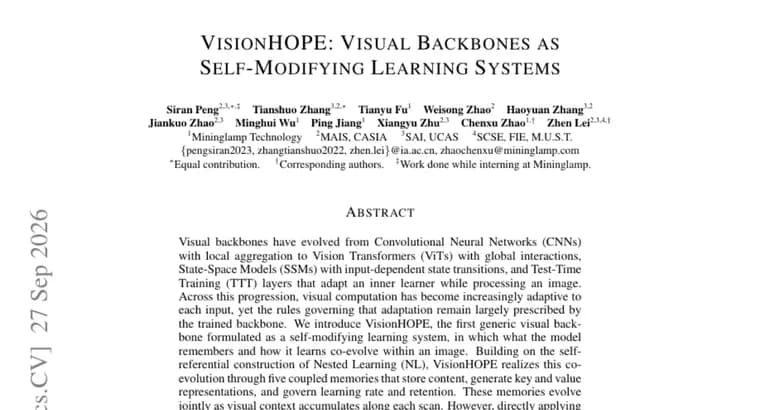
A paper on Hugging Face introduces VisionHOPE, a visual backbone that the authors describe as "the first generic visual backbone formulated as a self-modifying learning system". The idea is that what the model remembers and how it learns co-evolve within a single image.
The paper starts from the history of visual backbones: Convolutional Neural Networks (CNNs) with local aggregation, then Vision Transformers (ViTs) with global interactions, State-Space Models (SSMs) with input-dependent state transitions, and Test-Time Training (TTT) layers that adapt an inner learner while processing an image. Across this progression, the authors say, visual computation has become more adaptive to each input, yet the rules governing that adaptation remain largely prescribed by the trained backbone. VisionHOPE is meant to change that.
It builds on the self-referential construction of Nested Learning (NL). VisionHOPE uses five coupled memories. They store content, generate key and value representations, and govern learning rate and retention. The memories evolve jointly as visual context accumulates along each scan.
The authors report a problem: directly applying the unconstrained self-referential update to a visual backbone leads to instability. Their fix is a stability-matched step-size control scheme. It combines a soft cap on self-referential injection with a spectral clamp on the retained memory transition. They prove that the resulting memory dynamics are non-expansive along each scan.
For two-dimensional feature maps, they adapt NL's chunk formulation by aligning chunks with image rows and columns across four directional scans.
On results, the abstract says VisionHOPE achieves competitive results on ImageNet-1K, COCO and ADE20K, and the authors conclude this establishes self-modifying learning systems as a practical foundation for general-purpose visual backbones. Code is available at https://github.com/PSRben/VisionHOPE.
Key facts
- VisionHOPE is presented as the first generic visual backbone formulated as a self-modifying learning system, where memory and learning co-evolve within an image.
- It builds on Nested Learning and uses five coupled memories: they store content, generate key and value representations, and govern learning rate and retention.
- Applying the unconstrained self-referential update directly to a visual backbone leads to instability, so the authors add a soft cap on self-referential injection and a spectral clamp on the retained memory transition.
- The authors prove the memory dynamics are non-expansive along each scan; for 2D feature maps they align chunks with image rows and columns across four directional scans.
- Results are described as competitive on ImageNet-1K, COCO and ADE20K, and code is on GitHub.
Why it matters
The paper places itself at the end of a line of backbone designs: CNNs, ViTs, SSMs and Test-Time Training layers. Each made computation more adaptive to the input, but the authors argue the rules of that adaptation are still fixed by the trained backbone. VisionHOPE tries to let the model shape those rules itself while it processes an image. If the approach holds up, it would be a different kind of backbone, not just a variant of an existing one. That is the authors' framing; the abstract gives no numbers to test it against.
Who it affects
Mainly researchers working on vision architectures, especially those following state-space models, test-time training and Nested Learning. The evaluation covers ImageNet-1K, COCO and ADE20K, the standard benchmarks for general-purpose backbones, so the work is aimed at people who would use a backbone across many vision tasks.
How to use it
Code is available at https://github.com/PSRben/VisionHOPE. The abstract says nothing about licences, pricing, pretrained weights or hardware needs, so anyone interested should start from the repository. Adapting the design to 2D inputs means aligning chunks with image rows and columns across four directional scans.
How solid is it
The stability claim is backed by a proof: the authors state that the memory dynamics are non-expansive along each scan. The empirical claim is weaker as far as the abstract shows. It says only "competitive" on ImageNet-1K, COCO and ADE20K. No numeric benchmark results (accuracy, mAP, mIoU, FLOPs, parameter counts) are given, and no comparison baselines or named competing models are given. No model sizes, training cost or inference speed are stated. The claim of being the first generic self-modifying visual backbone is the authors' own.
Risks and caveats
The authors themselves note that the unconstrained self-referential update makes a visual backbone unstable, so the design depends on the step-size control scheme to work. The statement that self-modifying systems are now a practical foundation for general-purpose backbones rests on results that are described only as competitive. Until the full paper's tables and independent replication are checked, how VisionHOPE compares with established backbones remains open.