VLAct pre-training boosts robot policy transfer without more robot data
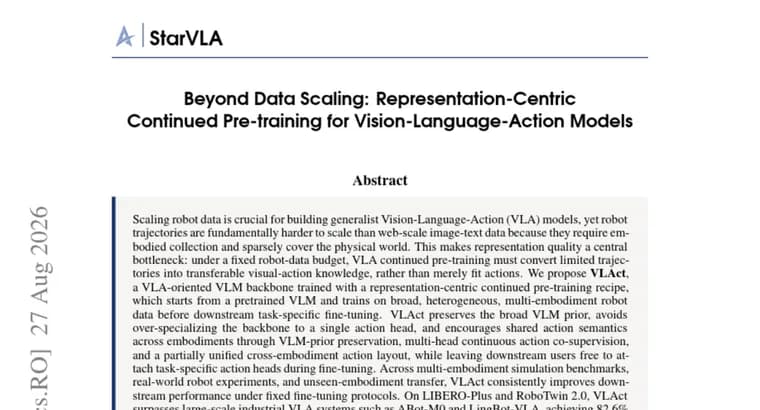
Researchers propose VLAct, a method for continued pre-training of the vision-language model (VLM) backbone that underlies vision-language-action (VLA) robot policies. The starting problem: robot trajectory data is far harder to scale than web-scale image-text data, because collecting it requires physical embodied interaction, which is costly and only sparsely covers the range of real-world situations. The authors argue this makes representation quality, not raw data volume, the real bottleneck: under a fixed robot-data budget, continued pre-training has to turn a limited set of trajectories into visual-action knowledge that transfers across tasks and robot bodies, rather than just fitting actions to the training examples at hand.
VLAct trains its VLM backbone on broad, heterogeneous, multi-embodiment robot data before any task-specific fine-tuning. It keeps the broad prior knowledge of the underlying VLM and pushes different robot embodiments toward sharing action semantics, through three mechanisms: preserving the VLM's prior, co-supervising with multiple continuous action heads, and using a partially unified action layout across embodiments. Task-specific action heads are still used at fine-tuning time.
Across simulated benchmarks, real-world tests, and transfer to embodiments never seen during pre-training, VLAct improved downstream performance under fixed fine-tuning protocols. On the LIBERO-Plus and RoboTwin 2.0 benchmarks, VLAct beat industrial VLA systems ABot-M0 and LingBot-VLA, reaching success rates of 82.6% and 92.5% respectively (the source does not give the baselines' own numeric scores, only that VLAct exceeded them). On RoboDojo, VLAct placed sixth by success rate among all policies tested and beat every policy explicitly labeled as a world-action model (WAM) on both of the benchmark's metrics. The most notable result came on RoboCasa-GR1, an unseen humanoid embodiment: using only 20% of the downstream trajectories available, VLAct still outperformed the full-data GR00T-N1.6 baseline. The authors obtained all of these results using fully open-source data and a training setup of just 16 GPUs, which they present as evidence that representation-centric continued pre-training is a competitive, compute-modest, and largely independent axis for improving VLA models, separate from simply scaling up robot data.
Key facts
- VLAct is a representation-centric continued pre-training method for the VLM backbone of vision-language-action (VLA) robot policies, aimed at squeezing more transferable knowledge out of limited robot trajectory data.
- On LIBERO-Plus and RoboTwin 2.0, VLAct beats industrial VLA systems ABot-M0 and LingBot-VLA, reaching success rates of 82.6% and 92.5% respectively.
- On RoboDojo, VLAct ranks sixth among all tested policies by success rate and beats every policy explicitly designated a world-action model (WAM) on both metrics.
- On the unseen humanoid embodiment RoboCasa-GR1, VLAct uses only 20% of downstream trajectories yet outperforms the full-data GR00T-N1.6 baseline.
- All results were produced with fully open-source data and a 16-GPU training setup.
Why it matters
Robot trajectory data cannot scale the way web text and images do: every trajectory requires real physical collection, which is expensive and only thinly covers the space of real-world tasks and environments. VLAct's pitch is that under a fixed, limited robot-data budget, how a model's representations are pre-trained matters as much as how much data it sees. Treating representation quality as an independent lever, alongside data scale, gives VLA researchers a second axis to improve performance when collecting more robot data is not practical.
Who it affects
The work is aimed at researchers and engineers building generalist vision-language-action policies for robots, and at teams evaluating or deploying VLA systems across multiple robot embodiments, including named comparison points ABot-M0, LingBot-VLA, and GR00T-N1.6. It is also relevant to anyone working on humanoid robot control, since the strongest single result is transfer to an unseen humanoid embodiment (RoboCasa-GR1).
How to use it
VLAct is a continued pre-training stage applied to a VLM backbone before task-specific fine-tuning, using broad, heterogeneous, multi-embodiment robot data; task-specific action heads are still trained afterward for the particular robot and task. The authors report using fully open-source data and only a 16-GPU training setup, positioning the method as reproducible without large-scale compute. The source text does not give a parameter count, model size, or licensing terms for VLAct, so those details cannot be stated here.
How solid is it
The claims rest on results across four benchmark settings: simulation (LIBERO-Plus), a second simulation suite (RoboTwin 2.0), a broader multi-policy leaderboard (RoboDojo), and a cross-embodiment transfer test on an unseen humanoid (RoboCasa-GR1), plus unspecified real-world tests. VLAct's own success rates are given as concrete percentages (82.6%, 92.5%) and a rank (sixth on RoboDojo), and the 20%-of-data result on RoboCasa-GR1 is a clearly stated relative comparison against GR00T-N1.6. However, the source text does not report the baselines' own numeric scores on LIBERO-Plus or RoboTwin 2.0, only that VLAct surpassed them, and it does not name the other five policies ranked around VLAct on RoboDojo, which limits how the size of the improvement can be judged from the text alone.
Risks and caveats
The source provides no author names, institutional affiliations, or publication date, and no parameter count or model size for VLAct, so those cannot be verified here. The comparison baselines' own scores are not given, meaning the margin of VLAct's advantage over ABot-M0, LingBot-VLA, and GR00T-N1.6 cannot be independently assessed from this text. The description of 'industrial VLA systems' is limited to the two named systems, without a broader definition of the category.