VSpark speeds up robot action models 1.28x to 2.10x with speculative decoding
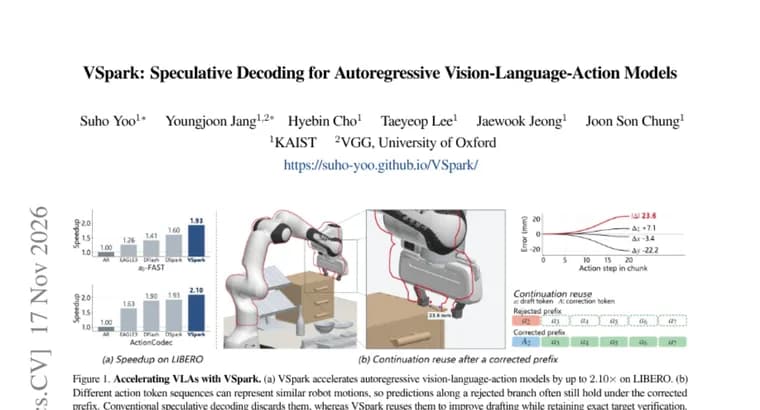
A new paper presents VSpark, a method for making autoregressive vision-language-action (VLA) models faster. These models control robots by generating actions one token at a time, which is a slow way to work.
The starting point is speculative decoding. A lightweight draft model proposes several tokens at once, and the VLA checks them in a single pass. It accepts only the tokens that match its own predictions, so the output stays lossless: the result is the same as if the VLA had decoded alone.
The authors say this speedup is limited in robot control. Many different tokens encode nearly the same motion, so a draft that is close to the correct action is still rejected.
VSpark is built on three design choices to address that. First, the draft is trained on rollouts collected with calibrated action noise, which expose it to a wider range of robot states. Second, feature alignment trains the draft to match the VLA's hidden features rather than only its output tokens. Third, continuation reuse keeps the predictions the VLA has already computed along rejected drafts and uses them as candidates for the next verification step, instead of discarding them.
Tested on four VLAs with different action tokenizers and four manipulation benchmarks, VSpark achieves a 1.28x to 2.10x speedup while keeping the VLA's decoding lossless. The source does not say whether the range is per model, per benchmark, or an average.
Key facts
- VSpark is a speculative-decoding method for autoregressive VLA models that generate robot actions token by token.
- It rests on three design choices: rollouts with calibrated action noise, feature alignment with the VLA's hidden features, and continuation reuse of predictions from rejected drafts.
- The authors say plain speculative decoding gains little in robot control because many different tokens encode nearly the same motion, so near-correct drafts get rejected.
- Reported result: 1.28x to 2.10x speedup across four VLAs with different action tokenizers and four manipulation benchmarks.
- Decoding stays lossless: the VLA accepts only draft tokens that match its own predictions.
Why it matters
Autoregressive VLAs produce robot actions one token at a time, so decoding speed limits how quickly they can act. Speculative decoding is an established way to speed up token generation without changing outputs. The paper's argument is that it works less well for robot control, because several different tokens can mean almost the same motion and a draft that is close to right still gets rejected. VSpark targets exactly that mismatch, and reports speedups of 1.28x to 2.10x.
Who it affects
Mainly researchers and engineers working on autoregressive VLA models and action tokenizers, who may want faster decoding without changing what the model outputs. The tests cover four VLAs with different action tokenizers, which suggests the method is meant to work across tokenizer designs.
How to use it
The source gives no code or usage details, so there is nothing to run yet. For practitioners, the three ideas are the takeaway. Train the draft on rollouts collected with calibrated action noise. Align the draft with the VLA's hidden features, not just its output tokens. Keep the VLA's computed predictions along rejected drafts as candidates for the next verification step.
How solid is it
The evidence is the paper's own summary: four VLAs and four manipulation benchmarks, with a reported 1.28x to 2.10x speedup and lossless decoding. The source does not say which setting gives 1.28x and which gives 2.10x, nor whether the range is per-model, per-benchmark, mean or median. The four VLAs, their action tokenizers and the benchmarks are not named. The baseline is not stated beyond ordinary autoregressive decoding.
Risks and caveats
No real-robot results, task success rates, latency figures in milliseconds or hardware details are given. No code or model release is mentioned. The gain depends on the setting, and the spread from 1.28x to 2.10x is wide, so the speedup on a given model and task could sit anywhere in that range. These are the authors' own reported figures and have not been independently checked.