WeVisForensics uses self-evolving agents to detect AI-generated video
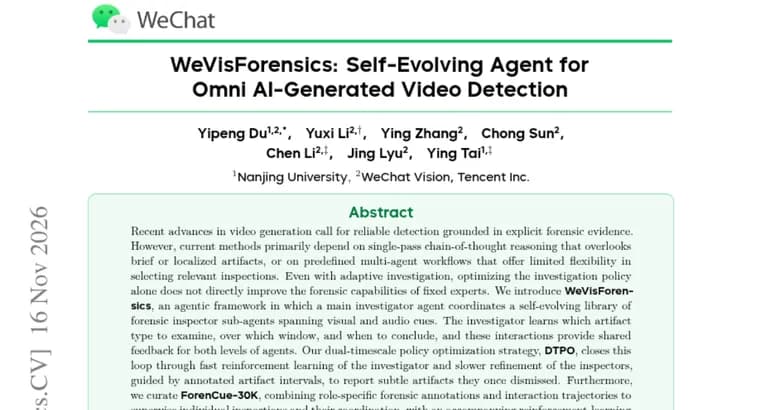
A paper listed on Hugging Face Papers introduces WeVisForensics, an agentic framework for detecting AI-generated video. The starting point is that video generation keeps improving, so detection needs to rest on explicit forensic evidence. The authors say current methods fall short in two ways. Some depend on single-pass chain-of-thought reasoning, which overlooks brief or localized artifacts. Others use predefined multi-agent workflows, which offer limited flexibility in choosing which inspections to run. They add that even with adaptive investigation, optimizing the investigation policy alone does not directly improve the forensic capabilities of fixed experts.
WeVisForensics has two levels. A main investigator agent coordinates a self-evolving library of forensic inspector sub-agents that span visual and audio cues. The investigator learns which artifact type to examine, over which time window, and when to conclude. Those interactions give shared feedback to both levels of agents.
Training uses a dual-timescale policy optimization strategy called DTPO. It closes the loop through fast reinforcement learning of the investigator and slower refinement of the inspectors. The inspector refinement is guided by annotated artifact intervals, so that inspectors learn to report subtle artifacts they once dismissed.
The authors also built a dataset, ForenCue-30K. It combines role-specific forensic annotations and interaction trajectories, which supervise individual inspections and their coordination, and comes with a reinforcement-learning pool.
On results, the authors say WeVisForensics averages 95.2% detection accuracy across in-domain, out-of-domain and agentic benchmarks. They put that 9.0% above the strongest prior detector, and say the system grounds its verdicts in localized evidence.
Key facts
- WeVisForensics pairs a main investigator agent with a self-evolving library of forensic inspector sub-agents covering visual and audio cues.
- The investigator learns which artifact type to examine, over which window, and when to conclude.
- The DTPO training strategy combines fast reinforcement learning of the investigator with slower refinement of the inspectors, guided by annotated artifact intervals.
- The authors curated a dataset named ForenCue-30K, with forensic annotations, interaction trajectories and a reinforcement-learning pool.
- Reported result: 95.2% average detection accuracy across in-domain, out-of-domain and agentic benchmarks, 9.0% above the strongest prior detector.
Why it matters
Video generators keep improving, and the authors argue that detection should rest on explicit forensic evidence rather than a single verdict. They say existing approaches either reason once and miss brief or localized artifacts, or follow fixed multi-agent workflows with little flexibility in what to inspect. WeVisForensics tries to fix both: the investigator chooses what to check, and the inspectors themselves improve over time.
Who it affects
The work is aimed at people building detectors for AI-generated video, including systems that must weigh both visual and audio evidence. The authors' emphasis on verdicts grounded in localized evidence points to uses where a flagged artifact has to be shown, not just asserted.
How to use it
The abstract mentions no released code, models or data, so there is nothing to run yet. For researchers, the transferable ideas are the two-level design (investigator plus inspector library), the dual-timescale training that updates the investigator quickly and the inspectors more slowly, and supervision from annotated artifact intervals.
How solid is it
This is a paper abstract on Hugging Face Papers, so the numbers are the authors' own claims. The headline figure is a 95.2% average across in-domain, out-of-domain and agentic benchmarks. It is described as 9.0% above the strongest prior detector, but the abstract does not say whether that is percentage points or a relative gain. The individual benchmarks and the strongest prior detector are not named, and no per-benchmark breakdown is given.
Risks and caveats
An average across benchmark groups can hide weak spots, and no separate in-domain, out-of-domain or agentic figures are given. The abstract does not mention limitations, failure cases or false-positive rates. The size of ForenCue-30K, the base model and the training cost are also not stated, so the claims cannot be judged beyond the headline numbers until the full paper is read.