WARC world model learns unseen ARC-AGI-3 game mechanics at test time
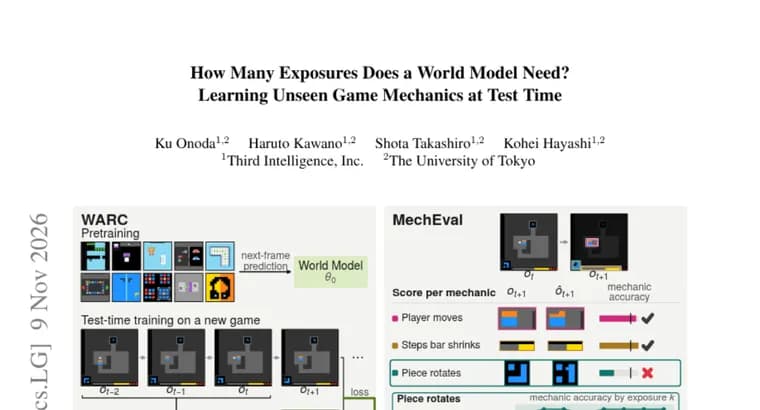
A new preprint asks a narrow question about world models: how many exposures does one need to predict the effects of a new environment's mechanics? The authors define a mechanic as a rule for how an action or an interaction changes part of the environment, and count each occurrence of a mechanic that the model observes as one exposure. The motivation is that world models let agents plan and learn from imagined experience, but in an unfamiliar environment they must first learn its mechanics from limited interaction.
The study is run on ARC-AGI-3, a benchmark of interactive games defined by their programs. The authors introduce MechEval, which labels 69 recurring mechanics across 20 games, taken from those programs. It scores each prediction on the cells the mechanic changes at each exposure, so a model is judged on the part of the screen the mechanic actually affects.
As a test bed the authors build WARC (World model for ARC-AGI-3), a 35M-parameter vision transformer. It is pretrained on other games and updates all of its parameters after each transition, which is the test-time learning the title refers to.
On held-out games, WARC learns to predict four in five mechanics with at least 80% accuracy on the cells they change, and it keeps that accuracy to the end of the recordings. Half of the mechanics reach that accuracy within about 80 exposures, which the authors say is within a single play of the game. Without test-time updates, only one in seven mechanics reaches that accuracy at all.
The authors also test the model in closed-loop play. WARC-Agent pairs WARC with a fixed graph explorer. On the public games it triples the explorer's official efficiency score, from 0.15 to 0.46, and the authors say the gain comes mostly through test-time training. On the hidden games of the Kaggle leaderboard, their entry scores 0.20.
Key facts
- MechEval labels 69 recurring mechanics across 20 ARC-AGI-3 games and scores predictions on the cells each mechanic changes at every exposure.
- WARC, a 35M-parameter vision transformer pretrained on other games, updates all its parameters after each transition.
- On held-out games WARC predicts four in five mechanics with at least 80% accuracy on the changed cells; half get there within about 80 exposures, and without updates only one in seven does at all.
- WARC-Agent, WARC paired with a fixed graph explorer, lifts the explorer's official efficiency score on public games from 0.15 to 0.46, mostly through test-time training.
- The authors' entry scores 0.20 on the hidden games of the Kaggle leaderboard.
Why it matters
Agents that plan with a world model need to understand a new environment quickly, and this paper puts a number on how quickly. Half of the labelled mechanics reach 80% accuracy within about 80 exposures, in a single play of a game, and four in five get there eventually. The comparison that carries the argument is with a model that does not update: only one in seven mechanics reaches that accuracy without test-time updates. The result points to learning during the episode, not only pretraining, as the source of the gain.
Who it affects
Researchers working on world models, interactive-game benchmarks and ARC-AGI-3 entries are the direct audience. MechEval gives them a way to measure mechanic-by-mechanic learning, which a single game-level score cannot show. The setup, a small 35M-parameter model that adapts after every transition, is also relevant to anyone designing agents that must act in environments they have not seen.
How to use it
For a reader, the practical value is the evaluation idea: count exposures to a mechanic and score predictions only on the cells that mechanic changes. WARC-Agent shows one way to combine a learned world model with a fixed graph explorer. No code or dataset release is mentioned.
How solid is it
These are the authors' own results on their own benchmark and model, reported in a preprint. The numbers are specific and internally consistent: 69 mechanics, 20 games, 35M parameters, 80% accuracy threshold, 0.15 to 0.46 on public games. The abstract names no authors or institutions. It does not say how the 0.20 Kaggle score compares with other entries or with the leaderboard top.
Risks and caveats
The 0.15 to 0.46 gain is on the public games only; the abstract does not say it carries to hidden games. The hidden-games score of 0.20 is lower, and the abstract does not state whether it uses the same metric or the same agent as the 0.46 figure, nor what the explorer scores on those games. It gives no compute, training-data size or training-time details for WARC. The 80% threshold and the four-in-five figure apply to the 69 labelled mechanics, so they describe MechEval and not games in general.
“A mechanic is a rule for how an action or an interaction changes part of the environment.”
— Paper abstract, Hugging Face