WarpSAC boosts off-policy RL across CPU and GPU benchmarks
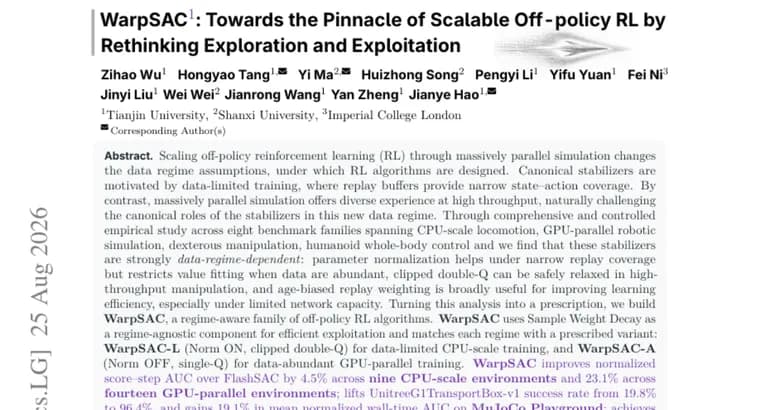
Massively parallel simulation has changed the data regime that off-policy reinforcement learning runs in, and the stabilizers built for older, data-limited replay setups do not all carry over. Controlled experiments across eight benchmark families found that these stabilizers are data-regime-dependent: parameter normalization helps when replay coverage is narrow but restricts value fitting once data become abundant, while clipped double-Q can be relaxed in high-throughput manipulation tasks. Age-biased replay weighting improved learning efficiency across regimes, especially when network capacity was limited.
Based on these findings, the researchers built WarpSAC, a regime-aware family of off-policy RL algorithms that uses Sample Weight Decay for efficient exploitation. It ships in two variants: WarpSAC-L, with parameter normalization on and clipped double-Q, for data-limited CPU-scale training, and WarpSAC-A, with normalization off and a single Q-function, for data-abundant GPU-parallel training.
Against the FlashSAC baseline, WarpSAC improved normalized score-step AUC by 4.5% across nine CPU-scale environments and by 23.1% across fourteen GPU-parallel environments. On the UnitreeG1TransportBox-v1 task, it raised the success rate from 19.8% to 96.4%. It also improved mean normalized wall-time AUC on MuJoCo Playground by 19.1%, and in a real-world test, deployment from simulation to an actual Unitree G1 robot was 36.4% faster than with FlashSAC.
The authors' conclusion is that scalable off-policy RL should adapt its stabilizers to the available data regime rather than using one fixed configuration everywhere.
Key facts
- WarpSAC improves normalized score-step AUC over FlashSAC by 4.5% across nine CPU-scale environments and by 23.1% across fourteen GPU-parallel environments.
- It raises the UnitreeG1TransportBox-v1 success rate from 19.8% to 96.4%.
- It improves mean normalized wall-time AUC on MuJoCo Playground by 19.1%, and cuts sim-to-real deployment time on a Unitree G1 robot by 36.4% compared with FlashSAC.
- WarpSAC comes in two variants: WarpSAC-L (parameter normalization on, clipped double-Q) for data-limited CPU-scale training, and WarpSAC-A (normalization off, single-Q) for data-abundant GPU-parallel training.
- Controlled experiments across eight benchmark families show existing stabilizers are data-regime-dependent: parameter normalization helps narrow replay coverage but restricts value fitting once data are abundant, and clipped double-Q can be relaxed in high-throughput manipulation.
Why it matters
Massively parallel simulation lets off-policy RL train on far more data than the replay-buffer setups these algorithms were originally stabilized for. The paper's controlled tests show that stabilizers tuned for data-limited replay, such as parameter normalization and clipped double-Q, can actually hold back training once data become abundant. WarpSAC turns that observation into a practical fix: pick the stabilizer configuration to match the data regime instead of using one fixed recipe everywhere, and the reported gains hold on both small CPU-scale setups and large GPU-parallel ones.
Who it affects
Researchers and engineers training off-policy RL agents, particularly teams moving from traditional CPU-based simulation to massively parallel GPU simulation, where the data regime shifts and older stabilizer defaults may no longer be the right choice. The Unitree G1 robotics results also make this relevant to teams deploying learned policies from simulation onto physical robots.
How to use it
WarpSAC is offered as two variants selected by data regime. WarpSAC-L keeps parameter normalization on and uses clipped double-Q, aimed at data-limited CPU-scale training. WarpSAC-A turns normalization off and uses a single Q-function, aimed at data-abundant GPU-parallel training. Both use a technique the authors call Sample Weight Decay for exploitation. The source gives no pricing, licensing, or release details beyond the algorithm description itself.
How solid is it
The claims rest on controlled experiments across eight benchmark families, with head-to-head AUC comparisons against FlashSAC on nine CPU-scale and fourteen GPU-parallel environments, plus a physical robotics test: sim-to-real deployment on a Unitree G1. That combination of benchmark breadth and one real-world hardware result is a reasonably strong evidence base for a systems paper, though it is still evidence from the authors' own experiments rather than independent replication.
Risks and caveats
The source text does not name the authors, their institutions, or any publication venue or peer-review status, and it does not define the AUC metric or spell out the full experimental setup beyond the headline comparisons to FlashSAC. It also does not explain mechanically what Sample Weight Decay does beyond naming it. Readers should treat the reported percentages as the authors' own benchmark results until the work is independently reviewed or reproduced.