US creative industries lost 200k jobs in four years: how much is AI?
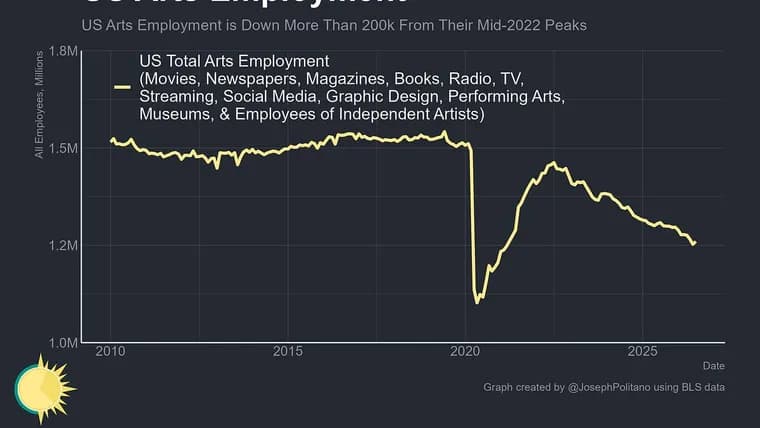
An article on Apricitas says America has lost more than 200k jobs in "creative" industries over the last four years, roughly 50k of them within the last year alone. It calls this one of the worst stretches for media employment in modern US history; similar intensity and duration appeared only in the recessions of 2001 and 2008. Today there is no generalized recession. Instead, the losses coincide with the rise of AI systems that can produce novels, photorealistic images, soundalike music and other digital art in bulk at very low cost.
The author says proving how much of the loss is driven by AI is extremely difficult. Media firms are coy about their AI use, both to avoid public backlash and, more importantly for finances, to preserve the legal basis for their copyrights. AI is also tangled up with other pressures: consolidation in Hollywood, offshoring of content production, and the shift from traditional media to social media creators. Still, the author calls it perhaps the clearest evidence of AI's influence that every subsector of the digital arts is losing jobs while in-person entertainment keeps growing at a healthy pace.
The damage is broad. Some digital losses continue old trends, such as newspaper and magazine jobs worn down by technology for decades. But live broadcasting, streaming and graphic design are seeing an unusual downturn after years of calm. The worst-hit area is movie & sound recording, which accounts for nearly half of the media job losses of the last four years. The movie & TV industry alone lost more than 100k jobs, nearly one-third of the sector's total. At the low point this summer, employment was below any point since the 2008 recession and approaching the lowest in 30 years. Written publishing is next, with employment down by more than 70k. Losses hover around 50k a year and have even accelerated in recent months.
To judge what could come next, the article retells what the internet did to music. Around the turn of the millennium, unreleased Metallica tracks leaked through Napster, where albums that sold for $15 were shared free. Metallica sued, later joined by other artists and the Recording Industry Association of America (RIAA), and won, forcing Napster into bankruptcy. The author argues they were right on the law but wrong on technology: piracy could not be policed, individual songs lost value, and Spotify and Apple Music eventually assembled huge catalogues and charged a small access fee. Streaming revenue, even before adjusting for inflation, is far below 1990s physical-media sales. Musicians survived by turning recordings into advertising for live concerts and merch, with longer tours, bigger venues and higher ticket prices. Without rising concert income, the author says, the business model would have collapsed.
Video has moved the other way, from theatres into the home, and each earlier leap raised total watch time. Not now: before inflation adjustment, movie ticket sales ended last year down 25% from their 2019 peak, cable revenue is down 18% from its peak, and streaming revenue has not made up the gap. Free user-generated content on YouTube, Twitch and TikTok already competed hard before ChatGPT launched, and now streaming services also face a flood of AI-generated content. Unlike music, Hollywood has basically no equivalent of live concerts to soften the blow.
The author's worst case for creative workers is what happened to publishing after the internet: near-total collapse of the business model. Newspapers once employed roughly half a million people in the US, more than the entire oil industry; payrolls are down nearly 85% and still falling. Magazine publishers have let 66% of staff go since the 90s, and book publishers 40%. Newspapers lost box scores, stock prices and forecasts to specialist sites, ad revenue to Google, breaking news to social media users, and paywalls were easy to copy around. The article calls that scale of copyright dilution and forced unbundling the worst case for media in the age of AI.
Could consumers' aversion to explicitly AI-generated content save jobs? Possibly, the author writes, but AI is increasingly used in ways invisible to consumers. About 32% of workers in the arts, entertainment and recreation sector use generative AI to some extent, against a 62% average across all industries, yet enough that virtually every major media project could contain some AI. Studios would struggle to keep it out of writers' rooms or storyboarding, and would still have to compete with independent creators who have fewer scruples.
The conclusions urge caution about forecasting. Book sales have risen 70% over the last six years after decades of struggle, helped by TikTok's "BookTok", which the author calls an unpredictable spillover. AI tools, the author says, might have similarly unforeseeable effects on other forms of art. The article then begins a point about the arts being a small part of the overall economy and hard to get into; the text breaks off there.
Key facts
- More than 200k US creative-industry jobs have been lost over four years, roughly 50k in the last year, with no general recession; the pace was matched only in the 2001 and 2008 recessions.
- Movie & TV lost more than 100k jobs, nearly one-third of the sector's total; written publishing is down by more than 70k; movie & sound recording holds nearly half of all media losses.
- The author says AI's exact share is extremely difficult to prove, citing secretive media firms and other causes, but sees the pattern (digital arts shrinking, in-person entertainment growing) as perhaps the clearest evidence.
- Music survived the internet thanks to live concerts; video has no such fallback. The worst case is publishing's fate: newspaper payrolls down nearly 85% from roughly half a million jobs.
- About 32% of arts, entertainment and recreation workers use generative AI, against a 62% average across all industries.
Why it matters
The article puts a number on a worry that is usually argued by anecdote: more than 200k lost creative jobs in four years, about 50k a year, in an economy that is not in a general recession. Its historical frame is the point. Music, video and print each went through the internet's disruption, and the article asks which of those paths AI will follow. The author's answer is that video, with no live-event fallback like music's concerts, looks more exposed.
Who it affects
Workers in movie & TV, sound recording, written publishing, live broadcasting, streaming and graphic design, where the losses are described. Newspaper, magazine and book publishers are used as the long-run precedent. Musicians appear as the case that adapted through touring and merch. In-person entertainment is described as still growing.
How to use it
It works as a reference for the figures and as a framework: compare any creative sector with music (a live component to fall back on) and with publishing (unbundling and copyright dilution). The article's own pointers for watching the story are whether losses keep running near 50k a year and whether in-person entertainment keeps growing while digital arts shrink.
How solid is it
The job counts, percentages and historical comparisons are the article's own. The article gives no estimate of the share of the 200k job losses attributable to AI; it says proving this is extremely difficult. The link to AI rests on timing and on the contrast between digital and in-person arts, which the author presents as suggestive, not proof. The text does not name the article's author or the data source for the job figures. The closing argument was not available.
Risks and caveats
Correlation is not attribution: Hollywood consolidation, offshoring and the shift to social media creators also hit these businesses, and the author says the effects are hard to disentangle. Some losses continue decades-old trends in publishing. The author also warns that technology's effects on the arts are hard to predict, noting that TikTok's BookTok helped lift book sales by 70% over six years. The Napster-to-streaming analogy is the author's argument, not a forecast from data.
“Proving the exact amount of AI-driven job loss in the arts is extremely difficult.”
— Apricitas article