WeFair trains WeChat short-video search to rewrite queries from human feedback
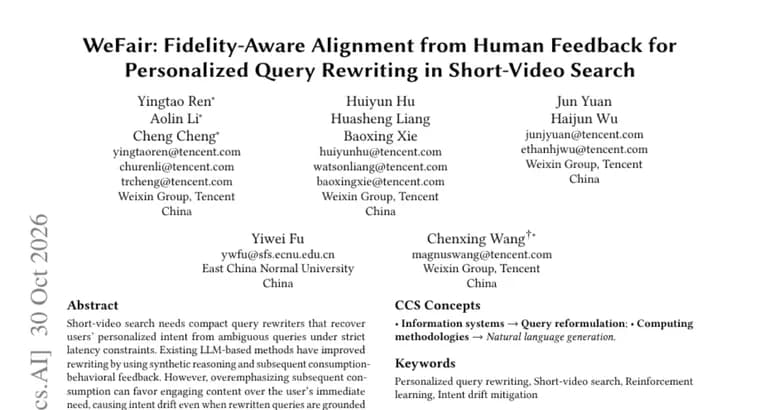
Short-video search needs compact query rewriters that can recover a user's personalized intent from an ambiguous query while meeting strict latency constraints. Existing LLM-based methods have improved rewriting by using synthetic reasoning and feedback from what users consume after searching. The paper's authors argue that this has a flaw: overemphasizing subsequent consumption can favor engaging content over the user's immediate need, causing intent drift even when the rewritten query is grounded in the user's behavioral history.
The proposed fix is WeFair, short for Fidelity-Aware Alignment from Human Feedback for Personalized Query Rewriting, built for WeChat short-video search. Its core idea is to treat human feedback differently according to how directly it reflects personalized intent. Feedback is assigned a fidelity along a progression from demonstration to preference to verification.
Training data come first. The authors mine actual queries and user reformulations from search sessions, then screen them for contextual support. Three training stages follow. In the demonstration stage, a supervised fine-tuning curriculum moves from large-scale context-to-query learning to reasoning and direct prediction on human reformulation and preservation. In the preference stage, direct preference optimization learns relative preferences from subsequent consumption feedback. In the verification stage, group relative policy optimization rewards exact agreement with reformulation or preservation targets, which is meant to constrain intent drift.
Further analysis shows two things: broad supervision benefits the full curriculum of supervised training, and strict verification achieves better performance than auxiliary rewards.
In offline experiments, WeFair-2B outperforms strong rewriting baselines in overall accuracy and intent preservation. An online A/B test shows a relative increase of 2.593% in effective video-view rate and a relative reduction of 2.350% in query reformulation rate. WeFair-2B has been deployed in the WeChat short-video search system, which serves over 100 million queries per day.
Key facts
- WeFair assigns human feedback a fidelity by how directly it reflects personalized intent: demonstration, then preference, then verification.
- Training uses supervised fine-tuning (demonstration), direct preference optimization (preference) and group relative policy optimization with exact-match rewards (verification).
- Online A/B test: relative increase of 2.593% in effective video-view rate and relative reduction of 2.350% in query reformulation rate.
- Offline, WeFair-2B beats strong rewriting baselines in overall accuracy and intent preservation.
- WeFair-2B is deployed in WeChat short-video search, a system serving over 100 million queries per day.
Why it matters
Query rewriting is how a search system turns a short, ambiguous query into what the user actually wants. The paper targets a specific failure of behavior-driven training: optimizing for what users watch next can pull a rewrite toward engaging content and away from the user's immediate need. WeFair answers by ranking feedback signals by how directly they reflect intent, and by finishing training with a strict check against reformulation or preservation targets.
Who it affects
The direct beneficiaries are users of WeChat short-video search, where the system is deployed and serves over 100 million queries per day (a system-wide figure, not WeFair's own share of traffic). The approach is also of interest to teams building compact, latency-bound query rewriters for personalized search.
How to use it
The abstract describes the recipe rather than a release. Mine real queries and user reformulations from search sessions and screen them for contextual support. Run a supervised fine-tuning curriculum on human reformulation and preservation, then direct preference optimization on subsequent-consumption feedback, then group relative policy optimization with exact-agreement rewards. No code, dataset or model release is mentioned.
How solid is it
The claims are the authors' own, from the paper's abstract. The offline result is stated only as WeFair-2B outperforming strong rewriting baselines in overall accuracy and intent preservation; no metric values or baseline names are given. The online A/B result is two relative changes (2.593% and 2.350%), and the test duration, traffic share and baseline arm are not stated. Deployment in a large production system is a point in its favor.
Risks and caveats
The meaning of "2B" and the base model are not stated. No deployment date or rollout timescale is given, and no latency figures are given despite the emphasis on strict latency constraints. The 100 million queries per day figure describes the whole search system, not WeFair-2B's own traffic. The gains are relative percentages on WeChat's own metrics, so they say little about other products or languages.