Weight-space programming study: 1,023 edited Qwen3.5 parameters give up to 29.45 points on MATH-500
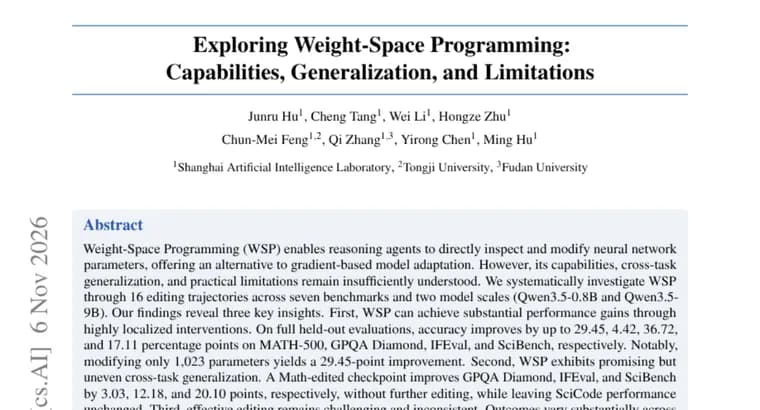
A new paper studies Weight-Space Programming (WSP), an approach in which reasoning agents directly inspect and modify a neural network's parameters, offered as an alternative to gradient-based model adaptation. The authors say its capabilities, cross-task generalization and practical limits were insufficiently understood, so they investigate it systematically: 16 editing trajectories, seven benchmarks and two model scales, Qwen3.5-0.8B and Qwen3.5-9B.
The paper reports three findings. First, WSP can deliver substantial gains through highly localized interventions. On full held-out evaluations, accuracy improves by up to 29.45 points on MATH-500, 4.42 on GPQA Diamond, 36.72 on IFEval and 17.11 on SciBench (percentage points). The headline example: modifying only 1,023 parameters yields the 29.45-point improvement. These are "up to" figures, the best outcomes reported, not averages.
Second, cross-task generalization is promising but uneven. A checkpoint edited on math, with no further editing, improves GPQA Diamond by 3.03 points, IFEval by 12.18 and SciBench by 20.10. SciCode performance stays unchanged.
Third, effective editing remains challenging and inconsistent. Outcomes vary substantially across trajectories, and six of the 16 trajectories retain the original weights when candidate improvements cannot be reliably validated.
The authors conclude that the results show WSP's potential for highly localized model adaptation while revealing important challenges in intervention discovery, reliability and cross-task transfer. The paper lists a project homepage (wsp-scope.github.io) and a GitHub repository (WSP-Scope/WSP-Scope-Project).
Key facts
- Weight-Space Programming (WSP) lets reasoning agents inspect and modify model parameters directly, as an alternative to gradient-based adaptation.
- The study covers 16 editing trajectories, seven benchmarks and two scales, Qwen3.5-0.8B and Qwen3.5-9B.
- Best-case gains on full held-out evaluations: up to 29.45 points on MATH-500, 4.42 on GPQA Diamond, 36.72 on IFEval and 17.11 on SciBench; modifying only 1,023 parameters yields the 29.45-point gain.
- A Math-edited checkpoint improves GPQA Diamond by 3.03, IFEval by 12.18 and SciBench by 20.10 points without further editing, but leaves SciCode unchanged.
- Editing is inconsistent: outcomes vary widely, and six of the 16 trajectories keep the original weights because improvements could not be reliably validated.
Why it matters
Most model adaptation today goes through gradient-based training. This paper examines a different route in which an agent reads and rewrites the weights itself, and it tries to map what that route can and cannot do. The headline result is that a very small edit, 1,023 parameters in one reported case, produced a 29.45-point gain on MATH-500. The same abstract is blunt about the other side: transfer to other tasks is uneven and the process is unreliable.
Who it affects
Mainly researchers working on model adaptation, editing and agent-driven model improvement. The experiments use small open Qwen3.5 models (0.8B and 9B), so the findings are most directly relevant to people working at that scale.
How to use it
This is a research study, not a product. The paper points to a homepage at https://wsp-scope.github.io/ and a GitHub repository at https://github.com/WSP-Scope/WSP-Scope-Project. Practitioners can treat the three findings as a map of what to test: localized edits, transfer from an edited checkpoint to neighbouring benchmarks, and validation of candidate edits before keeping them.
How solid is it
The numbers come from the paper's abstract, which reports results on full held-out evaluations. The gains are maxima across trajectories, not averages, and no mean or median gain is given. Baseline accuracies are not stated, so the gains cannot be turned into final scores. The abstract does not say which of the two model scales produced each result, including the 29.45-point MATH-500 gain and the 1,023-parameter edit.
Risks and caveats
The authors themselves call effective editing challenging and inconsistent: outcomes vary substantially across trajectories, and six of the 16 trajectories ended up keeping the original weights because gains could not be reliably validated. Generalization is uneven, with SciCode unchanged by the Math-edited checkpoint and GPQA Diamond rising only 3.03 points. The source does not compare WSP with gradient-based fine-tuning on cost or performance, and gives no compute cost or timescale for the editing process, so it cannot be read as showing WSP is better or cheaper.
“WSP exhibits promising but uneven cross-task generalization.”
— Paper abstract, Hugging Face