WildAWM pipeline builds 341 computer-use agent tasks using only open models
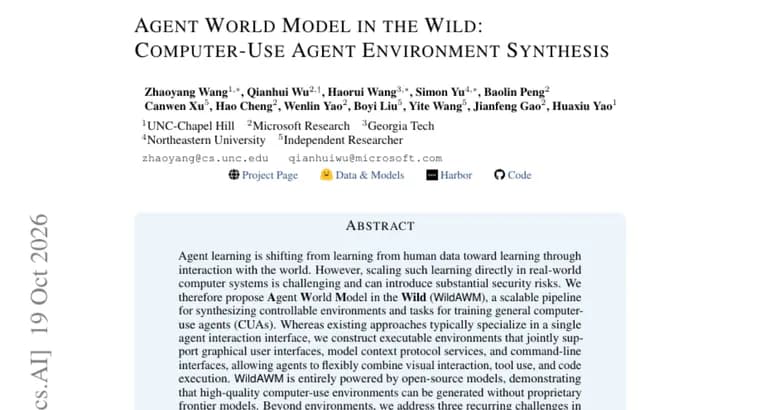
The paper introduces Agent World Model in the Wild (WildAWM), a scalable pipeline for synthesizing controllable environments and tasks for training general computer-use agents (CUAs). Its starting point is that agent learning is shifting from human data toward learning through interaction with the world, but scaling that interaction directly in real-world computer systems is challenging and can introduce substantial security risks. Synthetic worlds are the proposed way around it.
The authors contrast their work with existing approaches, which typically specialize in a single agent interaction interface. WildAWM instead builds executable environments that jointly support graphical user interfaces, model context protocol (MCP) services and command-line interfaces. That lets an agent combine visual interaction, tool use and code execution within one environment. The whole pipeline is powered by open-source models, which the authors say shows that high-quality computer-use environments can be generated without proprietary frontier models.
Beyond the environments, the paper addresses three recurring problems in task synthesis: making sure each task is solvable, keeping it sufficiently difficult, and producing reliable verifiers. The proposed fix is a set of execution-based quality gates that combine heterogeneous agent rollouts, cross-judge consistency checks and counterfactual probes of judgment robustness.
The resulting pipeline synthesizes 341 long-horizon environment-task pairs. Some can require over 100 agent steps to solve, and they remain challenging even for frontier models: GPT-6-Astra solves only 60% of them.
For the training test, the authors train two Qwen models of different sizes exclusively in these synthetic worlds. Both models achieve substantial gains across 8 out-of-distribution benchmarks spanning web, claw and computer-use agents. The authors conclude that learning in WildAWM's synthesized worlds generalizes broadly to unseen computer-use tasks. The code is publicly available on GitHub at MSR-Orchard/WildAWM.
Key facts
- WildAWM synthesizes executable environments that combine graphical interfaces, MCP services and command-line interfaces in one setting, where existing approaches typically specialize in a single interface.
- The pipeline is entirely powered by open-source models; the authors say this shows high-quality computer-use environments do not need proprietary frontier models.
- It yields 341 long-horizon environment-task pairs, some requiring over 100 agent steps; GPT-6-Astra solves only 60% of them.
- Execution-based quality gates (heterogeneous agent rollouts, cross-judge consistency checks, counterfactual probes) target solvability, difficulty and verifier reliability.
- Two Qwen models of different sizes, trained only in the synthetic worlds, show substantial gains on 8 out-of-distribution benchmarks covering web, claw and computer-use agents.
Why it matters
Training computer-use agents on real systems is hard to scale and can introduce substantial security risks, according to the authors. WildAWM offers synthetic, executable worlds as a substitute. Two points set it apart: one environment supports GUI, MCP and command-line interaction together, and the whole pipeline runs on open-source models rather than proprietary frontier ones.
Who it affects
Researchers and teams building or training general computer-use agents, especially those without access to proprietary frontier models for data generation. The code is publicly available. The work also bears on anyone concerned with the safety of letting agents learn on live computer systems.
How to use it
The code is publicly available at https://github.com/MSR-Orchard/WildAWM. The pipeline is meant to generate environments and tasks that can then be used to train computer-use agents, as the authors did with two Qwen models.
How solid is it
This is a preprint, and the claims come from the authors' own abstract. The concrete figures are 341 environment-task pairs, a 60% solve rate for GPT-6-Astra, and gains on 8 out-of-distribution benchmarks. The abstract gives no per-benchmark scores, no size of the gains and no baseline numbers for the two Qwen models. The Qwen model sizes and versions, the open-source models powering the pipeline and the names of the 8 benchmarks are not specified.
Risks and caveats
"Over 100 agent steps" is stated as what some pairs can require, not as a typical or average figure. The abstract does not compare GPT-6-Astra with the trained Qwen models, so it is unclear how the trained models stand against frontier ones. Because the size of the gains is not given, "substantial" is the authors' word and cannot be checked from the abstract. No license, release date or training cost is stated.
“WildAWM is entirely powered by open-source models, demonstrating that high-quality computer-use environments can be generated without proprietary frontier models.”
— WildAWM paper abstract