Wizard game world model offers real-time character control
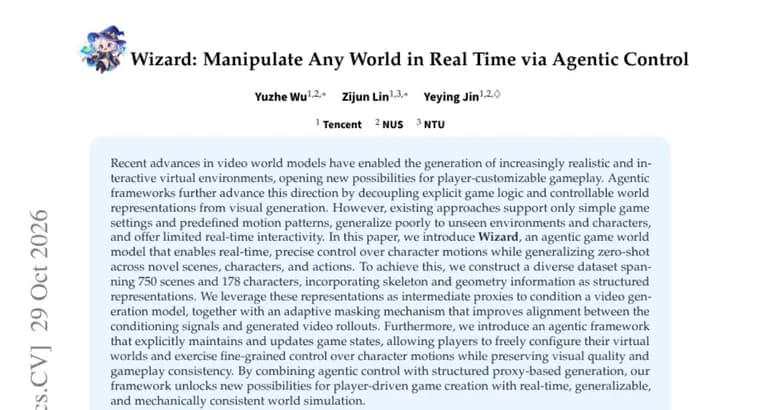
A paper titled "Wizard: Manipulate Any World in Real Time via Agentic Control" introduces Wizard, an agentic game world model.
The authors start from the state of video world models. Recent advances let them generate increasingly realistic and interactive virtual environments, which opens the door to gameplay that players can customize. Agentic frameworks push this further by separating explicit game logic and controllable world representations from the visual generation itself. But the authors argue that existing approaches support only simple game settings and predefined motion patterns, generalize poorly to unseen environments and characters, and offer limited real-time interactivity.
Wizard is presented as the answer to those gaps. According to the authors, it enables real-time, precise control over character motions while generalizing zero-shot across novel scenes, characters and actions.
The approach has three parts. First, the authors build a diverse dataset spanning 750 scenes and 178 characters, which includes skeleton and geometry information as structured representations. Second, they use those representations as intermediate proxies to condition a video generation model, together with an adaptive masking mechanism that is meant to improve alignment between the conditioning signals and the generated video rollouts. Third, they add an agentic framework that explicitly maintains and updates game states. This is meant to let players freely configure their virtual worlds and control character motions in fine detail, while keeping visual quality and gameplay consistent.
The authors conclude that combining agentic control with structured, proxy-based generation opens new possibilities for player-driven game creation, with real-time, generalizable and mechanically consistent world simulation.
Key facts
- Wizard is an agentic game world model that the authors say gives real-time, precise control over character motions.
- The authors claim zero-shot generalization across novel scenes, characters and actions.
- The authors built a dataset of 750 scenes and 178 characters, with skeleton and geometry information.
- Skeleton and geometry data act as intermediate proxies that condition a video generation model, with an adaptive masking mechanism to improve alignment with generated rollouts.
- An agentic framework explicitly maintains and updates game states so players can configure their worlds.
Why it matters
Video world models can already produce realistic, interactive environments, but the authors say current approaches are limited to simple game settings and predefined motion patterns, generalize poorly to unseen environments and characters, and offer limited real-time interactivity. Wizard targets exactly those limits. Its core idea is to split the job: an agentic layer keeps explicit game state and logic, while a video model handles the visuals, guided by skeleton and geometry proxies.
Who it affects
The paper points to player-driven game creation, where players configure their own virtual worlds and control character motions in fine detail. That makes it most relevant to researchers working on video world models and agentic game frameworks, and to anyone watching how generated games might become customizable by players.
How to use it
The text mentions no code, model or dataset release, so there is nothing to try yet. The method is described at a high level: build a dataset with skeleton and geometry information, use those as proxies to condition a video generation model with adaptive masking, and run an agentic framework that tracks and updates game states.
How solid is it
This is an abstract-level description of a research preprint. The capabilities are stated as the authors' claims: real-time control and zero-shot generalization. The text gives no benchmark results, latency or frame-rate figures, and no comparison with named baseline systems, so 'real-time' has no number attached. The only concrete figures are the dataset size: 750 scenes and 178 characters.
Risks and caveats
Treat the headline claims as unverified. The base video generation model is not named, and no evidence for the claimed precision, consistency or generalization is given in the text. The 750-scene, 178-character dataset is modest in size, and how well the approach holds up beyond it is not shown here.