World Observer video world model keeps out-of-view objects evolving
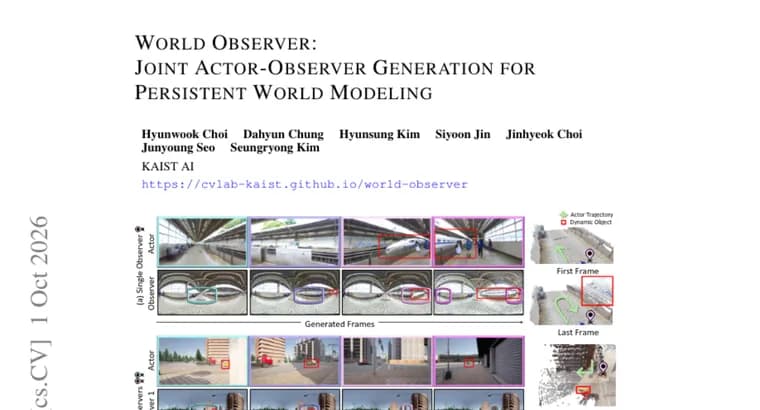
Video world models simulate how an environment evolves in response to an agent's actions, but they stay actor-centric. According to the authors, once an object leaves the actor's view, the model loses direct evidence of how it is changing, and it often fails to preserve the object's state and dynamics when it re-enters the frame.
The paper's answer is World Observer, which decouples observing from acting. It jointly generates two kinds of views: a perspective actor, which is the agent-centric view, and one or more panoramic observers that watch selected regions of the world. An object that walks out of the actor's view keeps evolving visually inside an observer, so its updated state is reflected when it comes back into view.
Two technical pieces hold this together. The actor and the observers are grounded by warping from a shared panoramic source, which gives explicit geometric correspondence between them. And an Observer Sink, a set of high-resolution perspective references, is introduced to restore fine appearance upon re-entry.
Because the observers are decoupled from the actor, they can be placed freely across the scene, extended to multiple locations for broader coverage, and driven by control signals to steer out-of-view evolution.
To measure this, the authors also introduce world-space metrics and a benchmark spanning real and synthetic scenes. They report that World Observer substantially improves out-of-view dynamics while remaining competitive in visual fidelity, camera control, and 3D adherence. The abstract does not quantify the improvement.
Key facts
- World Observer is a video world model that separates observing from acting: it generates a perspective actor view plus one or more panoramic observers watching selected world regions.
- Objects that leave the actor's view keep evolving in an observer, so their updated states show up when they re-enter.
- The actor and observers are grounded by warping from a shared panoramic source, and an Observer Sink of high-resolution perspective references restores fine appearance on re-entry.
- Observers can be placed freely, extended to multiple locations, and driven by control signals to steer out-of-view evolution.
- The authors add world-space metrics and a benchmark spanning real and synthetic scenes, and report substantially better out-of-view dynamics with competitive visual fidelity, camera control and 3D adherence.
Why it matters
Most video world models track the world only through the agent's current view. The authors say that once an object leaves that view, the model loses direct evidence of what it is doing and often fails to keep its state and dynamics consistent when it returns. World Observer targets exactly this gap by giving the model a separate place to keep watching what the actor cannot see. It also comes with its own world-space metrics and benchmark for out-of-view evolution, so the problem can be measured rather than judged by eye.
Who it affects
The paper is aimed at work on video world models that simulate an environment from an agent's actions. Researchers building or evaluating such models are the direct audience, particularly where persistence of objects outside the camera frame matters. The multi-location observers and control signals also bear on anyone who wants to steer what happens in parts of a scene the agent is not looking at.
How to use it
Only the abstract is available here. It does not describe a usable product, and the source states no code, dataset or model release. Practically, the ideas can be read as a design pattern: generate an agent-centric view together with panoramic observers tied to a shared panoramic source by warping, and keep high-resolution perspective references (the Observer Sink) to restore detail on re-entry. The new benchmark and world-space metrics are described as covering real and synthetic scenes.
How solid is it
The claims come from the authors' own abstract. They say World Observer substantially improves out-of-view dynamics while remaining competitive in visual fidelity, camera control, and 3D adherence. Note the wording: competitive, not better, on those three. The source gives no numerical results, no metric values, no named baselines and no names for the benchmark or metrics, so the size of the gain cannot be judged from this text.
Risks and caveats
The headline result, substantially improved out-of-view dynamics, is not quantified in the source. The evaluation relies on metrics and a benchmark the same authors introduced. On visual fidelity, camera control and 3D adherence the claim is only that the model stays competitive. The source states no model size, training data, architecture backbone or compute details, and no authors or affiliations are named, so independent assessment needs the full paper.
“Once an object leaves the actor's view, they lose direct evidence of its evolution, often failing to preserve its state and dynamics upon re-entry.”
— Abstract of the World Observer paper