WorldStream paper presents a 3D world model that streams terrain as you move
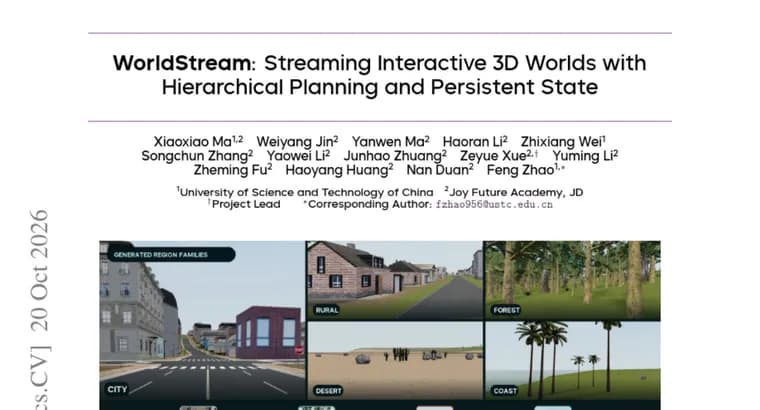
WorldStream is an open-ended 3D world model presented in a paper listed on Hugging Face Papers. The authors claim three simultaneous capabilities: it extends playable terrain beyond any pre-specified map, it acts on open-ended language in the running world, and it restores visited places with their edits.
The design starts with a hierarchical planner over a typed decision model, which emits structured decision state. The planner has two levels. Macro fixes settlement, ecology, transport and hydrological structure across a group of tiles. Micro then specializes that Macro contract into tile semantics, working under measured terrain and accepted neighbor commitments. The model does not build the geometry itself: deterministic local code compiles the accepted plans into terrain, roads, settlements, vegetation and entities.
Streaming separates how far each stage reaches. Plans run ahead along the predicted corridor of movement, compilation happens only where movement will soon need it, and geometry behind the user is released.
Persistence comes from one world record. It retains plans, seeds, object identities and mutable state, boundary commitments, and edits by attribute, and it is revised as the user advances and edits. When the user returns to a tile, that tile is recompiled from the record.
The same record grounds interaction. According to the authors, the model can act on existing entities, including stateful NPCs that update as they act. It can also edit the present region, or attach intent to unplanned regions. Taken together, the authors say, this yields a world that expands under bounded budgets, stays connected across independently planned tiles, and is interactive.
Key facts
- WorldStream is described as an open-ended 3D world model with three simultaneous capabilities: extending terrain beyond any pre-specified map, acting on open-ended language, and restoring visited places with their edits.
- A two-level hierarchical planner does the planning: Macro fixes settlement, ecology, transport and hydrological structure across a group of tiles, and Micro turns that into tile semantics under measured terrain and accepted neighbor commitments.
- Deterministic local code, not the model, compiles accepted plans into terrain, roads, settlements, vegetation and entities.
- Plans run ahead along the predicted corridor, compilation happens only where movement will soon need it, and geometry behind the user is released.
- One world record keeps plans, seeds, object identities and mutable state, boundary commitments and edits by attribute, so returning tiles recompile from it.
Why it matters
The paper targets a specific problem for generated 3D worlds: staying open-ended while remaining consistent. WorldStream's answer is to split the work. A model-driven planner decides what a region should contain, and deterministic code builds it, while a single world record remembers what was planned and edited. The authors present this as a way to get a world that grows under bounded budgets and stays connected across tiles that were planned independently.
Who it affects
The text names no authors or institutions and does not describe a product. The work is most relevant to researchers and developers working on interactive 3D world models, procedurally generated environments and game-like simulations with NPCs, where terrain has to extend as the user moves and edits have to survive a return visit.
How to use it
The text does not mention a release of code, weights or a demo, so there is nothing to try from the source alone. What a reader can take away is the architecture: a Macro and Micro planner, deterministic compilation of accepted plans, corridor-ahead streaming with release of geometry behind the user, and a persistent world record that tiles recompile from.
How solid is it
This is the authors' own description of their system, in the form of an abstract. It reports no quantitative results, benchmarks, baselines, or latency, memory or compute figures, and 'bounded budgets' is not quantified. No comparison to other world models is stated, and no user study or evaluation of interaction quality is reported. The capabilities are claims, not measured outcomes.
Risks and caveats
The underlying model type, size and training data are not specified. Without numbers, it is unclear how well the system holds up in practice, how large the budgets are, or how well independently planned tiles actually fit together. No submission or publication date is given in the text. Treat the three-capability claim as a design goal the authors say they met, pending the full paper's evidence.
“Together they yield a world expanding under bounded budgets, connected across independently planned tiles, and interactive.”
— WorldStream paper abstract