Zero-WAM learns unseen robot tasks from a human video, reaches 47% success rate
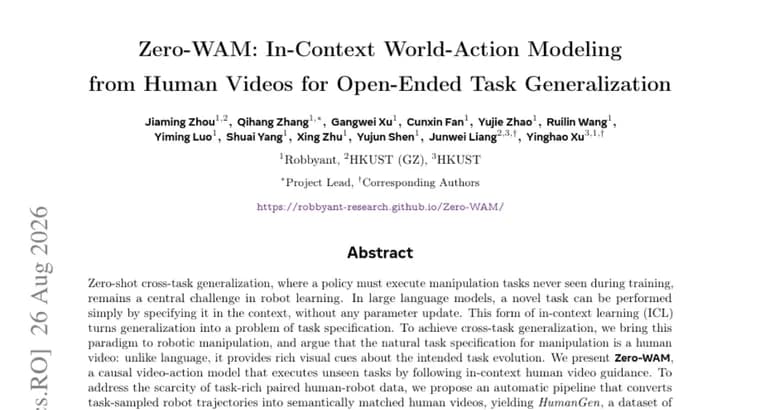
Zero-shot cross-task generalization, where a robot manipulation policy has to carry out a task it never saw during training, remains a central challenge in robot learning. Large language models handle an analogous problem through in-context learning (ICL): a new task can be performed simply by specifying it in the model's context, without any parameter update. The authors bring that paradigm to robotic manipulation and argue that a human video, not a language description, is the natural way to specify a manipulation task, because a video carries rich visual cues about how the task unfolds that words do not.
The resulting system, Zero-WAM, is a causal video-action model: shown a human video of a task in its context, it executes the task on a robot by following that video guidance. Training a model like this needs paired human and robot demonstrations of the same tasks at scale, which are scarce, so the authors built an automatic pipeline that converts task-sampled robot trajectories into semantically matched human videos. That pipeline produced HumanGen, a dataset of 74.2K human-robot in-context-learning pairs spanning 8.6K distinct manipulation tasks. The authors trained Zero-WAM on this data with a new objective they call in-context future chunk prediction (IFP), meant to stop the model from taking shortcuts it learned on tasks it has already seen and force it to pull task information from the video prompt instead.
On seven unseen tasks in the RoboTwin 2.0 simulator, Zero-WAM reaches a 47.0% average success rate, an absolute improvement of 29.5 percentage points over the strongest video-action baseline the authors tested it against. The authors also report real-world evaluations in which Zero-WAM follows human video guidance to generalize to unseen task setups, including multi-object scenes, long-horizon manipulation and fine-grained insertion. No success-rate figures are given for these real-world runs; only the RoboTwin 2.0 simulation results above are quantified.
Key facts
- Zero-WAM executes robot manipulation tasks it never saw during training by following a single human video demonstration shown in its context, bringing the in-context-learning paradigm (no parameter update) from language models to robotic manipulation.
- HumanGen, a dataset the authors built with an automatic pipeline that converts existing robot trajectories into semantically matched human videos, contains 74.2K human-robot in-context-learning pairs spanning 8.6K distinct manipulation tasks.
- Zero-WAM is trained with a new objective, in-context future chunk prediction (IFP), designed to stop the model taking shortcuts from tasks it already saw and force it to pull task information from the video shown in context.
- On seven unseen tasks in the RoboTwin 2.0 simulator, Zero-WAM reaches a 47.0% average success rate, 29.5 percentage points above the strongest video-action baseline the authors tested it against.
- In real-world tests, Zero-WAM generalizes to unseen task setups such as multi-object scenes, long-horizon manipulation and fine-grained insertion, but the abstract gives no success-rate numbers for these runs.
Why it matters
Robot manipulation systems normally need task-specific training or fine-tuning for every new task they take on. Zero-WAM's contribution is showing that a policy can instead be shown a single human video of a task, in context, and carry out that task the way a language model follows a new instruction in its prompt, with no separate training run for the new task itself. That reframes robot generalization the same way in-context learning reframed language models: from a problem of collecting more training data for every task to a problem of specifying the task well at inference time. If the approach holds up beyond the RoboTwin 2.0 simulator, it points toward cutting the amount of task-specific robot data and retraining that deploying a robot on a new task currently requires.
Who it affects
The direct audience is robotics and embodied-AI researchers working on manipulation, imitation learning and generalist robot policies, plus teams building or curating human-robot demonstration datasets, who gain both a method (the human-video-to-robot pipeline, the IFP training objective) and a new dataset, HumanGen, to build on. It also matters to teams using or building on the RoboTwin 2.0 benchmark, since that is where the headline numbers come from. There is no mention in the text of a deployed product, so end users of robots are not yet affected.
How to use it
This is a research paper, not a released product: the text does not say whether Zero-WAM's code, trained weights or the HumanGen dataset are or will be made public, so nothing here can be tried directly yet. What other teams can take from the paper right away is the method: the automatic pipeline that turns existing robot trajectories into semantically matched human videos, which avoids hand-collecting large volumes of paired human-robot demonstrations, and the in-context future chunk prediction (IFP) training objective, which is not tied to this particular dataset and could be applied to other video-conditioned robot-learning setups.
How solid is it
The headline result, a 47.0% average success rate and a 29.5-point improvement over the strongest baseline, comes from one benchmark suite, RoboTwin 2.0 simulation, on seven tasks the authors selected as unseen; the abstract does not name the baseline it is compared against, which makes the size of that gap harder to judge from the text alone. The real-world evaluations are described only qualitatively, as generalizing to multi-object scenes, long-horizon manipulation and fine-grained insertion; no success-rate figure is given for them, so the simulation gains cannot be checked against a real-world number. The paper had drawn modest attention at the time it was collected, about a dozen points and a single comment on Hugging Face, consistent with an early-stage result reaching a specialized robotics audience rather than having faced broad outside scrutiny yet.
Risks and caveats
A 47% success rate, even as a large jump over the baseline, still means the policy fails on unseen tasks more often than it succeeds, so this is an early generalization result, not a solved problem. Every quantified number in the abstract comes from a single simulator on seven tasks chosen by the authors; how Zero-WAM performs on a wider or independently chosen task set, and what its real-world success rate actually is, is not stated. The HumanGen training data was generated automatically by converting robot trajectories into matched human videos rather than collected as fully independent human demonstrations, which leaves open how closely those videos resemble the more varied human videos the system would encounter outside the pipeline that built its own training set. The text gives no information on compute cost, training time, inference speed or model size, all of which affect whether the approach is practical to run on a physical robot outside a research lab.