Zest launches AI restaurant concierge that books tables by text
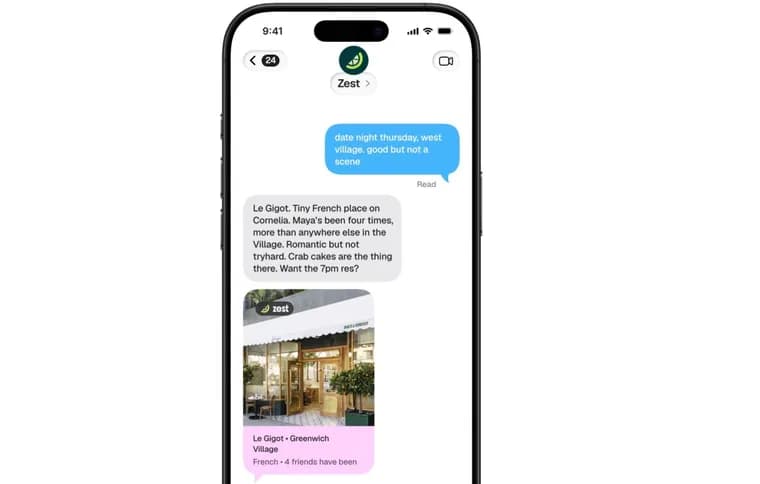
Zest, a restaurant discovery app that launched earlier this year, introduced a new feature on Thursday, according to TechCrunch: a personal AI-powered "restaurant concierge" that lives in your text messages. TechCrunch compares it to other popular AI agents such as Instinct or Poke. The idea is part of a wider shift in which conversational agents take over tasks that used to require opening a stand-alone mobile app. For Zest, that means moving its recommendations into texts and letting users book a table straight away.
Zest founder and CEO Mario Gomez-Hall puts it this way: "The agent is the product now." He says you text it, and it answers from your own history and your friends', and that it does not need weeks of conversation to learn you because it starts from where you have actually been.
That starting point is the app's distinctive feature. Zest was originally founded in November 2024 and has $1.8 million in pre-seed backing from Alexis Ohanian at 776 and Steve Jang at Kindred Ventures. It links to users' credit cards to see where they really eat out, and uses that to infer tastes and interests. From this it makes tailored suggestions, either in the user's own city or for places to try while travelling. The card data is imported via the financial services company Plaid, which banks and other fintech and budgeting apps use. Zest says it focuses only on transactions in the food and drink categories when building its personalized map and lists.
The new concierge attacks the same question, where should I go to eat, from a different angle. Suggestions now arrive inside a text thread, and the AI can check availability and make the reservation through connected services such as OpenTable, Resy and SevenRooms. Users text the concierge at (212) 470-6067.
Zest can also be dropped into a group chat, where it blends everyone's tastes to find places the whole group will like. It can settle indecision with an in-thread voting feature and then book a table for the group without anyone leaving the conversation. Users can ask for recommendations by cuisine, craving, occasion, dietary restrictions or neighborhood. They can also ask questions about a restaurant, such as how busy it may be or whether it has Wi-Fi, and can ask Zest to send the menu.
In TechCrunch's tests, the AI worked fairly well. It offered a list of new places matched to the tester's tastes that also fit conditions like time of day, party size and location. TechCrunch notes that finding an open table is something other apps have offered for years; the gain here is the convenience of texting back and forth about options and being told the available booking times.
The company began testing the concierge last month but held the launch until it could add booking. Over time it is considering moving Zest beyond restaurants to recommendations for businesses, shopping and more. By shifting to texts, Zest hopes to grow beyond its initial thousands of users and generate revenue. Gomez-Hall says booking and ordering are the first revenue lines: Zest books your table through OpenTable or Resy today, food ordering is coming, and there are transactions there to participate in. He adds that Zest learns your taste faster than a general assistant does, because it starts from where you have been rather than asking questions, and that this is "worth something well beyond dinner."
Key facts
- Zest introduced a text-message AI "restaurant concierge" on Thursday that recommends places and can check availability and book through OpenTable, Resy and SevenRooms.
- Recommendations draw on users' credit card history imported via Plaid; Zest says it uses only food and drink transactions.
- The concierge can join a group chat, blend members' tastes, run an in-thread vote and book a table for the group.
- Zest was founded in November 2024 and has $1.8 million in pre-seed backing from Alexis Ohanian at 776 and Steve Jang at Kindred Ventures; it has thousands of users.
- Booking and ordering are described as the first revenue lines; booking works today, food ordering is coming, and expansion beyond restaurants is only under consideration.
Why it matters
Zest is a small example of a trend TechCrunch describes: conversational AI agents taking over jobs that once needed a dedicated mobile app. Here the app's recommendations move into a text thread, and the step that follows, booking a table, happens in the same place. The pitch is that the agent starts with a head start on personalization because it reads where you have actually eaten, instead of learning you over weeks of chat. TechCrunch also points out that finding an open table is not new; the novelty is the convenience of doing it by text.
Who it affects
Diners who want a restaurant suggestion and a booking without opening an app, and groups of friends who struggle to agree on a place, since the concierge works inside a group chat and offers voting. It also touches the reservation platforms OpenTable, Resy and SevenRooms, which Zest connects to. Zest itself is a startup with thousands of users, trying to grow and earn revenue through this move.
How to use it
Text the Zest concierge at (212) 470-6067. Ask for recommendations by cuisine, craving, occasion, dietary restrictions or neighborhood, ask about a place (how busy it may be, whether it has Wi-Fi), or ask for the menu. Add Zest to a group chat to find a place that suits everyone, use the in-thread vote to decide, and have it book for the group. Food ordering is described as coming, not yet available. No pricing or fees for the concierge or bookings are stated.
How solid is it
This is TechCrunch's report of a company launch, with the CEO's statements as the main supporting voice. TechCrunch ran its own tests and says the AI worked fairly well, matching suggestions to its tastes and to conditions such as time of day, party size and location; no quantitative results are given. The user base is described only as thousands of users, and no revenue figures are given. The AI model behind the concierge is not named.
Risks and caveats
The personalization depends on linking a credit card through Plaid, which some users may be wary of; Zest says it focuses only on food and drink transactions. Revenue from booking and ordering is a stated hope, not a result, and food ordering has no stated timescale. Expansion to businesses and shopping is only being considered. The source does not say whether the concierge is available outside the US or on messaging platforms beyond text messages.
“The agent is the product now”
— Mario Gomez-Hall, Zest founder and CEO