Worldwide 1-minute grid frequency cycle linked to clock-synced UPS software
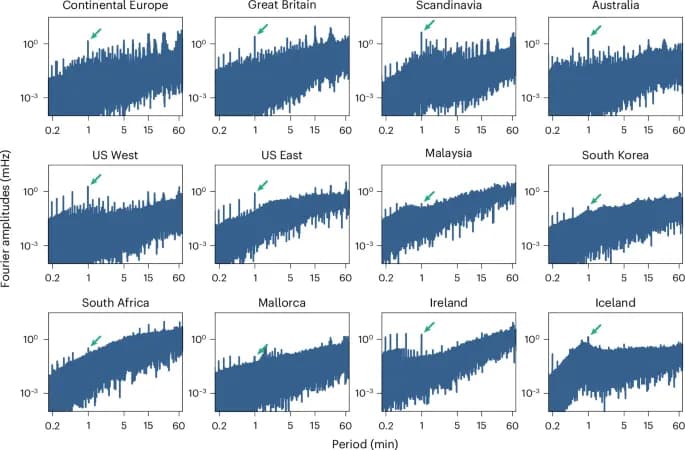
A research article published on nature.com takes on a long-unexplained feature of electricity grids: grid-frequency time series worldwide show a persistent oscillation with a period of exactly 1 minute. The authors report that clock-synchronized control software in digitally controlled energy devices, particularly uninterruptible power supplies (UPSs) and battery energy storage systems, generates periodic power-demand peaks. Those peaks propagate across voltage levels and can give rise to the observed pattern.
The authors ran a Fourier analysis of grid-frequency time series from multiple power systems. The grids span five continents and range in size from about 400,000 customers in Iceland to more than 400 million customers in the Continental European synchronous area. In every one of them they found a remarkably narrow spectral peak at exactly 1 minute. It is strongest in large interconnected systems in Europe, North America and Australia, but clearly visible in smaller grids such as Malaysia, South Korea and South Africa, and in island systems such as Mallorca, Ireland and Iceland. The peak is narrow and stays stable over multiple years, which the authors read as a precisely timed, phase-coherent process. The Continental European grid also shows pronounced peaks at 15 and 60 minutes, plus higher harmonics; the authors attribute these to electricity trading, where generation is adjusted roughly stepwise at market-interval boundaries while demand changes continuously. A weaker peak around 100 seconds also appears, and its origin remains uncertain.
To characterize the pattern, the authors split the frequency series into chunks, typically 1 hour long to remove the hourly market-induced patterns, and average each second of the minute across the chunk to get a minutely waveform. For the Continental European grid, the amplitude is weaker at night and stronger by day, while the waveform shape stays remarkably stable. Frequency is typically highest at the start of the minute and then falls, for a few seconds at night and up to half a minute in the daytime. Using the aggregated swing equation, the authors conclude that this fall implies demand exceeds generation during the first half of each minute. They argue that such long-term phase coherence is hard to square with intrinsic oscillatory modes of the power system and points instead to drivers synchronized to a stable external clock.
The authors then weigh other explanations. Oscillations near 1 minute have previously been described as ultralow-frequency oscillations and tied to resonance in hydropower turbine-governor systems. A mechanistic model of hydropower plant control in the Scandinavian grid shows an internal resonance that can produce oscillations with periods around 1 minute, and a machine-learning analysis finds systematic correlations between hydropower commitment and signal amplitude in the Continental European grid. But neither analysis supports the view that hydropower alone explains the long-term phase coherence and the reproducibility across systems. The authors' reading is that hydropower can amplify externally driven coherent disturbances, or produce transient incoherent oscillations with periods close to 1 minute. They also note earlier work linking 1-minute oscillations to periodic set-point updates in secondary frequency control, and say they see a 1-minute pattern in the secondary control set-point in German control areas.
For the cause, the authors provide empirical evidence that clock-synchronized control actions in battery-based UPSs generate periodic power-demand peaks, and they demonstrate that this signal propagates across multiple voltage levels up to the transmission interface. They stress that the mechanism is not specific to UPSs or batteries: it reflects a general property of digitally controlled devices that operate with external timing signals or periodic software routines.
The amplitude has also grown. In the British and Scandinavian grids it increased substantially after 2015, reaching peak values in 2020. The authors name reduced effective system inertia as one important factor behind the increase (the visible text cuts off mid-sentence at this point). They say the oscillation contributes to wear and tear, especially in hydropower turbines, and has motivated stricter load-frequency control requirements. They warn that the rapid expansion of battery storage, data centres and Internet-of-Things devices may further amplify such cyber-physical power oscillations, and conclude that coherent oscillations of this kind can be mitigated at their source through improved control design.
Key facts
- Grid-frequency data from grids on five continents, from Iceland (about 400,000 customers) to Continental Europe (more than 400 million), shows a narrow spectral peak at a period of exactly 1 minute.
- The authors provide empirical evidence that clock-synchronized control actions in battery-based UPSs generate periodic power-demand peaks that propagate up to the transmission interface and can give rise to the pattern.
- Hydropower resonance alone does not explain the phase coherence and cross-system reproducibility, according to the authors' mechanistic and machine-learning analyses; hydropower can amplify the disturbance.
- The amplitude rose substantially in British and Scandinavian grids after 2015, peaking in 2020, and is said to contribute to wear in hydropower turbines and to motivate stricter frequency-control requirements.
- The authors say the mechanism is general to digitally controlled devices with external timing signals, and that improved control design can mitigate the oscillation at its source.
Why it matters
A regular one-minute swing in grid frequency, seen across continents and left unexplained, now has a proposed cause: many devices running software on the same clock. The authors frame this as a class of cyber-physical power oscillations driven by externally synchronized control software, not a quirk of one device type. They say the effect has grown over recent years, contributes to wear and tear in hydropower systems, and has already pushed some operators toward stricter load-frequency control requirements. Earlier explanations centred on hydropower resonance; this work argues that such resonance cannot explain the pattern's long-term phase coherence on its own.
Who it affects
Grid operators and frequency-control engineers face the oscillation directly, as do hydropower operators, whose turbines the authors say suffer wear and tear. Makers and operators of UPSs, battery energy storage systems and other digitally controlled devices are the group whose control software the authors point to. The article also names the growth of battery storage, data centres and Internet-of-Things devices as a trend that may further amplify such oscillations. The pattern is visible in grids from large interconnected systems in Europe, North America and Australia to small and island systems.
How to use it
This is a research finding, not a product or tool. The practical takeaway the authors draw is that coherent cyber-physical oscillations can be mitigated directly at their source through improved control design. The visible text does not say what specific control-design changes are required or on what timescale. Engineers can take from it that software routines timed to a shared external clock, such as a minute boundary, are a possible source of coherent demand peaks across many devices.
How solid is it
The evidence is empirical and multi-part: Fourier analysis of frequency data from multiple grids, a stable waveform over multiple years, a mechanistic hydropower model, a machine-learning analysis, and measurements tying UPS control actions to demand peaks that propagate to the transmission interface. The wording is careful, though. The authors say the UPS and battery mechanism can give rise to the pattern; they do not claim it is the sole or fully proven cause, and they concede that hydropower and secondary frequency control may play a role. Part of the spectrum also remains unexplained: a weaker peak near 100 seconds has an uncertain origin. The visible text names no specific UPS or battery manufacturer and gives no numeric amplitude for the oscillation.
Risks and caveats
The authors warn the problem may get worse as battery storage, data centres and Internet-of-Things devices spread, since the mechanism is general to any digitally controlled device using external timing signals or periodic software routines. Lower effective system inertia is named as one important factor in the amplitude increase, making grids more sensitive to coherent power imbalances. On the evidence side, the visible text gives no quantified damage costs, outages or hydropower plant failures, and was truncated before the Methods and later sections, so details of the UPS measurements are not available here.
“Such long-term coherence is difficult to reconcile with intrinsic oscillatory modes of the power system and instead points to drivers synchronized to a stable external clock.”
— From the research article on nature.com