ZipTok3D reconstructs a 3D shape using as few as one token
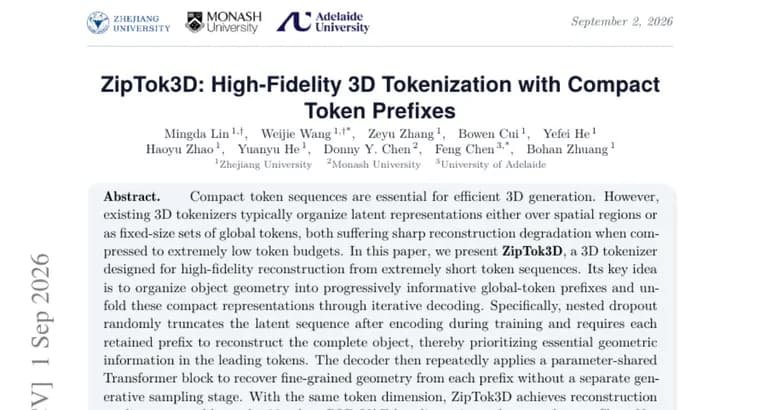
Researchers have introduced ZipTok3D, a 3D tokenizer built to keep reconstruction quality high even when the token budget is pushed to an extreme minimum. Compact token sequences matter for efficient 3D generation, but the authors argue that existing 3D tokenizers share a common failure mode: whether they spread a shape's latent representation across spatial regions or pack it into a fixed-size set of global tokens, both approaches suffer sharp reconstruction degradation once compressed to very low token counts.
ZipTok3D's core idea is to arrange an object's geometry into global-token prefixes ordered by how much information each one carries, then unfold those compact prefixes through iterative decoding. During training, a technique called nested dropout randomly truncates the latent token sequence after encoding and requires every retained prefix, however short, to reconstruct the complete object; that forces the model to pack the most essential geometric information into the leading tokens instead of spreading it evenly across the sequence. On the decoding side, a single parameter-shared Transformer block is applied repeatedly to recover fine-grained geometry from whichever prefix it is given, with no separate generative sampling stage needed.
At the same token dimension, ZipTok3D reaches reconstruction quality comparable to a 32-token COD-VAE baseline while using only one token on the ShapeNet benchmark and four tokens on TRELLIS, sequences 32× and 8× shorter than the baseline respectively.
Key facts
- ZipTok3D is a 3D tokenizer built to avoid the sharp reconstruction degradation that existing tokenizers show once compressed to very low token budgets.
- It orders an object's geometry into global-token prefixes ranked by importance; a training technique called nested dropout requires every retained prefix, however short, to reconstruct the complete object.
- Decoding reuses a single parameter-shared Transformer block repeatedly on each prefix, recovering fine geometric detail without a separate generative sampling stage.
- At the same token dimension, ZipTok3D reaches reconstruction quality comparable to a 32-token COD-VAE baseline while using only 1 token on ShapeNet and 4 tokens on TRELLIS.
- That is a 32× shorter token sequence on ShapeNet and an 8× shorter one on TRELLIS than the COD-VAE baseline.
Why it matters
Token budget is a practical bottleneck for 3D generation: the fewer tokens a shape needs, the cheaper and faster it is to generate, store and move through a pipeline. The authors argue that existing 3D tokenizers, whether they spread a shape's representation across spatial regions or pack it into a fixed set of global tokens, both suffer sharp reconstruction degradation once the token budget is pushed to an extreme low. ZipTok3D targets exactly that failure point: ordering geometric information into progressively informative prefixes and unfolding it through iterative decoding lets the tokenizer hold onto high-fidelity reconstruction even from a handful of tokens, which is the difference between a technique that only works at moderate compression and one that survives compression 8 to 32 times more aggressive.
Who it affects
This is a research contribution aimed at people building 3D generative pipelines: teams working on text-to-3D or image-to-3D generation, 3D asset creation for games, simulation or AR/VR, and anyone whose system has to store or transmit large numbers of 3D objects as compact tokens. The source text names no company, product or deployment, so the immediate audience is other researchers and engineers evaluating tokenizer architectures rather than end users of a finished product.
How to use it
This is a tokenizer architecture from a research paper, so applying it means adopting the method rather than downloading a finished tool. A team building a 3D generation pipeline could use ZipTok3D's prefix-ordered token layout and its repeated, parameter-shared decoder block as the compression stage, calling for as few as one token per object on ShapeNet-style data or four on TRELLIS-style data while keeping reconstruction quality comparable to a 32-token baseline. That directly cuts how much has to be stored, transmitted or generated per object.
How solid is it
The comparison rests on one named baseline, the 32-token COD-VAE tokenizer, evaluated on two benchmarks, ShapeNet and TRELLIS; the source text names all three only as the baseline and the datasets, with no further description of what they contain or how the comparison was run. The paper describes the resulting reconstruction quality as comparable to that baseline at one token and four tokens respectively, but it does not attach a quantified metric such as PSNR, IoU or Chamfer distance to that claim, so what is on record is a qualitative comparison plus the token counts, not a hard number showing how close the two actually are.
Risks and caveats
The source text does not name individual authors or institutions behind the work, and it gives no publication or submission date; the crawled author metadata is submission metadata, not a claim made in the article text itself. It also gives no detail on training data, compute cost, inference speed or model size, so there is no way from this text alone to judge how expensive ZipTok3D is to train or run, or how it was validated beyond the two named benchmarks.