ABot-Recon cuts long-horizon 3D reconstruction error using only local context
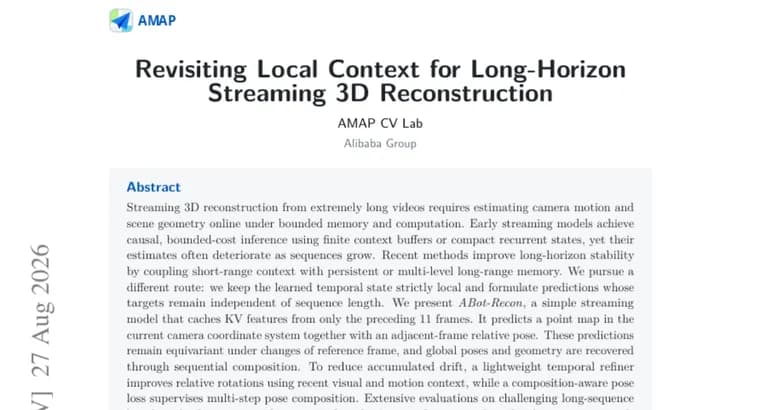
A paper on Hugging Face's papers feed presents ABot-Recon, a streaming 3D reconstruction model built to handle extremely long videos: it estimates camera motion and scene geometry online, frame by frame, under bounded memory and compute. The authors note that earlier streaming models already achieve this kind of causal, bounded-cost inference through finite context buffers or compact recurrent states, but their accuracy typically deteriorates as the video sequence grows longer. The more recent trend has been to fix this by pairing short-range context with persistent or multi-level long-range memory that accumulates information across the whole sequence.
ABot-Recon takes the opposite route. Its learned temporal state stays strictly local: the model caches key-value (KV) features from only the preceding 11 frames, with no long-range memory bank at all. At each step it predicts a point map expressed in the current camera's own coordinate system, together with the relative pose between adjacent frames. Because these predictions are defined relative to the current frame rather than to a fixed global frame, they remain equivariant under changes of reference frame; the model recovers global poses and scene geometry by sequentially composing these local, frame-to-frame predictions rather than tracking a single running global state.
To limit the drift that this kind of sequential composition can accumulate over a long video, the authors add two components: a lightweight temporal refiner that improves relative rotation estimates using recent visual and motion context, and a composition-aware pose loss that directly supervises how well multi-step pose composition holds up. On the Oxford Spires benchmark, a challenging long-sequence test, ABot-Recon reaches an Absolute Trajectory Error (ATE) of 4.35 m and a rotation Relative Pose Error (RPE-R) of 0.12 degrees, which the authors report as roughly a 40% reduction in both metrics relative to the best prior results. The text does not name the institution or authors behind the work beyond the single listed author, does not identify which prior methods that 40% figure is measured against, and names only Oxford Spires among the 'challenging long-sequence benchmarks' its evaluations are said to cover.
Key facts
- ABot-Recon caches KV features from only the preceding 11 frames, keeping its temporal state strictly local instead of relying on persistent or multi-level long-range memory.
- It predicts a point map in the current camera's own coordinate system plus the adjacent-frame relative pose; these stay equivariant under reference-frame changes, and global poses and geometry are recovered by composing them sequentially.
- A lightweight temporal refiner improves relative rotations from recent visual and motion context, and a composition-aware pose loss supervises multi-step pose composition, both aimed at curbing accumulated drift.
- On the Oxford Spires benchmark, ABot-Recon achieves an ATE of 4.35 m and an RPE-R of 0.12 degrees, about a 40% reduction on both metrics relative to the best prior results.
- The text does not name the prior methods behind that 40% baseline, the paper's institution or full author list, or how many benchmarks beyond Oxford Spires its 'extensive evaluations' covered.
Why it matters
Most recent work on long streaming video has chased better long-horizon stability by adding memory: persistent or multi-level stores that accumulate context across an entire sequence. ABot-Recon tests the opposite bet, that a strictly local, fixed-size context (just the last 11 frames) combined with predictions that do not depend on sequence length can match or beat that trend on long-sequence accuracy. If a bounded local window is enough, that is a simpler, more predictable design for real-time reconstruction than growing memory banks.
Who it affects
This is a research result aimed at people building streaming 3D reconstruction, visual SLAM, or camera-tracking pipelines for long or continuous video, the kind of workload behind robotics navigation, AR/VR tracking, and drone or vehicle mapping. It is not a consumer-facing product or tool.
How to use it
The source is a paper listing on Hugging Face's papers feed. It describes the method and its benchmark results but does not state whether code, model weights, or a dataset have been released, and does not mention pricing or licensing.
How solid is it
The claims rest on quantitative results on one named long-sequence benchmark, Oxford Spires, where ABot-Recon posts a 4.35 m ATE and 0.12 degree RPE-R, about 40% lower than the best prior results on both. The text calls its evaluations 'extensive' and covering 'challenging long-sequence benchmarks' in the plural, but names only Oxford Spires and does not identify the prior methods the 40% improvement is measured against, so the comparison cannot be checked from the text alone.
Risks and caveats
The text does not name the institution, lab, or funding source behind the work, nor a paper venue, arXiv identifier, or full author list beyond the page's single listed author. It gives no definition or duration for 'extremely long videos' or 'long-horizon' beyond the 11-frame cache window, and does not say how many benchmarks its evaluations actually covered. Treat the 40% figure as the authors' own comparison against unnamed prior results until independently checked.