EdgeWise lets a small local model hand hard agent steps to a cloud LLM
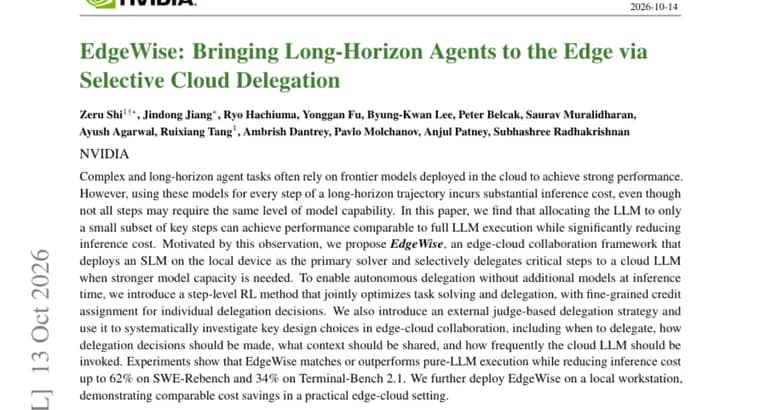
Long-horizon agent tasks usually lean on frontier models in the cloud. Running such a model on every step of a long trajectory is expensive, even though not every step needs that much capability. The paper behind EdgeWise starts from an observation: giving the large model only a small subset of key steps can reach performance comparable to full LLM execution, while cutting inference cost significantly.
Building on that, the authors propose EdgeWise, an edge-cloud collaboration framework. A small language model (SLM) sits on the local device and acts as the primary solver. When it needs stronger model capacity, it delegates the critical steps to a cloud LLM.
To let the system decide on delegation by itself, without any additional models running at inference time, the authors introduce a step-level reinforcement learning method. It optimizes task solving and delegation jointly, and it uses fine-grained credit assignment so that each individual delegation decision gets its own signal.
The authors also introduce a separate, external judge-based delegation strategy. They use it to study design choices in edge-cloud collaboration in a systematic way: when to delegate, how delegation decisions should be made, what context should be shared with the cloud model, and how often the cloud LLM should be invoked.
On results, the abstract says EdgeWise matches or outperforms pure-LLM execution while reducing inference cost by up to 62% on SWE-Rebench and 34% on Terminal-Bench 2.1. Both reductions are relative to the cost of running the LLM alone. Finally, the authors deployed EdgeWise on a local workstation and report comparable cost savings in a practical edge-cloud setting.
Key facts
- EdgeWise puts a small language model on the local device as the primary solver and delegates only critical steps to a cloud LLM.
- A step-level RL method jointly trains task solving and delegation, with fine-grained credit assignment per delegation decision, so no extra model is needed at inference time.
- Reported inference cost reduction versus pure-LLM execution: up to 62% on SWE-Rebench and 34% on Terminal-Bench 2.1, while matching or outperforming it.
- An external judge-based delegation strategy is used to study when to delegate, how to decide, what context to share and how often to call the cloud model.
- The authors also ran EdgeWise on a local workstation and report comparable cost savings.
Why it matters
Agents that work through long sequences of steps can get costly when a frontier cloud model handles every one of them. The paper's central finding is that the large model is needed for only a small subset of key steps to keep performance comparable to full LLM execution. If that holds up, the expensive model becomes a specialist called in at critical moments, and a small local model carries the rest of the work.
Who it affects
The framing is aimed at teams running long-horizon agents on tasks like software engineering and terminal work, where cloud inference bills grow with trajectory length. It is also relevant to anyone interested in splitting work between a local device and a cloud model. The abstract names no authors or institutions.
How to use it
The abstract describes a method rather than a product. A small model on the local device works as the main solver, and a trained policy decides when to call the cloud LLM. The authors say this delegation is learned with step-level RL, so no additional model is needed at inference time. Their judge-based strategy is a separate, external option used to study the design questions of timing, decision method, shared context and call frequency. No code or model release is mentioned.
How solid is it
The claims come from the paper's own abstract, which reports experiments on SWE-Rebench and Terminal-Bench 2.1 plus a local workstation deployment. The 62% figure is stated as 'up to', and the abstract does not say which configuration or setup produced it, nor how cost is measured. No absolute task-success or accuracy figures are given for either benchmark. No specific models are named for the SLM or the cloud LLM. The workstation savings are only called 'comparable', with no figure.
Risks and caveats
The headline numbers are best-case and relative to pure-LLM cost: 62% is a ceiling on one benchmark, and the other benchmark shows 34%. The abstract does not describe the workstation hardware, so how far the practical setting generalizes is unclear. Without the models and absolute success rates, it is hard to judge how much capability is actually preserved. The preprint should be read as authors' reported results, not independent confirmation.
“allocating the LLM to only a small subset of key steps can achieve performance comparable to full LLM execution while significantly reducing inference cost”
— EdgeWise paper abstract