3DCodeVerse introduces a 3D code dataset and multi-agent harness for coding agents
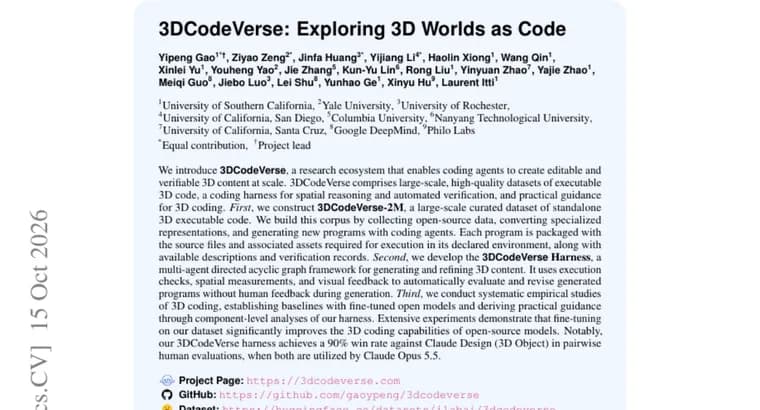
The paper introduces 3DCodeVerse, which the authors describe as a research ecosystem that lets coding agents create editable and verifiable 3D content at scale. It has three parts: large-scale datasets of executable 3D code, a coding harness for spatial reasoning and automated verification, and practical guidance for 3D coding.
The first part is 3DCodeVerse-2M, a large-scale curated dataset of standalone 3D executable code. The authors build the corpus in three ways: collecting open-source data, converting specialized representations, and generating new programs with coding agents. Each program is packaged with the source files and assets needed to run it in its declared environment, along with available descriptions and verification records.
The second part is the 3DCodeVerse Harness, a multi-agent directed acyclic graph framework for generating and refining 3D content. It relies on execution checks, spatial measurements and visual feedback to evaluate and revise generated programs automatically, with no human feedback during generation.
The third part is a set of systematic empirical studies of 3D coding. The authors establish baselines with fine-tuned open models and derive practical guidance from component-level analyses of the harness.
On results, the authors say extensive experiments show that fine-tuning on their dataset significantly improves the 3D coding capabilities of open-source models. They also report that the harness achieves a 90% win rate against Claude Design (3D Object) in pairwise human evaluations, when both are run on Claude Opus 5.5. That 90% is an absolute win rate in head-to-head human comparisons, not a relative improvement.
Key facts
- 3DCodeVerse is presented as a research ecosystem for coding agents to create editable, verifiable 3D content, combining a dataset, a harness and empirical studies.
- The dataset, 3DCodeVerse-2M, is built from open-source data, converted specialized representations and programs newly generated by coding agents; each program ships with its source files, assets and available descriptions and verification records.
- The 3DCodeVerse Harness is a multi-agent directed acyclic graph framework that checks and revises programs using execution checks, spatial measurements and visual feedback, without human feedback during generation.
- The authors report that fine-tuning open-source models on the dataset significantly improves their 3D coding capabilities.
- With both systems run on Claude Opus 5.5, the harness wins 90% of pairwise human evaluations against Claude Design (3D Object).
Why it matters
Most code-generation work targets text and software; this paper aims at 3D content that is written as executable code, so the result stays editable and can be checked. The authors pair three things that are usually separate: a large curated corpus of runnable 3D programs, an agent harness that verifies its own output with spatial measurements and visual feedback, and empirical studies meant to give practical guidance. The headline result is a 90% win rate in pairwise human evaluations against Claude Design (3D Object), with both run on Claude Opus 5.5.
Who it affects
Researchers and engineers building coding agents for 3D generation are the direct audience, along with anyone training or fine-tuning open models on 3D code. The paper reports baselines with fine-tuned open models, so open-model groups have a reference point. The abstract does not describe end-user products.
How to use it
The paper offers three things to work with: the 3DCodeVerse-2M dataset for fine-tuning, the multi-agent harness for generating and refining 3D content, and guidance derived from component-level analyses of that harness. The source does not state whether the dataset, harness or models are publicly released, nor any license or code link, so access is unconfirmed.
How solid is it
The claims come from the authors' own abstract, so they are self-reported. The 90% figure is a win rate from pairwise human evaluations, with both systems run on Claude Opus 5.5. The number of human raters, the number of comparisons and the evaluation prompts are not given. The abstract gives no size of improvement from fine-tuning, and no names or sizes of the open models fine-tuned.
Risks and caveats
No exact number of programs in 3DCodeVerse-2M is stated; only the name contains "2M". The abstract does not say who makes Claude Design (3D Object) or describe it beyond the name, so the comparison is hard to interpret on its own. The abstract names no authors or institutions. Without release details, results cannot be reproduced from the abstract alone.
“fine-tuning on our dataset significantly improves the 3D coding capabilities of open-source models”
— 3DCodeVerse paper abstract