ACE lens organizes how LLM agent training data gets generated
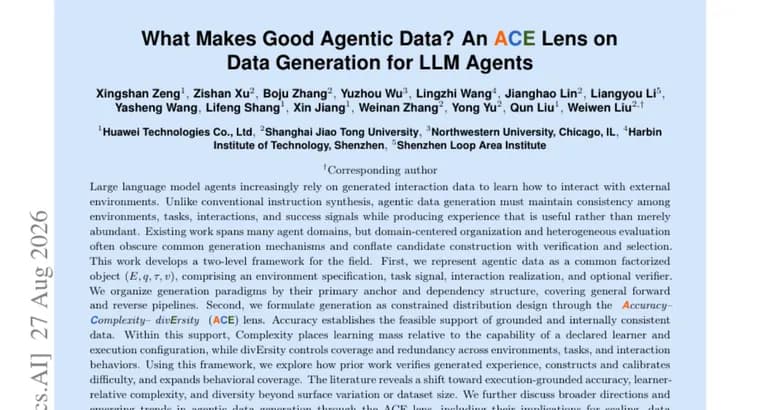
LLM agents increasingly rely on generated interaction data to learn how to interact with external environments. Agentic data generation, the authors write, must maintain consistency among environments, tasks, interactions, and success signals, while producing experience that is useful rather than merely abundant. Existing work on producing this data spans many different agent domains, but its domain-centered organization and differing evaluation approaches often obscure the generation mechanisms most of these methods actually share, and blur together two steps that get treated as one: building candidate data in the first place, and then verifying and selecting which of it is good enough to use. This paper sets out to fix that by developing a two-level framework for the field as a whole.
The first level is a common representation of what a piece of agentic data actually is. The authors factor it into four parts, written as the object (E, q, τ, v): an environment specification, a task signal, an interaction realization, and an optional verifier. Rather than sorting existing data-generation methods by the agent domain they target, the paper sorts them by which of these four elements they anchor on first, and by how the elements depend on one another.
The second level reframes generating data as what the authors call constrained distribution design, viewed through the Accuracy-Complexity-divErsity lens, or ACE for short. Accuracy establishes the feasible support: the grounded, internally consistent data that is valid to use at all. Within that support, Complexity places the learning mass relative to the capability of a declared learner and its execution configuration. Diversity, the third axis, then controls how much coverage the data provides and how redundant it is.
Using the ACE lens, the authors survey how prior work has verified generated interaction data, calibrated its difficulty, and expanded the range of behavior it covers. They report that the literature has shifted toward execution-grounded accuracy, learner-relative complexity, and diversity defined beyond surface-level variation or dataset size.
The paper closes by discussing broader directions and emerging trends in agentic data generation through the same ACE lens, including implications for scaling, data sources, training regimes, and adaptive learning. Its central argument is that the challenge is not simply to generate more data, but to continually allocate experience that is valid, informative, and non-redundant as agents and environments evolve.
Key facts
- The paper represents agentic data as a shared factorized object made of four parts, an environment specification, a task signal, an interaction realization, and an optional verifier, and groups existing data-generation methods by which of these four elements they anchor on.
- It reframes data generation as constrained distribution design through the Accuracy-Complexity-divErsity (ACE) lens: accuracy sets which data is valid and internally consistent at all, complexity places learning mass relative to a specific declared learner and its execution configuration, and diversity governs coverage and redundancy.
- Surveying prior work through this lens, the authors report a shift toward execution-grounded accuracy, learner-relative complexity, and diversity defined beyond surface-level variation or dataset size.
- The paper is a conceptual, organizing framework built on a synthesis of prior literature; it reports no new experiments, benchmark scores, or evaluation numbers of its own.
- The authors frame the central challenge as continually allocating valid, informative, non-redundant experience as agents and their environments evolve, not simply producing more data.
Why it matters
LLM agents increasingly learn from data generated specifically for them, and that line of work has grown large but stayed fragmented across many separate agent domains. Domain-centered organization and differing evaluation approaches, the authors argue, often obscure the generation mechanisms most of these methods actually share, and blur together two things that get treated as one: building candidate data and then verifying and selecting which of it is good enough to use. This paper's contribution is a shared vocabulary and evaluation lens that cuts across that fragmentation: a common factorized representation of what a piece of agentic data is, plus a three-axis lens, accuracy, complexity, and diversity, for judging whether a generation method is producing something useful rather than just producing more of it.
Who it affects
Researchers and engineering teams who build pipelines that generate interaction data for training LLM agents, whatever specific domain they work in (the text names no particular domains as examples). The factorized object gives them a shared way to categorize an existing pipeline by which of its four elements, environment, task, interaction, or verifier, it anchors on, and the ACE lens gives them three separate questions, on accuracy, complexity, and diversity, to check that pipeline against, instead of a different evaluation standard for every domain.
How to use it
There is no product, tool, or dataset release described here: the contribution is a way of organizing and evaluating data-generation work, not software. A team building a data-generation pipeline for LLM agents can use the factorized object, environment, task, interaction, and optional verifier, to see which of those four elements its own method actually builds from, then apply the ACE lens as three separate checks: is the resulting data grounded and internally consistent (accuracy), is its difficulty calibrated to the specific learner that will train on it (complexity), and does it add real coverage rather than near-duplicate examples (diversity).
How solid is it
This is a framework and literature-synthesis paper, not a report of new experiments: it presents no benchmark results or empirical scores of its own, and its contribution is the organizing scheme itself plus a reading of prior work through it. The claimed shift toward execution-grounded accuracy, learner-relative complexity, and diversity defined past surface variation is presented as an observation from surveying that prior literature, not as a claim the authors tested themselves. The text names no individual authors, institution, or publication venue, so those specifics cannot be confirmed here.
Risks and caveats
The text gives no concrete examples of the agent domains, environments, or datasets the framework is meant to cover, so how well the factorization and the ACE lens hold up outside the cases surveyed cannot be checked from this text alone. It is a conceptual synthesis rather than an empirical study, so none of its claims come with benchmark scores or evaluation numbers attached, and the text does not say whether any code or dataset accompanies the framework.
“the central challenge is not simply to generate more data, but to continually allocate valid, informative, and non-redundant experience as agents and environments evolve”
— the authors