WikiSkill turns AI agent experience into a persistent shared wiki
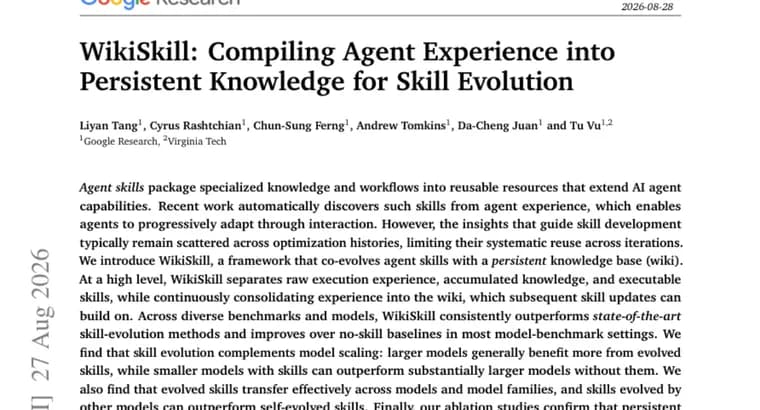
Researchers have introduced WikiSkill, a framework that lets an AI agent's skills evolve together with a persistent knowledge base, built as a wiki, rather than treating each skill-discovery run as a one-off. Agent skills are reusable packages of specialized knowledge and workflows that extend what an AI agent can do, and recent methods already let agents discover such skills automatically from their own experience, adapting as they interact with tasks. The gap WikiSkill targets is that the insights behind those skill updates usually stay scattered across separate optimization histories, so they cannot be systematically reused across iterations.
WikiSkill's design keeps three things distinct: the raw execution experience an agent generates while working, the accumulated knowledge that experience produces, and the executable skills built from that knowledge. Experience is continuously consolidated into the wiki, and each new round of skill updates builds on what is already stored there rather than starting over.
Across a range of benchmarks and models, the authors report that WikiSkill consistently outperforms state-of-the-art skill-evolution methods and improves over baselines that use no skills at all in most model-benchmark combinations. They also find that skill evolution complements rather than substitutes for model scaling: larger models generally gain more from evolved skills, while smaller models equipped with skills can outperform substantially larger models that lack them. Skills evolved on one model transfer effectively to other models and model families, and in some cases skills evolved by a different model outperform a model's own self-evolved skills. Ablation studies confirm that the persistent knowledge accumulation in the wiki, not just the skill set itself, is what drives the improvement: removing that persistent layer degrades the effect.
Key facts
- WikiSkill co-evolves AI agent skills with a persistent wiki that stores accumulated knowledge, separate from raw execution experience and from the executable skills themselves.
- The framework consistently outperforms state-of-the-art skill-evolution methods and beats no-skill baselines in most model-benchmark settings tested.
- Skill evolution complements model scaling: larger models benefit more from evolved skills, and smaller models with skills can outperform much larger models without them.
- Skills evolved on one model transfer effectively to other models and model families, sometimes outperforming a model's own self-evolved skills.
- Ablation studies show the persistent knowledge accumulation in the wiki, not the skills alone, is critical to the gains.
Why it matters
Most agent-skill approaches so far let an agent discover reusable workflows from its own experience, but the reasoning behind why a skill got refined a certain way tends to get lost once the optimization run ends. WikiSkill's contribution is architectural: by keeping a standing wiki that accumulates knowledge across iterations, and separating that knowledge from both raw experience and the compiled skills, the system gives future skill updates something durable to build on instead of starting from scratch each time.
Who it affects
The work targets people building and researching AI agents, particularly anyone relying on automatic skill discovery to make agents better at repeated task types. The transfer result, that skills evolved by one model can help another model and even outperform that model's own self-evolved skills, matters to teams running multiple models or swapping models over time, since it suggests accumulated skill knowledge does not have to be rebuilt from zero for each new model.
How to use it
The paper describes WikiSkill as a framework tested across diverse benchmarks and models rather than a shipped product with pricing or a release date; no such details are given in the source material. The practical takeaway for teams building agent systems is architectural: maintain a persistent, continuously updated knowledge store alongside skill discovery, rather than letting the reasoning behind skill updates disappear at the end of each optimization run.
How solid is it
The claims come from the authors' own reported results across what they describe as diverse benchmarks and models, including ablation studies isolating the contribution of the persistent wiki specifically. The source text does not name the benchmarks, the models, or give numeric performance figures, so the size of the improvement cannot be independently gauged from what is available here.
Risks and caveats
The source material does not identify the paper's authors, institutions, specific benchmarks, models used, or any numeric results, which limits how far the claims can be checked without going to the full paper. As with any self-reported comparison against prior skill-evolution methods, the framing of what counts as a fair baseline is set by the authors themselves.
“These results demonstrate the benefits of systematically accumulating and refining agent experience for developing reusable and transferable skills.”
— the researchers