ActReview trains an 8B model to write actionable peer reviews
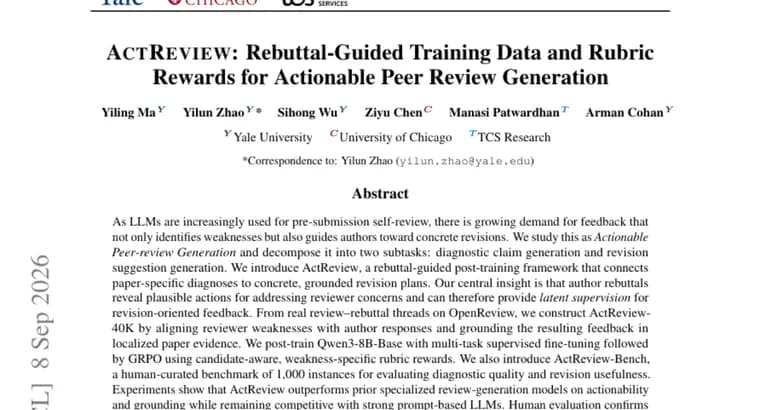
As more authors use large language models to self-review drafts before submission, a team of researchers built ActReview, a post-training framework aimed at making that feedback more useful. They split the problem into two subtasks: generating a diagnostic claim about a weakness in a paper, and generating a concrete suggestion for how to revise it. Their central insight is that author rebuttals on peer-review platforms already contain plausible fixes for the concerns reviewers raise, so those rebuttals can serve as a hidden source of supervision for training a model to give revision-oriented feedback rather than just criticism.
To build the training data, the researchers mined real review-rebuttal threads from OpenReview, aligning each reviewer's stated weakness with the author's actual response and grounding the resulting feedback in specific evidence from the paper text. The resulting dataset, ActReview-40K, contains 40,000 examples built this way. They then post-trained Qwen3-8B-Base in two stages: multi-task supervised fine-tuning, followed by GRPO (a reinforcement learning method) using rubric-based rewards that are candidate-aware and specific to each weakness being addressed.
To evaluate the approach, the team also introduced ActReview-Bench, a benchmark of 1,000 human-curated instances for judging both diagnostic quality and how useful the suggested revisions actually are. According to the authors, ActReview beats prior specialized review-generation models on actionability and grounding, while staying competitive with strong general-purpose prompted LLMs. A human evaluation backed this up on revision usefulness specifically, though it also surfaced a remaining gap in technical accuracy that the paper does not further detail. The authors report that additional analyses support the model generalizing to papers it was not trained on and staying robust across different human judges used to score it.
Key facts
- ActReview is a rebuttal-guided post-training framework for generating actionable peer-review feedback, split into diagnostic claim generation and revision suggestion generation.
- Training data (ActReview-40K, 40,000 examples) is built by aligning reviewer-stated weaknesses with actual author rebuttals from OpenReview threads, grounded in specific paper evidence.
- The base model, Qwen3-8B-Base, is post-trained with multi-task supervised fine-tuning followed by GRPO using weakness-specific rubric rewards.
- A new benchmark, ActReview-Bench, evaluates the approach on 1,000 human-curated instances covering diagnostic quality and revision usefulness.
- The authors report ActReview outperforms prior specialized review-generation models on actionability and grounding while remaining competitive with strong prompted LLMs, though human evaluation found a remaining gap in technical accuracy.
Why it matters
Peer review increasingly gets a first pass from LLMs, both as authors self-checking drafts and as reviewers drafting feedback, but most of that feedback stops at pointing out problems. ActReview targets the harder half of the job: turning a diagnosed weakness into a concrete plan for fixing it, using a training signal (author rebuttals) that already exists in public review archives but had not been used this way.
Who it affects
The work is aimed at researchers and platforms building AI-assisted review or self-review tools, and by extension at paper authors and conference reviewers who might eventually use such tools. The dataset and benchmark are also a resource for other groups working on review-generation models.
How to use it
The abstract does not mention a release date, code repository, or availability of model weights, so there is nothing yet to download or run based on this description alone.
How solid is it
The claims rest on the authors' own reported experiments and a human evaluation, comparing ActReview to prior specialized review-generation models and to strong prompt-based LLMs. No specific accuracy or benchmark scores are given in the abstract, and the paper's own analyses reportedly show generalization to held-out papers and robustness across different human judges.
Risks and caveats
The authors' own human evaluation found a remaining gap in technical accuracy in the revisions ActReview suggests, though the abstract does not describe what that gap consists of. The abstract also names no authors or institutions, so provenance beyond the paper itself is unclear from this source.
“Our central insight is that author rebuttals reveal plausible actions for addressing reviewer concerns and can therefore provide latent supervision for revision-oriented feedback.”
— the authors