Agent Sociodrama tracks social dynamics in LLM agent teams and recasts personas to fix failures
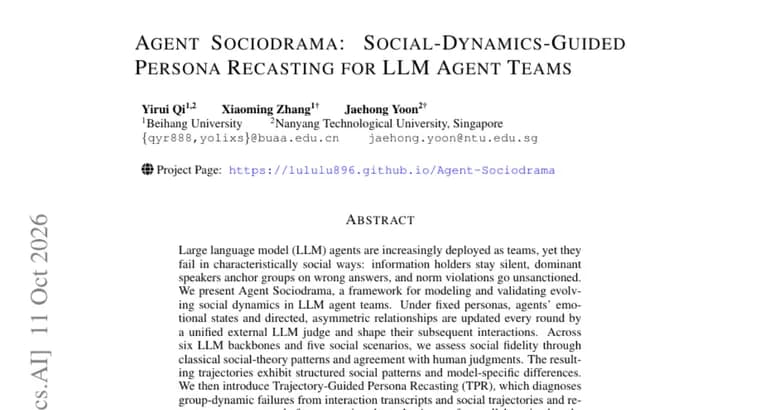
The paper starts from an observation about multi-agent LLM systems: teams of agents fail in characteristically social ways. Information holders stay silent, dominant speakers anchor the group on wrong answers, and norm violations go unsanctioned.
To study this, the authors present Agent Sociodrama, a framework for modeling and validating evolving social dynamics in LLM agent teams. Agents keep fixed personas, but their emotional states and their directed, asymmetric relationships are updated every round by a unified external LLM judge. Those states then shape how the agents interact in the following rounds.
The authors assess the social fidelity of the framework across six LLM backbones and five social scenarios, using classical social-theory patterns and agreement with human judgments. According to the paper, the resulting trajectories exhibit structured social patterns and model-specific differences.
On top of the framework comes a repair method, Trajectory-Guided Persona Recasting (TPR). It diagnoses group-dynamic failures from interaction transcripts and social trajectories, recasts the agents' personas, and reruns the task.
Across four collaborative benchmarks, TPR improves performance from both heterogeneous and randomly initialized persona compositions, with accuracy gains of up to 83.3 percentage points over the initial casting. On representative distributed-information cooperation and mixed-motive bargaining tasks, TPR outperforms SOTOPIA and AgentVerse in three of four comparisons, by up to 37.5 percentage points in Pareto rate. The authors conclude that validated social trajectories provide actionable signals for repairing LLM agent teams.
Key facts
- Agent Sociodrama models agents' emotional states and directed, asymmetric relationships, updated every round by an external LLM judge under fixed personas.
- Social fidelity was assessed across six LLM backbones and five social scenarios, using social-theory patterns and agreement with human judgments.
- Trajectory-Guided Persona Recasting (TPR) diagnoses group failures from transcripts and social trajectories, recasts personas and reruns the task.
- Across four collaborative benchmarks, TPR reports accuracy gains of up to 83.3 percentage points over the initial casting.
- Against SOTOPIA and AgentVerse, TPR wins three of four comparisons, by up to 37.5 percentage points in Pareto rate.
Why it matters
Teams of LLM agents are increasingly deployed, and the paper argues they break in social ways rather than only through weak reasoning: silent information holders, dominant speakers who lock in wrong answers, unsanctioned norm violations. The contribution is to treat those group dynamics as something that can be measured round by round and then used to repair the team, by changing personas instead of changing the task or the model.
Who it affects
Researchers and engineers who build multi-agent LLM systems, especially tasks where information is spread across agents or where agents must cooperate and bargain. The reported setups are distributed-information cooperation and mixed-motive bargaining, plus four collaborative benchmarks.
How to use it
The method as described is a loop: run the team with assigned personas, let an external LLM judge update each agent's emotional state and relationships every round, diagnose the group-dynamic failure from the transcript and social trajectory, recast the personas, and rerun the task. No code, dataset release or license is mentioned.
How solid is it
This is a preprint, and the numbers are the authors' own results across benchmarks. The 83.3 and 37.5 percentage point figures are maxima ('up to'), not averages or typical gains; no mean or median improvement is given. The abstract does not state which of the four comparisons against SOTOPIA and AgentVerse TPR did not win, or by how much it lost. No baseline accuracy values are given, so the starting level of the largest gain is unknown. The social dynamics are produced and scored by an LLM judge, though the authors also check agreement with human judgments.
Risks and caveats
TPR beats SOTOPIA and AgentVerse in three of four comparisons, not all four. The abstract does not name the six LLM backbones, the five social scenarios or the four benchmarks, so how far the results generalise cannot be judged from it. The abstract names no authors or institutions. The authors also report model-specific differences in the social trajectories, so behaviour may vary by backbone.
“These results show that validated social trajectories provide actionable signals for repairing LLM agent teams.”
— Agent Sociodrama paper abstract