ClawLoop trains harness-based LLM agents to self-improve without a teacher model
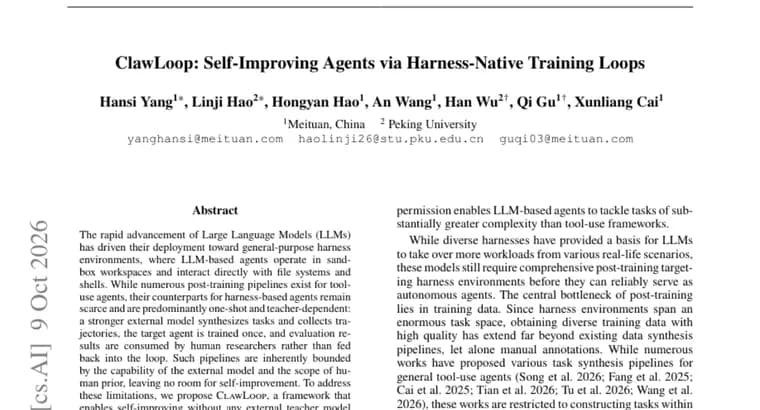
A paper on Hugging Face proposes ClawLoop, a framework for improving LLM-based agents that work inside general-purpose harness environments: sandbox workspaces where the agent interacts directly with file systems and shells.
The authors start from a gap. Post-training pipelines for tool-use agents are plentiful, but their counterparts for harness-based agents remain scarce, and those that exist are predominantly one-shot and teacher-dependent. A stronger external model synthesizes tasks and collects trajectories, the target agent is trained once, and the evaluation results are consumed by human researchers instead of being fed back into the loop. The authors argue that such pipelines are bounded by the capability of the external model and the scope of human prior, leaving no room for self-improvement.
ClawLoop is built to remove the external teacher and keep prior dependencies minimal. It composes three phases into a self-sustaining cycle. First, Task Synthesis generates a diverse pool of training tasks through two complementary construction routines, applies diagnosis-conditioned difficulty growth, and then runs both agent-free and agent-based task validation. Second, Training updates the agent via SFT and/or RL. Third, Diagnosis and Feedback analyzes the agent's rollout behaviors and produces a capability analysis report, which is used as feedback for task synthesis in the next iteration.
For results, the authors use Qwen3.6-27B as the loop model and report that ClawLoop yields consistent improvements on SkillsBench, Claw-Eval-Live, and ClawGym-Bench. They also transfer the iteratively refined tasks to smaller Qwen3.5-4B and 9B models and report gains across all benchmarks, which they say validates data quality independently of the loop model.
Key facts
- ClawLoop is a framework that lets a harness-based LLM agent improve itself without any external teacher model and with minimal prior dependencies.
- It cycles through three phases: Task Synthesis (two construction routines, diagnosis-conditioned difficulty growth, agent-free and agent-based validation), Training (SFT and/or RL), and Diagnosis and Feedback.
- The Diagnosis and Feedback phase turns rollout behaviors into a capability analysis report that steers task synthesis in the next iteration.
- With Qwen3.6-27B as the loop model, the authors report consistent improvements on SkillsBench, Claw-Eval-Live, and ClawGym-Bench.
- Refined tasks transferred to Qwen3.5-4B and 9B models give gains across all benchmarks, which the authors say validates data quality independently of the loop model.
Why it matters
The paper targets agents that run in sandboxed workspaces with file systems and shells, where, by the authors' account, training pipelines are scarce and mostly one-shot and teacher-dependent. A teacher-dependent pipeline is capped by the external model's capability and by human prior. ClawLoop's pitch is a closed loop in which evaluation findings flow back into the next round of task creation, so the agent is not limited by a stronger model's ceiling.
Who it affects
Researchers and engineers who post-train LLM agents for harness environments are the direct audience, especially those who currently rely on a stronger external model to write tasks and collect trajectories. Teams working with smaller models may also care: the authors report that tasks refined in the loop transferred to Qwen3.5-4B and 9B.
How to use it
The abstract describes a recipe rather than a product. A team could mirror its structure: synthesize a task pool with two construction routines, raise difficulty based on diagnosis, validate tasks with and without an agent, train with SFT and/or RL, then analyze rollouts into a capability report that feeds the next synthesis round. No code, model or dataset release is mentioned.
How solid is it
This is a paper whose claims come from the authors themselves. They report consistent improvements on SkillsBench, Claw-Eval-Live, and ClawGym-Bench with Qwen3.6-27B as the loop model, and gains on Qwen3.5-4B and 9B. The abstract gives no numeric scores, percentage gains or baseline comparisons for any benchmark, so the size of the improvements cannot be judged from it.
Risks and caveats
The abstract does not state the number of loop iterations, and it does not say whether SFT or RL produced the reported results, only that training uses SFT and/or RL. It also does not explain what the three benchmarks measure. The claim that transfer results validate data quality independently of the loop model is the authors' own interpretation.