BranchOPD adds branching to on-policy distillation and beats Vanilla OPD
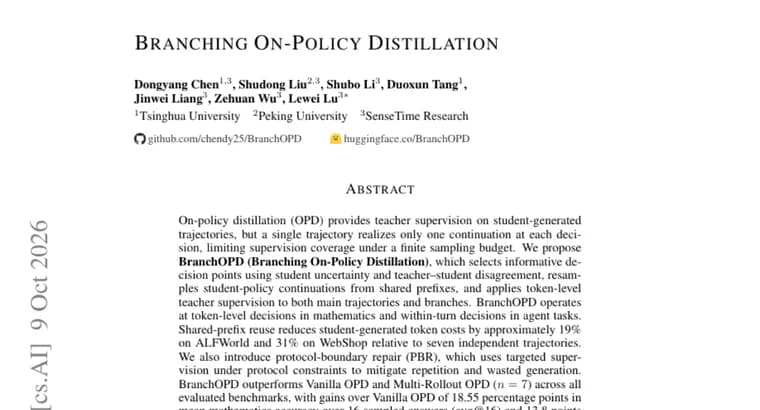
On-policy distillation (OPD) has a teacher model supervise a student on trajectories the student itself generated. The paper behind this story points to a limit of the standard setup: a single trajectory realizes only one continuation at each decision, so supervision coverage is restricted under a finite sampling budget.
The proposed fix is BranchOPD, short for Branching On-Policy Distillation. It selects informative decision points using student uncertainty and teacher-student disagreement. From the shared prefix at each chosen point, it resamples continuations from the student policy, and it applies token-level teacher supervision to both the main trajectories and the branches. In mathematics the decision points are individual token-level decisions; in agent tasks they are within-turn decisions.
Because branches reuse a shared prefix, generation is cheaper than sampling full independent trajectories. The abstract says shared-prefix reuse reduces student-generated token costs by approximately 19% on ALFWorld and 31% on WebShop, relative to seven independent trajectories.
The authors also introduce protocol-boundary repair (PBR), which uses targeted supervision under protocol constraints to mitigate repetition and wasted generation.
On results, the authors state that BranchOPD outperforms both Vanilla OPD and Multi-Rollout OPD (n=7) across all evaluated benchmarks. Against Vanilla OPD, the reported gains are 18.55 percentage points in mean mathematics accuracy over 16 sampled answers (avg@16) and 13.8 points in mean ALFWorld ID/OOD success. Mechanistic analyses and selection ablations, they say, show that branching at uncertain decisions expands subsequent behavior coverage and outperforms random selection and turn-initial branching.
Key facts
- BranchOPD branches student continuations from shared prefixes at decision points chosen by student uncertainty and teacher-student disagreement, with token-level teacher supervision on main trajectories and branches.
- Against Vanilla OPD, it gains 18.55 percentage points in mean mathematics accuracy (avg@16) and 13.8 points in mean ALFWorld ID/OOD success.
- Shared-prefix reuse cuts student-generated token costs by approximately 19% on ALFWorld and 31% on WebShop relative to seven independent trajectories.
- The authors say it outperforms Vanilla OPD and Multi-Rollout OPD (n=7) across all evaluated benchmarks.
- Protocol-boundary repair (PBR) adds targeted supervision under protocol constraints to reduce repetition and wasted generation.
Why it matters
On-policy distillation only sees one continuation per decision on each sampled trajectory, so a fixed sampling budget limits how much of the student's behavior the teacher can correct. BranchOPD spends extra samples where the student is uncertain or disagrees with the teacher, and reuses shared prefixes to keep generation cost down. The reported result is both better accuracy than Vanilla OPD and lower student-generated token costs than seven independent trajectories on ALFWorld and WebShop.
Who it affects
Mainly researchers and engineers who distill larger teacher models into smaller students, particularly for mathematical reasoning and for agent tasks such as ALFWorld and WebShop, where decisions happen within turns.
How to use it
The abstract describes a training method rather than a product. The practical recipe it outlines: pick decision points by student uncertainty and teacher-student disagreement, resample student continuations from the shared prefix, supervise main trajectories and branches token by token, and apply protocol-boundary repair for agent protocols. The abstract does not say whether code or models are released.
How solid is it
The claims come from the paper's own abstract; there is no independent replication in the source. The authors report analyses beyond headline scores: mechanistic analyses and selection ablations comparing uncertain-point branching against random selection and turn-initial branching. No absolute benchmark scores are given for BranchOPD, Vanilla OPD or Multi-Rollout OPD, only the gains over Vanilla OPD.
Risks and caveats
The size or identity of the teacher and student models is not stated. The gains over Multi-Rollout OPD (n=7) are not quantified, only that BranchOPD outperforms it. The token-cost reductions are given only for ALFWorld and WebShop, not for mathematics. The gain figures are relative to Vanilla OPD and should not be read as absolute accuracy.
“a single trajectory realizes only one continuation at each decision, limiting supervision coverage under a finite sampling budget”
— BranchOPD paper abstract