AI Night-Scientist uses GRPO to train LLMs toward more creative research ideas
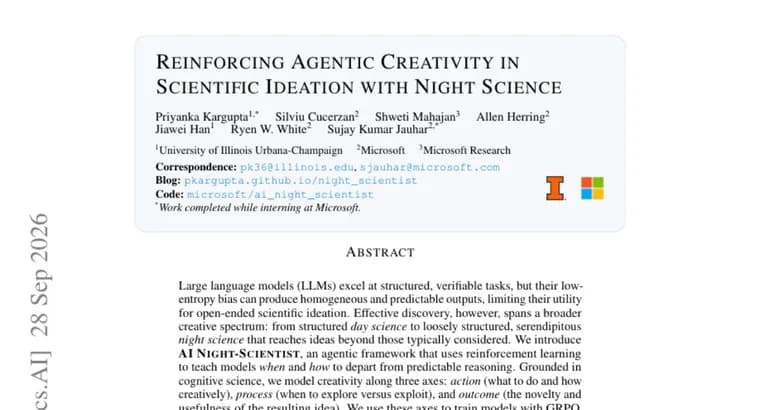
Large language models are good at structured, verifiable tasks, the paper says, but their low-entropy bias can produce homogeneous and predictable outputs. That limits their use for open-ended scientific ideation. The authors point out that effective discovery spans a wider creative range: from structured "day science" to loosely structured, serendipitous "night science" that reaches ideas beyond those typically considered.
To address this, they introduce AI Night-Scientist, an agentic framework that uses reinforcement learning to teach models when and how to depart from predictable reasoning. Grounded in cognitive science, it models creativity along three axes. Action covers what to do and how creatively. Process covers when to explore versus exploit. Outcome covers the novelty and usefulness of the resulting idea. The axes are used to train models with GRPO, exposing them to varying degrees and forms of creativity throughout training.
The result is what the authors call substantially more diverse scientific proposals. Compared with the base model, the range of research directions grows by 27.8% and the range of contribution types by 14.9%. The framework also improves predicted citation impact by up to 32.0 percentage points and originality by 66.2 points.
The authors also test a simpler alternative. These gains cannot be reproduced by simply increasing decoding temperature. Instead, they find that semantic guidance specifying what kind of creativity to pursue is critical. Overall, they say, the results suggest that creativity is a learnable, multi-level ability that can be shaped to help researchers reach ideas beyond those typically explored by LLMs.
Key facts
- AI Night-Scientist is an agentic framework that uses reinforcement learning (GRPO) to teach models when and how to depart from predictable reasoning.
- Creativity is modelled along three axes: action (what to do and how creatively), process (when to explore versus exploit) and outcome (novelty and usefulness of the idea).
- Against the base model, the range of research directions in generated proposals grows by 27.8% and contribution types by 14.9%.
- Predicted citation impact improves by up to 32.0 percentage points and originality by 66.2 points.
- Raising decoding temperature does not reproduce the gains; semantic guidance on what kind of creativity to pursue is found to be critical.
Why it matters
The paper targets a known weakness: LLMs tend toward homogeneous, predictable output, which is a poor fit for open-ended scientific ideation. Its approach is to train for creativity directly with reinforcement learning, instead of leaving it to sampling randomness. The finding that a higher decoding temperature does not reproduce the gains, while semantic guidance about the kind of creativity does, points to creativity as something that can be steered rather than just randomised. The authors frame it as a learnable, multi-level ability.
Who it affects
The intended beneficiaries are researchers who want ideas beyond those typically explored by LLMs. It is also relevant to teams building agentic systems for scientific ideation and to anyone training models with GRPO who wants more varied outputs.
How to use it
The abstract describes a training recipe: define creativity along the action, process and outcome axes, then train with GRPO while exposing the model to varying degrees and forms of creativity. Its practical lesson is that telling the model what kind of creativity to pursue matters more than adding sampling noise.
How solid is it
The evidence is the paper's own reported results against the base model: 27.8% more research directions, 14.9% more contribution types, up to 32.0 percentage points on predicted citation impact and 66.2 points on originality. The abstract does not say how predicted citation impact or originality are measured, or what scale the originality points refer to. The base model is not named, and the abstract names no authors or institutions. The authors word their conclusion as "suggest", not prove.
Risks and caveats
The 32.0 percentage point figure is an "up to" number, and no per-setting breakdown is given, so it should not be read as a typical gain. Citation impact is predicted, not observed. No evaluation by human researchers and no real-world discoveries are mentioned. No model sizes, datasets, compute or training cost are given, and no code or model release is mentioned.
“These gains cannot be reproduced by simply increasing decoding temperature; instead, we find that semantic guidance specifying what kind of creativity to pursue is critical.”
— AI Night-Scientist paper abstract