Allspark paper: a weak model's reasoning steers stronger models
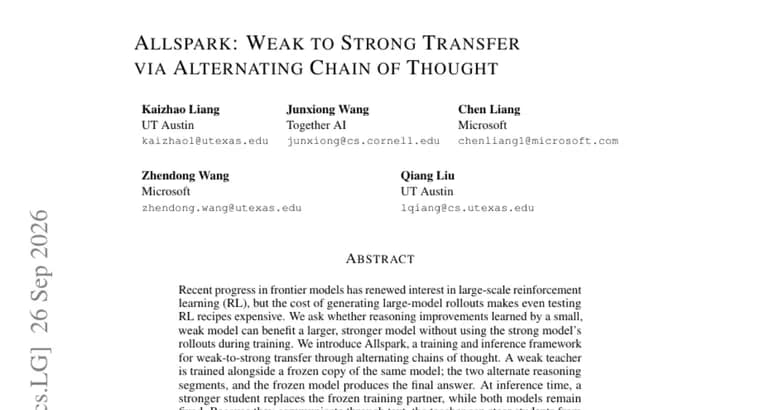
A paper on Hugging Face introduces Allspark, a training and inference framework for weak-to-strong transfer through alternating chains of thought. The starting point is cost. Recent progress in frontier models has renewed interest in large-scale reinforcement learning (RL), but generating rollouts from large models is so expensive that even testing RL recipes is hard. The authors ask whether reasoning improvements learned by a small, weak model can benefit a larger, stronger model without using the strong model's rollouts during training.
The method works in two phases. In training, a weak teacher is trained alongside a frozen copy of the same model. The two alternate reasoning segments, and the frozen model produces the final answer. At inference time, a stronger student replaces the frozen training partner, while both models remain fixed. Because the two models communicate only through text, the teacher can steer students from different model families and with different tokenizers.
The authors study Allspark at two scales. The first is controlled experiments with Qwen across math and reasoning. The second is larger-scale experiments with Inkling on ARC-AGI-2. The Inkling experiments show accuracy gains in within-family and cross-family settings, including transfer to Kimi and Nemotron, with benefits that vary across inference settings.
The authors conclude that these findings motivate reusing a trained weak teacher across strong students and examining the resulting accuracy-token tradeoff. That is a call for further work, not a proven result.
Key facts
- Allspark is a training and inference framework for weak-to-strong transfer through alternating chains of thought.
- In training, a weak teacher alternates reasoning segments with a frozen copy of the same model, which writes the final answer; at inference a stronger student replaces the frozen partner and both models stay fixed.
- Because the models communicate through text, the teacher can steer students from other model families and with different tokenizers.
- The paper studies two scales: controlled Qwen experiments on math and reasoning, and larger-scale Inkling experiments on ARC-AGI-2.
- The Inkling experiments show accuracy gains within and across families, including transfer to Kimi and Nemotron, with benefits that vary across inference settings.
Why it matters
Testing RL recipes on large models is costly because every rollout comes from the large model. Allspark explores a cheaper route: train reasoning on a small, weak model and let a stronger model benefit from it later, without using the strong model's rollouts during training. If the idea holds up, one trained teacher could be reused across several strong students. The authors say the findings motivate exactly that reuse, along with a closer look at the accuracy-token tradeoff.
Who it affects
Mainly researchers and teams working on reasoning and reinforcement learning for language models, especially those who cannot afford to run RL directly on very large models. The text-only interface also matters to anyone working across model families, since the teacher is reported to steer students with different tokenizers, including Kimi and Nemotron in the Inkling experiments.
How to use it
This is a research framework, not a product. The practical recipe as described: train a weak teacher next to a frozen copy of the same model so the two alternate reasoning segments, with the frozen copy giving the final answer. At inference, swap a stronger student in for the frozen partner and keep both models fixed. No release of code, models or data is mentioned.
How solid is it
The evidence comes from the abstract alone. It reports controlled Qwen experiments across math and reasoning and larger-scale Inkling experiments on ARC-AGI-2, with accuracy gains in within-family and cross-family settings. No numeric results are given: no accuracy figures, gains, baselines or token counts. It gives no ARC-AGI-2 scores and no comparison with training the strong model directly with RL. It also does not say what Inkling is or which Qwen, Kimi or Nemotron model sizes or versions were used.
Risks and caveats
The authors themselves say the benefits vary across inference settings, so gains are not uniform. The abstract does not say the benefits hold in every setting. It does not quantify the accuracy-token tradeoff either; it only says that tradeoff should be examined. The conclusions are framed as motivation for reusing a weak teacher, not as proof that it beats other approaches.
“We ask whether reasoning improvements learned by a small, weak model can benefit a larger, stronger model without using the strong model's rollouts during training.”
— Allspark paper abstract, Hugging Face Papers