AllenAI's BenchMIRT shows what LLM benchmarks actually measure
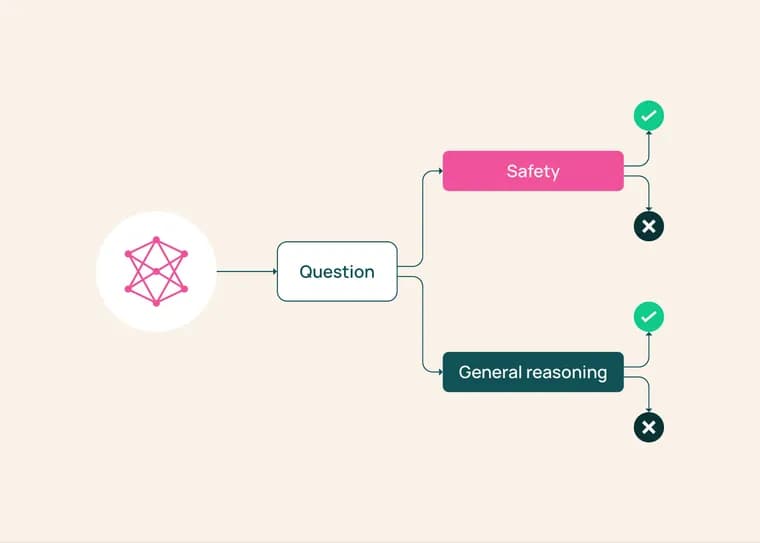
AllenAI has introduced BenchMIRT, a method for auditing LLM benchmarks at the level of individual questions rather than overall scores. The problem it targets: a benchmark is usually built to measure one stated ability, such as safety or general reasoning, but the tasks inside it can depend on more than that. In BBQ, a benchmark meant to test whether models rely on social stereotypes, one question asks about a grandson and grandfather trying to book an Uber; answering it requires tracking who is who and reasoning from evidence, not just detecting bias. WildJailbreak mixes harmful jailbreak prompts, which test safety, with benign prompts that test whether a model over-refuses harmless requests, which is closer to general reasoning; averaging both into one score can hide the difference.
BenchMIRT builds on Item Response Theory (IRT), a psychometrics technique that starts from the idea that not every test question carries the same information: some are harder, and some better separate strong performers from weak ones. AllenAI had previously applied single-dimensional IRT to individual benchmarks in its Fluid Benchmarking work. BenchMIRT extends this to multidimensional IRT (MIRT), letting it separate several capabilities that may drive performance on the same question. It estimates, per model, the model's strength on the capabilities behind the selected benchmarks, and per question, how difficult that question is and how well it distinguishes stronger from weaker models on those capabilities.
The team trained BenchMIRT on results from 100 LLMs across 16 benchmarks and more than 34,000 questions, without telling it in advance which benchmark measured which capability. Six of the 16 benchmarks measure general reasoning, including MMLU-Pro, GPQA, MATH, and BBH; the other 10 come from AllenAI's Olmo 3 safety suite, including HarmBench, StrongReject, WildJailbreak, BBQ, WMDP, and XSTest. BenchMIRT independently recovered two dominant dimensions, safety and general reasoning, and got the same two dimensions each time the analysis was repeated from scratch, which the team reads as a sign the result is stable rather than an artifact of one run.
For most benchmarks, BenchMIRT confirmed the intended focus: reasoning benchmarks tracked reasoning ability, and jailbreak or harmful-content benchmarks tracked safety. But it surfaced a more complicated picture elsewhere. BBQ, commonly grouped with safety benchmarks, aligned much more strongly with general reasoning in BenchMIRT's analysis, meaning a low BBQ score may partly reflect difficulty reasoning through a question rather than unsafe behavior. WMDP, which tests dangerous dual-use knowledge in biology, chemistry, and cybersecurity, also aligned more with general reasoning than safety; stronger reasoning was associated with lower WMDP scores, because the benchmark counts refusing to provide dangerous knowledge as the correct response. HarmBench showed a mixed picture within a single benchmark: its standard and contextual harmful-request questions aligned with safety, while its copyright questions, such as reproducing song lyrics, aligned with general reasoning instead.
BenchMIRT's question-level estimates can also be used to trim a benchmark. Ranking questions across the same 16 benchmarks and keeping only the most informative ones, the team found that keeping just 10% of questions generally preserved nearly the same picture of which models were stronger or weaker on the underlying capability as using the full set, and keeping 50% often matched the full benchmark even more closely. BenchMIRT could also predict, from what it had learned about a model and a question, whether that model would answer a held-out question correctly 79% of the time, versus 70% for a simpler baseline that assumes a model performs on every question as well as it does on the benchmark overall.
AllenAI flags real limits. Every model used to train and evaluate BenchMIRT was released by March 2025, so the analysis says nothing about newer model generations. The dimensions BenchMIRT finds depend on the benchmark set it is given; safety and reasoning emerged as dominant across these 16 benchmarks, but a different mix of evaluations could surface different capabilities. If the goal is simply to rank models on randomly held-out items, a benchmark's plain average score still performs slightly better than BenchMIRT; BenchMIRT's advantage is the finer-grained, per-question picture. The team also names a dual-use risk directly: the same estimates that identify a benchmark's most informative safety questions could be used to strip them out, producing a weaker evaluation an unsafe model could pass. AllenAI judges the added transparency worth that risk, while calling the risk real.
Key facts
- AllenAI trained BenchMIRT, a multidimensional item response theory (MIRT) method, on results from 100 LLMs across 16 benchmarks and more than 34,000 questions.
- Without being told which benchmark measured what, BenchMIRT independently and repeatably recovered two dominant capability dimensions: safety and general reasoning.
- BBQ and WMDP, both commonly treated as safety benchmarks, aligned more strongly with general reasoning than with safety in BenchMIRT's analysis; HarmBench's copyright questions did too, unlike its harmful-request questions.
- Keeping only the 10% of questions BenchMIRT ranks as most informative preserved nearly the same picture of model strength as the full benchmark; 50% often matched it even more closely.
- BenchMIRT predicted a model's correctness on a held-out question 79% of the time, versus 70% for a baseline that assumes benchmark-average performance on every question.
Why it matters
Benchmark scores are the main way the field compares models, but a single score can quietly blend several unrelated capabilities. BenchMIRT gives researchers a way to see, question by question, which capability is actually driving a benchmark's number, rather than trusting the benchmark's stated purpose. That two clean dimensions, safety and general reasoning, fell out of 16 mixed benchmarks without being told to look for them is the paper's strongest evidence that this blending is real and measurable, not speculative.
Who it affects
The direct audience is LLM evaluation researchers and labs building or relying on safety and capability benchmarks, including AllenAI's own Olmo 3 safety suite. It also matters to anyone citing a BBQ, WMDP, or HarmBench score as evidence of a model's safety: BenchMIRT's findings suggest some of those scores are partly reasoning scores in disguise.
How to use it
BenchMIRT is presented as a research method rather than a product; AllenAI describes training it on 16 named benchmarks and does not state a release timeline, license, or public tooling for other researchers to run it themselves. The practical use case described is benchmark auditing and question selection: ranking a benchmark's questions by how informative they are and keeping a smaller, cheaper subset (10 to 50%) that still reflects the full benchmark's read on a model's underlying capability.
How solid is it
The method draws on established single-dimensional IRT (AllenAI's own prior Fluid Benchmarking work) and extends it to multiple dimensions; the two-dimension result was stable across repeated from-scratch analyses. The prediction result, 79% accuracy on held-out questions versus a 70% baseline, is a direct, stated comparison rather than an estimate. AllenAI itself notes one place BenchMIRT underperforms: for plain model ranking on randomly held-out items, a benchmark's ordinary average score edges out BenchMIRT slightly, with BenchMIRT's real advantage being the finer per-question breakdown rather than raw ranking accuracy.
Risks and caveats
AllenAI is explicit about the limits. Every model in the training and evaluation set was released by March 2025, so the results say nothing about how the method behaves on newer generations. The two dimensions it found, safety and reasoning, are a property of the 16 benchmarks selected for this project; a different benchmark mix could surface different underlying capabilities. There is also a stated dual-use risk: the same question-level estimates that reveal a benchmark's most informative safety questions could be used to strip them out, producing a weaker evaluation that an unsafe model could pass. AllenAI says it judges the added transparency worth that risk, but calls the risk real rather than hypothetical.
“These findings don't necessarily mean the benchmarks are flawed or incomplete.”
— AllenAI, BenchMIRT blog post