Google Research ties AI agents to wet-lab robots, finds nanomolar protein binders
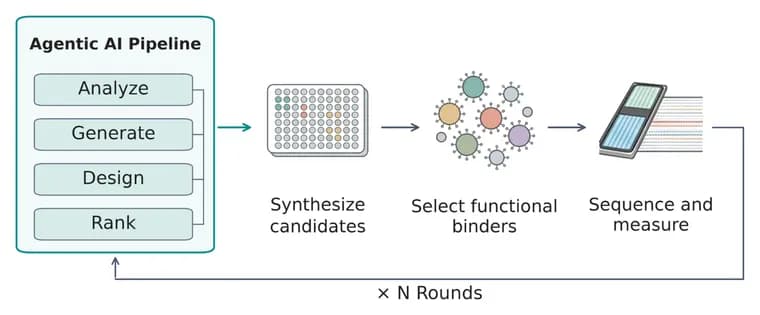
On October 16, 2026, Google Research published a blog post by Pooja Rao, Petar Sirkovic and Annalisa Pawlosky (who leads the research) on bringing AI agents to the wet-lab bench. The long-term vision is that agents will not only ideate and analyze but also run lab experiments to test their hypotheses, learn from the results and self-improve, all driven by human scientific agency. The authors name two obstacles. Frontier models still do not reason reliably about 3-dimensional geometry and physical state, which matters when automating liquid-handling robots. And while agentic hypothesis generation and in-silico design are advancing quickly, wet-lab experiments have not kept pace, so experimental readouts are more of a bottleneck than ever. The post covers three projects.
The first is VERID, the VERified Infrastructure for Discovery Laboratories. It is a semantic digital twin of a laboratory workcell: a live, stateful 3D volumetric entity tree that tracks everything from robotic arm geometry to individual well volumes, reagent identities and pipette tip inventory. It is built on the open-source PyLabRobot framework and provides four core capabilities. The motivation is that an agent can write syntactically valid code that is physically impossible (lowering an 8-channel pipette into a narrow trough that is too short), logistically invalid (aspirating from a depleted well) or scientifically compromised by unmodeled fluidic effects. In case studies, synchronized video and execution traces caught uneven dye stratification caused by dispensing too close to the well floor, so the agent refined its mixing strategy. The persistent digital twin state let the agent recover mid-run from a plate-reader failure without re-pipetting. When the simulator rejected an 8-channel aspiration that would not fit in a narrow trough, the agent replanned and designed a targeted factorial diagnostic that isolated a subtle bias from residual tip-wall carryover, which replication alone would have missed. In a closed-loop self-play campaign, an agent designed and ran robot experiments to reconstruct blinded dye mixtures from overhead camera images, identified its own optical and fluidic artifacts across runs, and improved accuracy more than fivefold. The authors say the reproducible execution and trace logs lay the groundwork for agents to eventually separate biological signals from experimental noise.
The second project, in the paper "Aptamers as a sandbox for lab-in-the-loop agentic molecular discovery", uses protein-binding DNA aptamers to prototype a closed loop with AI agents over 3 design-test-iteration cycles. A full cycle takes 7 to 10 days, because DNA can be chemically synthesized in pooled libraries and read out directly by sequencing. In each round, agents design candidate sequences, which are screened against target proteins on magnetic beads and then sequenced. Across three rounds on two targets, myoglobin and alpha-thrombin, AI-driven rational and de novo design raised confirmed on-target hit rates to 33.5% for myoglobin and 42.1% for alpha-thrombin, though each target needed a different wet-lab failure mode to be found and overcome. On alpha-thrombin, Round 1 yielded 0% binders because fixed primer overhangs disrupted folding in 48% of sequences. Once the agents introduced clamped flanking stems in Round 2 and diversified in Round 3, hit rates climbed to 26.0% and then 42.1% at 98.5% specificity. On myoglobin, agents prioritizing raw binding affinity in Round 2 heavily enriched G-quadruplex motifs (63% of designs). Raw pull-down rose, but the wet-lab data showed most of these were non-specific "sticky" binders that stuck to off-target proteins and bare magnetic beads. Target specificity fell from 75.0% to 19.1% and the true, bead-corrected hit rate from 10.2% to 3.7%. Seeing this artifact in the Round 2 readout, the agents autonomously revised their design rules for Round 3: they capped promiscuous motifs, subtracted bead binders and moved to non-G4 structural scaffolds. Specificity recovered to 72.4% and the on-target hit rate rose ninefold to 33.5%. The paper also examines how agents reason like scientists, analyzing data and suggesting tweaks to wet-lab protocols, but sometimes think atypically and explore sequence spaces that structural biologists might not.
The third project is about proteins, where closing the loop is harder: proteins must be expressed biologically, so each loop adds cellular or cell-free selection, expression and folding steps, on top of a larger sequence space. In "Agent-guided epitope excision enables economical de novo binder design", the team applied its workflow to fibroblast activation protein alpha (FAP), a large, challenging receptor overexpressed in solid tumors. In just a few experimental runs, the top designs yielded binders with single-digit nanomolar affinity, which the authors describe as tight, drug-like binding typically reached only after extensive rounds of laboratory optimization. On the compute side, the final re-folding step of de novo binder design consumes the vast majority of GPU compute because it scales quadratically with target length. By excising just the local binding pocket during folding, the pipeline sped up each cycle more than eightfold without losing structural accuracy. That turns choices about where to bind and how much surrounding structure to include into tactical levers for LLM agents. At equal compute, human-agent collaboration, with a scientist setting high-level strategy and an agent driving tactical execution, nearly doubled the in-silico hit rate of a scientist working alone and found hits across a much broader range of target sites. For wet-lab screening, the team operationalized yeast surface display with fluorescence-activated cell sorting (FACS) to screen large libraries of protein variants in parallel.
The next step is to combine VERID's traceable automation with closed-loop learning for protein discovery, so agents can navigate rugged biological search spaces directly in the wet lab. The authors say they build safeguards on both the computational and wet-lab sides in line with Google's Frontier Safety Framework and its approach to bioresilience. They also state that moving toward an autonomous wet lab requires solving open safety and reliability problems, with human agency and oversight: making sure agents optimize for true target binding rather than unintended experimental shortcuts, verifying multi-step wet-lab protocols, and continuously monitoring agent reasoning and execution traces.
Key facts
- VERID, built on the open-source PyLabRobot, is a live 3D digital twin of a lab workcell that tracks arm geometry, well volumes, reagent identities and pipette tips; in a self-play campaign an agent improved accuracy more than fivefold at reconstructing blinded dye mixtures.
- In a closed-loop DNA aptamer study over 3 rounds (7 to 10 days per cycle), confirmed on-target hit rates reached 33.5% for myoglobin and 42.1% for alpha-thrombin, the latter at 98.5% specificity after a 0% Round 1.
- On myoglobin, chasing raw affinity in Round 2 cut specificity from 75.0% to 19.1%; the agents revised their own design rules and Round 3 recovered specificity to 72.4% with a ninefold rise in on-target hit rate.
- For the tumor-linked receptor FAP, agent-guided design gave binders with single-digit nanomolar affinity in just a few experimental runs, with each design cycle more than eightfold faster after excising the local binding pocket during folding.
- At equal compute, human-agent collaboration nearly doubled the in-silico hit rate of a scientist working alone; the authors list open safety and reliability problems that still need human oversight.
Why it matters
The post targets a bottleneck the authors name directly: AI design and hypothesis generation are advancing quickly, but real-world wet-lab experiments have not kept pace, so readouts limit progress. Connecting agents to robots and fast experimental feedback is their answer. The aptamer study shows what that feedback buys. In the myoglobin case, a computational objective (raw binding affinity) produced designs that looked good in a pull-down but were mostly sticky, non-specific binders; only the wet-lab data exposed it, and the agents then changed their own design rules. The authors say computational models cannot replace empirical validation. On the protein side, they report single-digit nanomolar binders to FAP in a few runs, a level they say usually takes extensive laboratory optimization.
Who it affects
The work is aimed at life-science and drug-discovery researchers who run liquid-handling robots and screening workflows, and at teams building AI agents for science. Labs that use PyLabRobot are the most direct audience for VERID, since it is built on that framework. The protein binder work concerns researchers designing binders against large targets such as FAP, a receptor overexpressed in solid tumors. The authors frame the long-term goal as human-directed autonomous discovery, with scientists setting strategy.
How to use it
This is a research report, not a product, and the post gives no download or access details. The transferable ideas are concrete. Give a robot-driving agent a stateful digital twin so the simulator can reject physically impossible commands before they run. Keep full trace logs and synchronized video of runs. For fast experimental loops, use pooled DNA aptamer libraries read out by sequencing, which the authors say allows a 7 to 10 day cycle. For protein design, folding only the local binding pocket instead of the whole target cut cycle time more than eightfold in their pipeline, and a scientist setting strategy while an agent handles tactics outperformed a scientist alone in silico. Yeast surface display with FACS was their wet-lab screen for proteins.
How solid is it
This is a first-party blog post by Google researchers, and every result is reported by the authors themselves. The aptamer and protein projects are tied to named papers, "Aptamers as a sandbox for lab-in-the-loop agentic molecular discovery" and "Agent-guided epitope excision enables economical de novo binder design", plus a VERID report. The post does not give publication venues, preprint status or peer-review status for them. The specific numbers (hit rates by round, specificity, the 48% primer-overhang failure) are given in detail for the aptamer study, but no sample sizes are reported. For the FAP binders only "single-digit nanomolar" is stated, and the human-agent comparison is described as nearly doubling the in-silico hit rate without absolute figures. The post does not say which LLM or agent system was used.
Risks and caveats
The authors state that reproducible trace logs only lay the groundwork for agents to eventually separate biological signals from experimental noise; that is a prospect, not a demonstrated result. The protein results are binding affinities; the post does not say the binders were validated in cells, animals or patients, nor that any drug candidate results. The aptamer episode shows the failure mode directly: an agent optimizing for raw binding affinity drifted into artifacts. The authors list open problems that must be solved for an autonomous wet lab: ensuring agents optimize for true target binding rather than unintended experimental shortcuts, verifying multi-step wet-lab protocols, and continuously monitoring agent reasoning and execution traces. They say they apply safeguards in line with Google's Frontier Safety Framework, though the post's text does not spell out what those safeguards are. The planned merge of VERID automation with closed-loop protein discovery has no stated timescale.
“Moving toward an autonomous wet lab requires solving these open problems with opportunities for human agency and oversight”
— Pooja Rao, Petar Sirkovic and Annalisa Pawlosky, Google Research blog