Amazon speeds up Falcon 9 launches for Leo after Vulcan failure
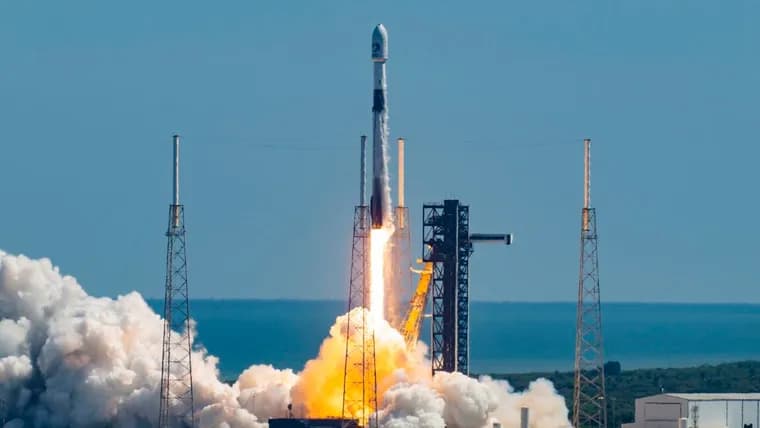
A European Ariane 6 rocket launched 36 satellites for Amazon's Leo broadband constellation on Tuesday. The launch brought the Amazon Leo fleet to 432 satellites. It came after 40 Leo satellites were lost earlier this month, when United Launch Alliance's Vulcan rocket misfired during an Amazon mission on November 15. Vulcan is Amazon's primary launch provider, and it will be sidelined for months.
To fill the gap, an Amazon official told Ars Technica that the company is accelerating several Falcon 9 launches it bought from SpaceX. SpaceX also owns the Starlink network that Amazon Leo is meant to dethrone. The next Falcon 9 launch for Amazon Leo is now planned for December, Amazon said, moved forward from a previous date next year. Several more Falcon 9s are scheduled to launch Leo satellites in rapid succession after that December flight.
The background is a very wide launch order. About five years ago Amazon started signing launch deals and secured rides on 108 flights, using every available medium- or heavy-lift rocket in the West, to place a fleet of 3,232 satellites in low-Earth orbit. As of Tuesday, Amazon and its launch partners have completed 17 of those flights, with one mission failure.
Amazon's executives first bought capacity from United Launch Alliance in the US, Europe's Arianespace and Blue Origin. Nearly all of those contracts depended on rockets still in development: ULA's Vulcan, Europe's Ariane 6 and Blue Origin's New Glenn. Each vehicle faced development delays, as all new rockets do. New Glenn has been grounded since May after an explosion on Blue Origin's launch pad in Florida. Vulcan's grounding follows the November 15 misfire. That leaves Ariane 6, now delivering, and the Falcon 9 flights bought from SpaceX.
Key facts
- An Ariane 6 launched 36 Amazon Leo satellites on Tuesday, bringing the fleet to 432.
- 40 Leo satellites were lost earlier this month when ULA's Vulcan misfired on November 15; Vulcan will be sidelined for months.
- An Amazon official told Ars the company is accelerating several Falcon 9 launches bought from SpaceX; the next is planned for December, moved up from next year.
- Amazon contracted 108 flights to deploy 3,232 satellites; 17 flights are done, with one mission failure.
- New Glenn has been grounded since May after a pad explosion at Blue Origin's Florida site.
Why it matters
Amazon Leo is built to challenge Starlink, and its schedule depends on rockets. Amazon bet on three new vehicles (Vulcan, Ariane 6 and New Glenn), and two of them are now out of action: New Glenn since May, Vulcan since the November 15 failure. Turning to Falcon 9 means leaning harder on SpaceX, the owner of the rival network. Amazon has 432 satellites in orbit against a planned 3,232.
Who it affects
Amazon and the Leo programme most directly. ULA loses its role as Amazon's primary provider for the coming months, and Blue Origin's New Glenn is also grounded. Arianespace gains a successful Amazon launch, and SpaceX gets more Amazon flights sooner than planned. Starlink's competitor is being built on SpaceX launches in part.
How to use it
This is launch news, not a product release, so there is nothing to adopt. The dates worth tracking are the next Falcon 9 launch for Amazon Leo, now planned for December, and the further Falcon 9 flights that follow in rapid succession.
How solid is it
The facts come from one Ars Technica report. The Falcon 9 acceleration and the December date are Amazon's statements, relayed by an unnamed Amazon official. The 36-satellite Ariane 6 launch, the 432 fleet total, the 108 contracted flights, 17 completed flights and the November 15 Vulcan failure are stated by the article as fact. No statement from SpaceX, Arianespace or ULA appears in the text.
Risks and caveats
The number of Falcon 9 launches being accelerated is given only as "several", and no exact date is given for the December flight or the later ones. The cause of the Vulcan failure is not stated. Vulcan is described as sidelined for months, with no return date, and New Glenn has no stated return date either. Amazon has completed 17 of 108 contracted flights, one of them a failure, so the build-out is still early.