AMD's Mike Clark explains Zen 6 and Zen 6c design choices
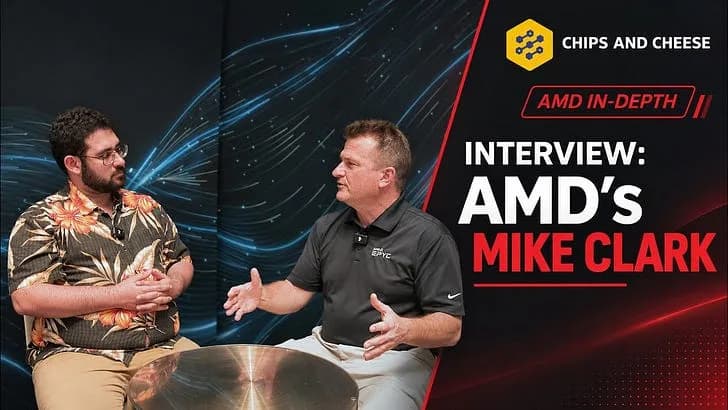
Chips and Cheese's George Cozma sat down with AMD's Mike Clark at AMD In-Depth, an event where the talk was about Venice, to discuss Zen 6, how it evolved from Zen 5, and how Zen 6 differs from the dense Zen 6c. The published transcript was edited for readability and conciseness. Clark introduces himself as the original architect of Zen, says some people call him "Zen Daddy", and says he has worked on cores at AMD for 33 years.
The central change is the role of the two core families. Clark says AMD has had two families since Zen 4, and until now the denser technology was used mainly as an area play. This generation AMD wanted to use the dense version to add IPC as well. What used to be the classic design is now thought of as the high-frequency design, while the dense core becomes, in his words, the top-of-the-line, no-questions-asked performance core, because the full L3 is enabled in it at 4MB per core. He describes 32 of those cores with 128MB of L3 and the highest IPC of the cores.
Cozma noted that the vector scheduler is bigger on Zen 6c. Clark says it was not the only thing enlarged. AMD's principle is not to create a delta between the two architectures that software has to be optimized for, so the same optimizations apply to both. But because Zen 6c has a reduced frequency target and does not need to reach the maximum frequency of the high-frequency core, it can have somewhat larger queues. The floating-point scheduler is one example; other queues are larger too, to pull out a little more IPC and more leverage in an SMT environment.
On the front end, Clark says Zen 5 was a new foundation that could fetch two basic blocks. It gets complicated when one thread runs a larger-footprint workload, with some code hitting the I-cache and some the op cache, and everything has to stay in sync. AMD spent a lot of time making this more efficient for both delivery and power.
Cozma observed that the number of integer multiply units fell from three to two. Clark says that in Zen 5 a more unified scheduler made a third multiplier easy to add. For Zen 6, AMD decided that scaling the architecture meant returning to more distributed schedulers that schedule into the ALUs. Since the extra multiplier on Zen 5 had not shown much uptick, AMD went back to two multipliers to optimize area and the schedulers.
On the vector side, Cozma said two more VNNI units were added. Clark says Zen 6 was not designed to be an agentic core; when the project started, nobody was really using that term. Zen 5 was a new foundation for AI workloads, and AMD believes the core has a place in AI for orchestration, data type manipulation and smaller models. "It's not going to beat a GPU, and that's not the point," he says. Seeing where inference was going, AMD decided it should have more VNNI. That came late, because these are long-lead projects and the floor plan was set, but the team squeezed in a couple more VNNI pipes and Clark calls it a big success.
Cozma also asked why Zen 6 can do four vector loads, assuming 128 or 256-bit loads, where Zen 5 managed two at a time even though the wires were there. Clark says that because Zen 5 could already do two 512-bit loads, it already had 1,024 wires headed to the load unit. Using them piecemeal rather than as one contiguous set complicates the design. AMD always wanted this on Zen 5, but with all the change it left the work for the Zen 6 team.
On the L2, Clark explains that Zen 5 could not always reach 64 bytes per cycle on reads because AMD was over-prefetching, and prefetches that hit in the L2 robbed bandwidth from demand requests. Zen 6 sustains those prefetches alongside demand requests, reduces conflicts, and delivers the full 64 bytes per cycle. Cozma says he has measured that Zen 6 hits it.
On branch prediction, Cozma noted lower misprediction latency with no loss of accuracy, which he calls slightly better than Zen 5's. Clark says the team explores a large design space, that AI has been getting involved in helping optimize it, and that the problem includes the number of TAGE tables, how much information they hold, and accuracy. AMD wanted a more efficient predictor rather than a larger one, by laying out the tables more efficiently, and is focused on getting back going quickly after a mispredict.
Cozma says he has had hands-on time with Zen 6c but not yet Zen 6, and that in SPECint 2026 Zen 6c matches AMD's fastest Zen 5 server CPU despite a clock deficit. Asked about the topology differences between the 12-core and 32-core CCDs and the slightly higher L3 latency, Clark says the design has to be balanced, that growing a structure lengthens distances even as new technology shrinks it, and that the cores grow their queues to handle the higher latencies. He says he cannot discuss the tricks inside the L3.
On Verano, which adds LPDDR5X to the EPYC ecosystem, Clark says AMD focuses on bandwidth per core at the CCX level, citing SDP ports with 32-byte reads per port. AMD was already well provisioned for bandwidth with MRDIMMs, so choosing a different memory technology did not have a major impact on how the core was built. The interview closes with Cozma's customary cheese question; Clark's new favorite is Cotija.
Key facts
- Mike Clark says the dense Zen 6c core is now AMD's top performance core: full L3 at 4MB per core, 32 cores with 128MB of L3, and the highest IPC.
- Zen 6 drops from three integer multipliers to two, as AMD returns to more distributed schedulers and saw little gain from the third multiplier on Zen 5.
- AMD added a couple more VNNI pipes late in the design, after the floor plan was set, and widened vector loads from two to four (for 128 or 256-bit loads).
- Zen 6 now delivers the full 64 bytes per cycle of L2 read bandwidth after AMD fixed over-prefetching that robbed demand requests.
- Cozma says Zen 6c in SPECint 2026 matches AMD's fastest Zen 5 server CPU despite a clock deficit; he has not yet tested Zen 6.
Why it matters
The interview gives first-party detail from the original architect of Zen on an upcoming CPU generation. The notable shift is the reversal of roles: the dense core, once an area play, now carries the full L3 and the highest IPC, while the classic design is the high-frequency variant. Clark also explains trade-offs that are usually invisible, such as dropping a multiplier to simplify scheduling and squeezing extra VNNI pipes into a floor plan that was already set.
Who it affects
Server and data-centre buyers and engineers following EPYC and Venice are the main audience, along with CPU architecture enthusiasts and performance analysts. Software developers are touched by one stated principle: AMD does not want a delta between the two architectures that software has to be optimized for, so the same optimizations apply to both Zen 6 and Zen 6c.
How to use it
Read it as an architecture briefing rather than a product guide. The interview is available as a video, and Cozma says a transcript is on the Chips and Cheese website. Useful takeaways for performance work: expect the same optimizations to apply across Zen 6 and Zen 6c, expect four 128 or 256-bit vector loads per cycle, full 64-byte-per-cycle L2 reads, and more VNNI capacity for inference.
How solid is it
The core claims come directly from Mike Clark, who describes himself as the original architect of Zen, so they are first-party. The transcript was edited for readability and conciseness. Some figures, such as the drop from three to two integer multipliers and the extra VNNI units, are stated by the interviewer in his questions and accepted by Clark. The SPECint 2026 comparison and the L2 and branch prediction measurements are Cozma's own, not AMD's.
Risks and caveats
Clark declines to discuss L3 tricks, so part of how the latency is handled stays undisclosed. The source gives no clock speeds, IPC percentage gains or release dates for Zen 6 or Zen 6c, and no SPECint 2026 scores, only the statement that Zen 6c matches the fastest Zen 5 server CPU. It does not say by how much branch misprediction latency fell, or how AI is used in branch predictor optimization beyond that it has been getting involved. Cozma has not yet tested Zen 6, only Zen 6c.
“It’s not going to beat a GPU, and that’s not the point.”
— Mike Clark, AMD, on the CPU core's role in AI workloads