SpaceX Starship flight 15 reaches orbit and deploys 26 Starlink V3 satellites, but loses its booster
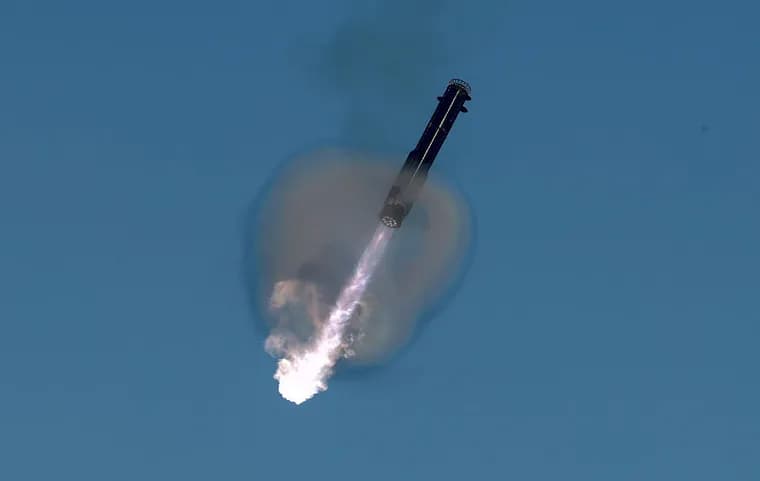
Starship lifted off on schedule on Friday from Starbase in South Texas, on its 15th test flight in more than three years. The launch came in the early evening. Conditions were ideal: the winds were so calm that the rocket's white plume did not dissipate for many minutes.
The first stage ascended flawlessly and released the upper stage above the Gulf of Mexico. The upper stage then ignited its Raptor engines and powered its way into a nominal orbit. It was the second time SpaceX has flown Starship into low-Earth orbit.
The booster did not fare as well. When it came time for the first stage to return to the ground, it dropped like a rock. Due to an unspecified issue, the vehicle was commanded to divert into the Gulf instead of returning to Starbase to be caught by the launch tower. It created a fantastically powerful explosion, even for observers more than 10 miles away.
The primary aim of the flight was the deployment of 26 Starlink V3 satellites, released from a narrow door at the base of the spacecraft. That happened about 40 minutes into the flight. All 26 satellites made it safely into orbit, where they will now use onboard propulsion to raise their altitude. Each has solar panels that stretch 60 meters end to end when fully deployed.
The article's author concludes that Starship is now an operational, orbital rocket, and the largest and most powerful machine humans have launched into space. The challenge now is to make it reusable and dramatically increase its flight rate. In that sense, the booster part of the mission was not a success: SpaceX had hoped to return the first-stage booster, refurbish it and fly it again. The company has previously landed and reflown Starship boosters, but has yet to do so with the latest iteration of the vehicle, version 3.
Key facts
- Starship flew its 15th test flight on Friday from Starbase, South Texas, lifting off on schedule in ideal weather.
- The upper stage reached a nominal orbit and deployed all 26 Starlink V3 satellites about 40 minutes into the flight.
- The first-stage booster was commanded to divert into the Gulf, due to an unspecified issue, rather than be caught by the launch tower; it exploded.
- Each Starlink V3 satellite has solar panels spanning 60 meters end to end when fully deployed, and the satellites will use onboard propulsion to raise their altitude.
- SpaceX has landed and reflown Starship boosters before, but not yet with version 3 of the vehicle.
Why it matters
The article's author calls this the point where Starship becomes an operational, orbital rocket: it carried a full load of 26 Starlink V3 satellites to orbit and released them as planned. It was only the second time SpaceX has flown Starship into low-Earth orbit. The remaining challenge, in the author's words, is to make Starship reusable and dramatically increase its flight rate, and the lost booster shows that part is not yet done for version 3.
Who it affects
SpaceX is the main party: it had hoped to return the booster, refurbish it and fly it again. The Starlink V3 satellites are now in orbit and will raise their own altitude with onboard propulsion. The article reports no damage or injuries from the booster explosion.
How to use it
This is a launch report rather than a product, so there is nothing to adopt. The thing to watch is whether a version 3 booster is eventually returned, refurbished and reflown, which the article names as the next challenge, along with a higher flight rate.
How solid is it
This is a first-hand launch report from Ars Technica, datelined Starbase, Texas. It gives specifics: 26 satellites, about 40 minutes to deployment, a 60-meter panel span. It quotes no statement from SpaceX or any named person. The judgments that Starship is now operational and the largest and most powerful machine humans have launched are the author's own. The headline of the original refers to a possible catch on Saturday, which the supplied text does not explain.
Risks and caveats
The cause of the unspecified issue that sent the booster into the Gulf is not given. The booster-return goal was missed, and the explosion was powerful enough to be striking from more than 10 miles away. The article does not say what happens to the upper stage after deployment. The launch is described as largely successful, with the satellite deployment a success and the booster recovery not.
“This means that Starship is now an operational, orbital rocket.”
— Ars Technica