FAA orders nationwide ground stop; Duffy blames overloaded routers
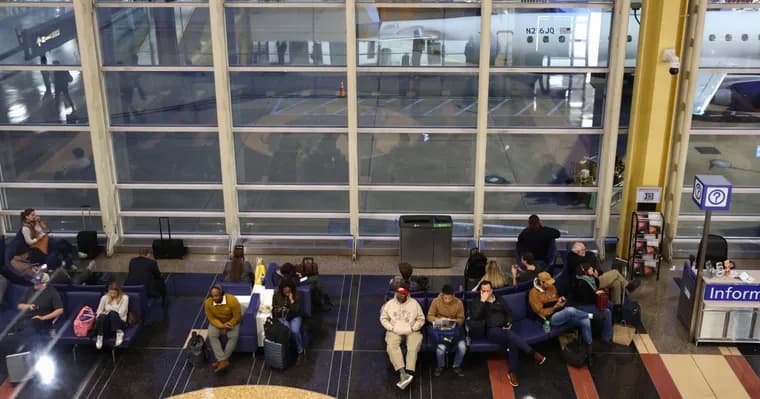
U.S. air traffic came to a standstill on a Friday after the Federal Aviation Administration ordered a nationwide ground stop for departing flights. The alert went out at 3:54 p.m. ET "due to extraordinary circumstances and for reasons of safety," and said only that "all departing traffic should remain ground stopped until further notice." The FAA lifted the stop at 8:15 p.m. ET. NBC News's opening line says the stop lasted more than five hours, but its own times work out to about 4 hours 21 minutes. More than 7,000 flights were canceled, and airports filled with stranded passengers. By Friday evening Delta Air Lines, United and American said they were resuming flights.
Hours later, at a White House news conference, Transportation Secretary Sean Duffy blamed an outdated air traffic control system in which the routers "got overloaded with data." He said the overload caused "instability for our radar and our communications in our centers, in our TRACONS throughout the country," with inconsistent radar data and shaky communication with aircraft. He said the instability was detected at 3:36 p.m. The FAA did not lose all telecom or radar capability, Duffy said, and the ground stop was a cautionary measure. Medical flights, such as organ transplant flights, were not stopped.
Homeland Security Secretary Markwayne Mullin said there was no sign of a cyberattack and the public was never in danger. "FAA was able to handle it. We did it out of an abundance of caution," he said. Earlier that day he had described the problem as a telecommunications outage. He added that authorities cannot rule out a cyberattack but that there was no evidence to suggest one: "There's nothing completely certain right now. It doesn't appear that way." Mullin also said President Donald Trump was briefed.
Air Space Intelligence (ASI), the AI startup that is an FAA vendor on its new SMART air traffic control system, said in a statement on X that the ground stop "is not based on or a result of the SMART system, any product of ASI or our integration with FAA and ATC." Duffy said SMART is "completely disconnected" from the equipment that had problems.
There were over 3,500 airplanes in the air when the stop began, per Duffy. Flightradar24 counted 4,042 flights headed for U.S. destinations airborne at the time of the alert. Several hours in, Dartmouth professor Vikrant Vaze, who specializes in commercial aviation logistics, estimated that 300,000 to 400,000 passengers were stranded. He wrote that the U.S. has about 25,000 domestic flights a day and that around 3,000 to 4,000 were held up over the first 2-plus hours. By 6 p.m., a source told NBC News, Reagan Washington National was at capacity and O'Hare was nearing capacity, leaving no place for planes to park and raising the odds of diversions. On a LiveATC feed from Newark, personnel called it "a whole mess right now," and one controller said, "I'm as much in the dark as everyone else."
Aviation safety expert Jeff Guzzetti called the outage "extraordinary" but stressed that pilots are trained to operate through communications outages and that redundancies exist. Shortly before the alert, O'Hare and Midway had been listed on a ground stop for an "equipment outage," NBC Chicago reported. Passenger Deveren Werne, on an American Airlines jet about to leave Indianapolis for Chicago, said pilots first cited a radio issue and then something more serious.
Duffy called the system decades old and analog, and said legacy equipment will continue to fail. He pushed Congress to approve $50 billion to overhaul it; Reuters reported that Congress last year approved $12.5 billion over five years for air traffic control upgrades. He expects American airspace to catch up before the Thanksgiving travel rush, though crews and planes are out of place and some staff may have hit shift limits. Nationwide ground stops are rare: the FAA ordered one after the Sept. 11, 2001 attacks, and in January 2023 it grounded all flights for a few hours after a failure in the Notice to Air Missions system. Officials then blamed contract personnel who accidentally deleted files, causing an outage of about an hour and a half. In May 2025, radar screens at Newark went black for 90 seconds.
Key facts
- The FAA issued a nationwide ground stop of departing flights at 3:54 p.m. ET and lifted it at 8:15 p.m. ET; more than 7,000 flights were canceled.
- Transportation Secretary Sean Duffy blamed an outdated air traffic control system whose routers got overloaded with data, causing instability in radar and communications; he said it was detected at 3:36 p.m.
- Homeland Security Secretary Markwayne Mullin said there was no sign of a cyberattack, though authorities cannot rule one out.
- AI vendor Air Space Intelligence and Duffy both said the new SMART system was not behind the stop; Duffy called it completely disconnected from the affected equipment.
- Duffy pushed Congress for $50 billion to overhaul the system and expects airspace to catch up before the Thanksgiving travel rush.
Why it matters
A single point of failure in aging ground infrastructure stopped departures across the whole country. Nationwide ground stops are rare: before this, the source cites the one after the Sept. 11, 2001 attacks and a few hours in January 2023 after a failure in the Notice to Air Missions system. Duffy described the system as decades old and analog, said it has caused several issues and outages in recent years, and said the legacy equipment will continue to fail. He used the day to argue for a $50 billion overhaul, on top of the $12.5 billion over five years that Congress approved last year, per Reuters.
Who it affects
Travelers above all. More than 7,000 flights were canceled, and Vikrant Vaze estimated 300,000 to 400,000 people were stranded as of several hours into the stop. Airlines such as Delta, United and American had to restart operations with crews and planes out of position. Airports were strained: Reagan Washington National was at capacity by 6 p.m. and O'Hare was nearing it, per an unnamed source. At Newark, personnel called the situation "a whole mess," and one controller said they were getting no information. Medical flights, such as organ transplants, kept flying.
How to use it
This is an incident report, not a product, so there is nothing to adopt. The practical points from the source: airlines said they were resuming flights Friday evening, but it will take time for the airspace to recover because crews and planes are out of place and some staff may have reached on-duty shift limits. Duffy said he expects American airspace to catch up before the Thanksgiving travel rush.
How solid is it
The cause rests on Duffy's account alone: routers in an outdated system got overloaded with data. No official root cause is confirmed beyond that, and the source does not say which routers or which vendor's equipment failed. The headline facts (3:54 p.m. ET start, 8:15 p.m. ET end, more than 7,000 cancellations) come from NBC News reporting. The duration is stated inconsistently: the article's opening says more than five hours, while its own times give about 4 hours 21 minutes. The 300,000 to 400,000 stranded figure is one expert's mid-outage estimate. Mullin's first description was a telecommunications outage, and he later said a cyberattack could not be ruled out but there was no evidence of one.
Risks and caveats
The cyberattack question is not fully closed: Mullin said authorities cannot rule it out. ASI said its software was not responsible, and Duffy said SMART is completely disconnected from the failed equipment, but those are statements from the vendor and the official, not an independent finding. Duffy's expectation that airspace will catch up before Thanksgiving travel is a forecast, not a commitment. The source gives no cost estimate of the outage and no confirmed count of affected passengers.
“got overloaded with data.”
— Transportation Secretary Sean Duffy, on the routers in the outdated air traffic control system, at a White House news conference