Apple launches study app with OpenEvidence on AI health answers
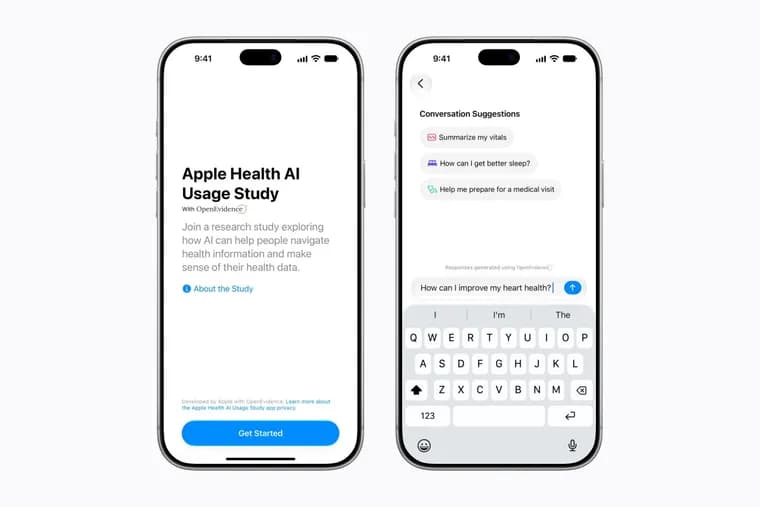
Apple is launching a research study to understand how people use AI for health questions. The iPhone maker is partnering with healthcare-focused AI company OpenEvidence on a new study app. TechCrunch frames it against OpenAI and Anthropic, which have bet on chatbots that answer health queries with specialized features. Apple is not quite following them: it says it wants to study how clinically grounded answers can help people.
Apple is inviting users in the U.S. who are over 21, use an iPhone 15 or later, and run iOS 26 or later with Apple Intelligence enabled. The company is aiming for up to 200,000 participants over more than 12 months. The app is available to download starting today (15 November 2026) for U.S. users.
Inside the app, people ask health questions much as they would with ChatGPT or Claude. Answers are grounded in clinical data from sources including The New England Journal of Medicine, the Journal of the American Medical Association and Nature. Apple said the app will try to give simplified answers to everyday medical questions. Users can rate the answers and give feedback, and they will also be asked to take monthly surveys.
Participants can share HealthKit data, such as resting heart rate, activity, sleep or lab results, to get more personalized and pointed suggestions. Apple said the app can also help people prepare for a doctor's visit, and it will guide users to specific providers for answers on concerning medical issues.
On privacy, Apple specified that data will be anonymized before it is sent to a secure third-party cloud provider, and that it won't be used to train any kind of AI models. The company also said OpenEvidence deletes the query and response data after 24 hours.
Sumbul Desai, M.D., Apple's vice president of Health and Fitness, said in a statement that responsible innovation at Apple starts with scientific rigor and clinical grounding. A dedicated research study, the statement says, is the most thoughtful way to understand how people engage with, comprehend and evaluate health AI in everyday life. It adds that the insights will help advance the broader scientific conversation as Apple keeps building trusted tools.
It is not clear whether Apple wants to bring AI-powered answering to its Health app or Siri. TechCrunch notes the potential is large: earlier this year OpenAI said users were asking over 300 million health-related queries each week.
Key facts
- Apple has partnered with healthcare-focused AI company OpenEvidence on a study app that answers health questions with clinically grounded answers.
- Apple is aiming for up to 200,000 participants over more than 12 months; participants must be U.S. users over 21 with an iPhone 15 or later, iOS 26 or later and Apple Intelligence enabled.
- Answers draw on sources including NEJM, JAMA and Nature; users rate answers, give feedback and take monthly surveys, and can optionally share HealthKit data.
- Apple says data is anonymized before going to a secure third-party cloud provider, won't be used to train any AI models, and that OpenEvidence deletes query and response data after 24 hours.
- The app is available to download from 15 November 2026 for U.S. users; it is unclear whether Apple will bring AI answering to the Health app or Siri.
Why it matters
Big AI labs such as OpenAI and Anthropic have already bet on chatbots that answer health queries. Apple is taking a different route: a formal study of how people engage with, understand and judge health AI, built on answers grounded in clinical literature. The scale is large, with up to 200,000 participants over more than 12 months. The market is large too: earlier this year OpenAI said users were asking over 300 million health-related queries each week.
Who it affects
The first group is eligible U.S. users: over 21, on an iPhone 15 or later with iOS 26 or later and Apple Intelligence enabled. They can join the study. Beyond them, the study bears on anyone watching how Apple handles health AI, since it is not clear whether Apple wants to bring AI-powered answering to its Health app or Siri.
How to use it
Eligible U.S. users can download the app starting 15 November 2026. Once in, they ask health questions and get simplified answers to everyday medical questions grounded in clinical sources. They can rate answers, leave feedback and take monthly surveys. Sharing HealthKit data (resting heart rate, activity, sleep, lab results) is optional and gives more personalized suggestions. Apple says the app can help people prepare for a doctor's visit and will point them to specific providers for concerning medical issues.
How solid is it
The details come from Apple's own description and statement as reported by TechCrunch, including the eligibility rules, the study size and duration, and the privacy commitments. The 200,000 figure is a target (up to), not an enrolled count. The 300 million weekly queries figure is OpenAI's, not Apple's, and does not come from the study.
Risks and caveats
Health questions and HealthKit data are sensitive. Apple says data is anonymized before it goes to a secure third-party cloud provider and won't be used to train any AI models, and that OpenEvidence deletes query and response data after 24 hours. The name of the third-party cloud provider is not given. Apple says the app will try to give simplified answers, which is a goal rather than a guarantee. The study is a research effort; the source says it is not clear whether it leads to a Health app or Siri feature.
“Health is deeply personal, and conducting a dedicated research study is the most thoughtful way to understand how people engage with, comprehend, and evaluate health AI in everyday life”
— Sumbul Desai, M.D., Apple's vice president of Health and Fitness