Atria Dawn Preview tops five of 16 agent benchmarks
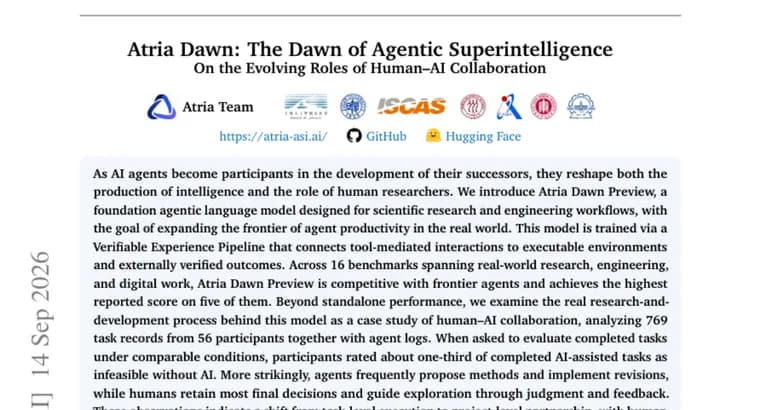
A team of researchers has introduced Atria Dawn Preview, a foundation agentic language model built specifically for scientific research and engineering workflows, with the stated goal of expanding what AI agents can productively do in the real world. The model is trained through what the paper calls a Verifiable Experience Pipeline: a training approach that connects the model's tool-mediated interactions to executable environments and to outcomes that are verified externally, rather than relying only on static text or simulated feedback.
The team evaluated Atria Dawn Preview across 16 benchmarks covering real-world research, engineering, and digital work. The model is competitive with frontier agents overall and achieves the highest reported score on five of the 16 benchmarks. The paper does not name the specific benchmarks or give numeric scores for these results, and it also does not state a release date, availability, or licensing terms for the model.
Beyond the model's own performance, the researchers used its development as a case study of human-AI collaboration in practice. They analyzed 769 task records from 56 participants together with the agents' own logs. When participants evaluated completed tasks under comparable conditions, they rated about one-third of the completed AI-assisted tasks as infeasible without AI. The paper does not describe the roles or expertise of the 56 participants.
More strikingly, the analysis found that agents frequently propose methods and implement revisions themselves, while humans retain most of the final decisions and guide the work through judgment and feedback. The authors read this as a shift from task-level execution, where AI simply carries out assigned steps, to project-level partnership, where human effort concentrates on deciding what is worth pursuing and how evidence should guide the research. They conclude that progress toward more autonomous AI research has to advance both the capacity for discovery and the capacity for meaningful human oversight, preserving accountable human authority over the risks and direction of continued development.
Key facts
- Atria Dawn Preview is a foundation agentic language model for scientific research and engineering, trained via a Verifiable Experience Pipeline that ties tool use to executable environments and externally verified outcomes.
- Across 16 benchmarks spanning real-world research, engineering, and digital work, the model is competitive with frontier agents and posts the highest reported score on five of them.
- A companion case study analyzed 769 task records from 56 participants plus the agents' own logs, covering the model's own development process.
- Participants rated about one-third of completed AI-assisted tasks as infeasible without AI, under comparable evaluation conditions.
- Agents often proposed methods and implemented revisions themselves while humans kept most final decisions, a pattern the authors call a shift from task-level execution to project-level partnership.
Why it matters
Most agentic-model papers report benchmark numbers and stop there. Atria Dawn Preview pairs its results with an unusually direct look at how the model actually got built: a study of nearly 800 real task records shows AI already doing more than execution, proposing its own methods and revisions, while the people involved still make the calls. That combination, a research-and-engineering agent competitive with the frontier plus concrete evidence of the human-AI division of labor that produced it, is what makes this more than another leaderboard entry.
Who it affects
AI researchers and engineering teams building or evaluating agentic systems for scientific and technical work, benchmark maintainers tracking frontier-agent performance, and organizations trying to decide how much autonomy to hand an AI collaborator in a real research-and-development pipeline.
How to use it
The paper does not give a release date, availability, or licensing terms for Atria Dawn Preview, so there is currently no public way to access or deploy it based on what the source states. It is presented as a preview model evaluated on benchmarks, not shipped as a product.
How solid is it
The evaluation spans 16 benchmarks across research, engineering, and digital work, and the human-AI collaboration study draws on 769 task records from 56 participants, a fairly substantial sample for this kind of analysis. Against that: the paper names neither the specific benchmarks nor the numeric scores behind the five wins, and it gives no detail on the participants' roles or expertise, so the headline claims cannot be independently checked from what is available here.
Risks and caveats
The 'infeasible without AI' figure comes from participants judging completed tasks, a self-reported measure rather than an independent one. The authors themselves flag the central risk: as agents take on more of the proposing and revising in research work, preserving human oversight and accountable human authority over direction and risk becomes something that has to be actively maintained, not assumed.
“Agents frequently propose methods and implement revisions, while humans retain most final decisions and guide exploration through judgment and feedback.”
— the paper's authors, on Atria Dawn Preview's development